Internet Allowance in India: Meaning, Tax Exemption Rules, Limits and Reimbursement Process


-
AuthorSalilendra Kumar
-
 Last Updated
November 02, 2026
-
 Reading Time
16 Mins
Internet allowance helps employees cover internet and mobile connectivity expenses required for work. Here are a few important things to know:
- Employers may provide an internet allowance as a fixed salary component or reimburse actual expenses.
- A fixed monthly internet allowance is generally taxable as salary.
- Employer-paid telephone and mobile expenses receive separate treatment under the applicable perquisite rules.
- Home broadband and WiFi reimbursements are not automatically tax-free.
- There is no universal internet reimbursement limit for private-sector employees in India.
- Employees should check their company’s policy for eligible expenses, claim limits and required documents.
- The tax treatment depends on the payment arrangement and applicable income-tax provisions.
Internet connectivity has become an essential part of modern work. Employees working from home, following hybrid schedules or travelling for business often use their personal internet connections to complete work-related tasks. To help manage these expenses, many employers include internet allowance or internet reimbursement in their employee benefit policies.
However, employees often have questions about how internet allowance works. Is it part of salary? Is internet allowance taxable in India? Can employees claim home WiFi bills from their employers? Does the new tax regime affect its tax treatment?
Understanding these rules helps employees manage their expenses and enables HR and payroll teams to structure reimbursement policies correctly.
This guide explains internet allowance in salary, its tax treatment in India, reimbursement limits, eligibility, required documents and the process of claiming internet expenses.
What Is Internet Allowance in Salary?
Internet allowance is an amount an employer provides to help employees cover internet and mobile expenses used for work. It may include home broadband bills, mobile data plans or other connectivity costs required for official work.
With more employees working remotely or in hybrid roles, many companies offer an internet allowance as part of their employee benefits. However, the benefit can be provided in different ways, and its tax treatment depends on how the employer structures it.
Why Do Employers Provide Internet Allowance?
An internet allowance helps employees manage work-related connectivity costs. It is particularly useful for organizations with remote, hybrid and field-based employees.
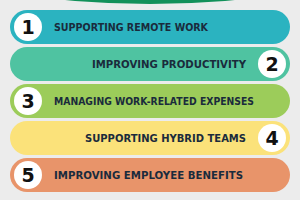
Some common reasons employers offer this benefit include:
- Supporting remote work: Employees can access reliable internet connections while working from home.
- Improving productivity: Stable connectivity helps employees participate in meetings, access business applications and collaborate with teams.
- Managing work-related expenses: Employees receive financial support for eligible internet expenses.
- Supporting hybrid teams: Employees working between the office and home can manage their connectivity requirements.
- Improving employee benefits: Internet reimbursement can be included in an organization’s overall employee benefits package.
Is Internet Allowance Part of CTC?
Yes, an employer can include an internet allowance in an employee’s CTC as a salary component. However, reimbursement for actual internet expenses is usually handled separately.
For example, an employer may include a fixed internet allowance in the monthly salary structure, as shown below:
| Salary component | Monthly amount |
| Basic salary | ₹30,000 |
| House Rent Allowance | ₹12,000 |
| Special allowance | ₹8,000 |
| Internet allowance | ₹1,000 |
| Total monthly salary | ₹51,000 |
Here, the ₹1,000 internet allowance is part of the employee’s monthly salary. Its tax treatment depends on how the employer provides it.
Similarly, employers may provide other salary components, such as shift allowance, to compensate employees for working specific shifts. Understanding what shift allowance is can help employees better understand how different allowances are structured in their salary.
Is Internet Allowance Taxable in India?
A fixed amount paid every month as an internet allowance is generally treated as part of the employee’s salary and is taxable unless a specific exemption applies.
However, employer-paid expenses and reimbursements may receive different tax treatment under the applicable rules.
For example, telephone and mobile phone expenses paid by the employer are excluded from perquisite valuation under the Income-tax Rules, 2026. This is covered under Rule 15(5)(a), Table IV, Serial No. 9.
So, a fixed internet allowance and employer-paid telephone expenses may be treated differently for tax purposes.
Is Internet Reimbursement Tax-Free?
Internet reimbursement is not automatically tax-free as its tax treatment depends on the type of expense and the applicable tax rules.
Here is a simple breakdown:
| Payment arrangement | General tax treatment |
| Fixed monthly internet allowance | Generally taxable as salary |
| Employer-paid telephone or mobile expenses | Excluded from perquisite valuation under the applicable rule |
| Reimbursement of actual broadband bills | Depends on the applicable tax provisions and circumstances |
| Reimbursement of personal and official expenses | Depends on the nature of the expenses and applicable rules |
| Important: The Income-tax Rules, 2026 specifically mention telephone and mobile phone expenses. They do not separately mention home broadband or WiFi subscriptions under this exclusion. Therefore, employers should not assume that every broadband reimbursement is tax-free. The tax treatment should be checked based on the expense and the applicable provisions. |
Is Internet Allowance Exempt Under Section 10(14)?
Section 10(14) of the Income-tax Act, 1961 provides tax exemptions for certain prescribed allowances given to employees. These include allowances for travel, conveyance, helper expenses, research and uniforms.
However, an internet allowance does not automatically qualify for exemption under this section.
The tax treatment of qualifying employer-paid telephone expenses is covered separately under the applicable perquisite rules. Therefore, employees should not assume that an internet allowance becomes tax-free simply because it is provided for official work.
A fixed cash internet allowance is generally taxable as salary. Other reimbursements should be assessed separately based on the expense and applicable tax provisions.
Is Internet Allowance Taxable in New Tax Regime?
The new tax regime does not make every employer-provided benefit taxable. Some benefits still receive favourable tax treatment under the applicable rules.
The Income-tax Act, 2025, is implemented on April 1, 2026. Section 17 covers the treatment of perquisites, while Rule 15 of the Income-tax Rules, 2026 explains how different benefits are valued.
Under these rules, employer-paid telephone and mobile phone expenses are excluded from perquisite valuation. This treatment does not depend on claiming a deduction under the old tax regime.
However, a fixed internet allowance paid as part of an employee’s salary is generally taxable. Broadband or WiFi reimbursements should also be checked separately, as they are not automatically covered by the telephone expense exemption.
Keep in mind which tax rules apply to your income:
- Earlier tax years: The Income-tax Act, 1961 and its applicable rules continue to govern those periods.
- Tax Year 2026–27 onwards: The Income-tax Act, 2025 and Income-tax Rules, 2026 apply.
If you are unsure how your internet allowance or reimbursement is treated, check with your payroll team or a qualified tax professional.
Employees should also understand how different tax regimes affect their overall tax liability and filing requirements. Read our guide on pay and taxes to learn more about income tax returns, tax regimes and online ITR filing.
What Is the Internet Allowance Exemption Limit in India?
There is no fixed monthly internet reimbursement limit set by the government for all private-sector employees in India.
Each employer can decide the reimbursement limit based on company policy, employee needs and budget.
For example, one company may set a monthly limit of ₹1,500, while another may allow up to ₹2,000. These are company-set limits, not standard income-tax exemption limits.
How Much Can You Claim for Internet on Tax?
Consider these examples:
Example 1: Your bill is below the company limit
Suppose your monthly internet bill is ₹1,500, while your employer allows reimbursement of up to ₹2,000 per month. Since your actual expense is lower than the limit, you can claim ₹1,500.
| Particulars | Amount |
| Monthly internet bill | ₹1,500 |
| Company reimbursement limit | ₹2,000 |
| Maximum amount you can claim | ₹1,500 |
You can claim ₹1,500 because your actual bill is lower than the company limit.
Example 2: Your bill is above the company limit
Now, suppose your monthly internet bill is ₹2,500, but your employer’s reimbursement limit is ₹2,000. In this case, you can claim only ₹2,000. You will have to pay the remaining ₹500 yourself.
| Particulars | Amount |
| Monthly internet bill | ₹2,500 |
| Company reimbursement limit | ₹2,000 |
| Maximum amount you can claim | ₹2,000 |
In this case, you can claim up to ₹2,000, subject to company policy and approval.
| Remember: The amount your employer reimburses is not automatically tax-free. The tax treatment depends on the applicable tax rules and the nature of the expense. |
Is ₹1,800 the Internet Allowance Exemption Limit?
No, ₹1,800 is not a fixed internet allowance exemption limit for private-sector employees in India.
Employers usually decide internet reimbursement limits based on their company policies. An amount mentioned under another allowance or perquisite category does not automatically apply to internet expenses.
Therefore, employees should check the applicable income-tax rules instead of assuming that ₹1,800 is the standard tax-free limit for internet allowance.
What Is the Difference Between Internet Allowance and Internet Reimbursement?
Internet allowance and internet reimbursement are related employee benefits, but they work differently.
An internet allowance is generally a fixed amount provided to employees, whereas internet reimbursement is linked to actual expenses submitted by employees.
Here is a comparison:
| Comparison criteria | Internet allowance | Internet reimbursement |
| Meaning | Fixed amount provided by employer | Payment against eligible expenses |
| Payment method | Regular salary payment | Expense claim process |
| Bill submission | Not necessarily required | Generally required under company policy |
| Amount | Usually predetermined | Based on actual expenses and policy limits |
| Payroll treatment | Generally treated as salary | Depends on the nature of the expense and tax rules |
| Expense verification | Not necessarily required | Bills and claims may be verified |
| Employer control | Fixed benefit structure | Controlled through reimbursement policy |
Example: Fixed Internet Allowance vs Actual Reimbursement
Suppose two employees receive internet-related benefits from their employer.
- Employee A: Receives ₹1,500 every month as a fixed internet allowance, regardless of actual expenses.
- Employee B: Submits a monthly internet bill of ₹1,200 and receives reimbursement according to the company’s policy.
Although both employees receive financial support for internet expenses but their payment arrangements are different.
Employee A receives a fixed salary component, while Employee B receives payment against an actual expense claim so their tax treatment should therefore be evaluated separately.
What Expenses Can Be Covered Under Internet Reimbursement?
The expenses covered under an internet reimbursement policy depend on the employer’s rules and the type of work-related expenses.
Employers may allow employees to claim the following expenses:
1. Broadband and WiFi Connection
Employees working from home may use broadband or WiFi for online meetings, emails and other work tasks. Employers may reimburse their monthly internet bills.
2. Mobile Data Plans
Employees who use mobile data for work may be allowed to claim the cost of data packs. This is helpful for employees who travel or work outside the office.
3. Postpaid Mobile Bills
Some employers cover monthly postpaid bills if employees use their phones for official calls, messages and internet access.
4. Telephone Expenses
Employers may also cover landline and mobile phone expenses, depending on their reimbursement policy.
5. Internet Installation Charges
Some companies may reimburse one-time installation charges for a new internet connection if their policy allows it.
Which Expenses May Not Be Covered?
Employers may not cover expenses that are mainly for personal use, such as:
- Entertainment and streaming subscriptions
- Personal gaming or app subscriptions
- Extra household internet connections not needed for work
- Other unrelated personal expenses
Employers should clearly explain which expenses employees can claim and what documents they need to submit.
| Note: Just because an expense is eligible for reimbursement does not mean it is automatically tax-free. Its tax treatment depends on the applicable income-tax rules. |
Who Is Eligible for Internet Allowance?
Companies usually offer an internet allowance to employees who need a regular internet connection for their work. However, eligibility depends on the company’s policy and job requirements.
The following employees may be eligible for this benefit:
1. Remote Employees
Employees working from home may receive an internet allowance to cover the cost of their personal internet connection.
2. Hybrid Employees
Employees who work from both home and the office may be eligible for reimbursement of their home internet expenses.
3. Field Employees
Employees who travel for work may need mobile internet to stay in touch with their teams, share updates and access work information.
4. Sales Employees
Sales employees often use the internet to check customer details, update records, attend online meetings and communicate with clients.
5. IT and Support Employees
IT and support employees may need a stable internet connection to access work applications, fix technical issues and assist customers.
Some companies provide internet allowance to all employees, while others offer it only to specific roles or departments.
Employees should check their company’s policy to understand whether they qualify for this benefit.
What Documents Are Required for Internet Reimbursement?
Employees generally need to provide supporting documents to claim internet reimbursement, depending on the company’s policy.
These documents help HR and payroll teams verify expenses and maintain reimbursement records.
| Document | Why is it required? |
| Internet or broadband bill | Verifies the connectivity expense |
| Mobile or telephone bill | Supports the telephone expense claim |
| Payment receipt | Confirms that the bill has been paid |
| Employee details | Identifies the employee submitting the claim |
| Expense claim form | Records the amount and nature of the expense |
| Manager approval | Confirms approval where required by company policy |
Should the Internet Connection Be in the Employee’s Name?
Employers may require the internet or telephone connection to be registered in the employee’s name to simplify verification.
However, this requirement can vary between organizations.
For example, an employee living with family members may use a broadband connection registered in another family member’s name. The employer’s reimbursement policy should clearly explain whether such claims are acceptable and what additional documents are required.
Employees should confirm these conditions with the Core HR team before submitting their bills.
How Can Employees Claim Internet Reimbursement?
The internet reimbursement process generally involves submitting expense details, providing supporting documents and receiving approval from the appropriate authority.
Although the process differs across organizations, the following steps are commonly followed.
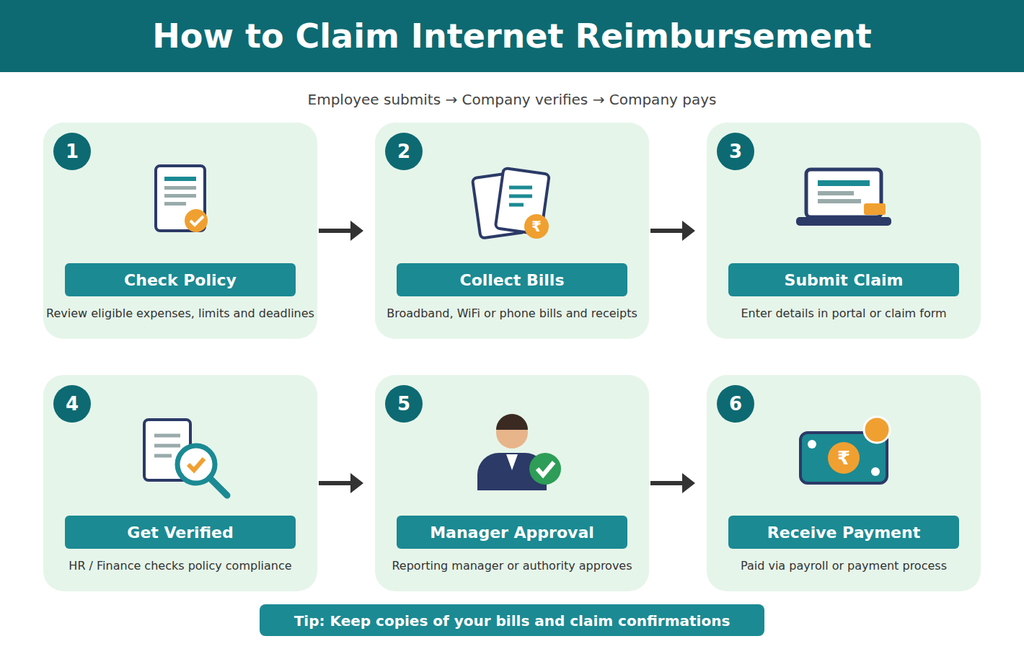
Step 1: Check the company reimbursement policy
Employees should first review the internet reimbursement policy to understand eligible expenses, reimbursement limits and submission deadlines.
Step 2: Collect supporting bills
Collect broadband, WiFi or telephone bills related to the relevant claim period. Keep payment receipts if the employer requires proof of payment.
Step 3: Submit the reimbursement claim
Enter the expense details in the company’s reimbursement portal or submit the required claim form.
Step 4: Get the claim verified
The HR or finance team reviews the submitted documents and checks whether the expense meets company policy requirements.
Step 5: Receive approval
The claim is forwarded to the reporting manager or designated authority for approval, where required.
Step 6: Receive reimbursement
Once approved, the eligible amount is processed through the employer’s designated payment or payroll process.
Employees should retain copies of their bills and claim confirmations for future reference.
What Should an Internet Reimbursement Policy Include?
An internet reimbursement policy helps organizations establish consistent rules for employees claiming connectivity expenses.
A clearly defined policy also helps HR and payroll teams avoid confusion during expense verification and processing.
Here are some important points to include:
- Employee eligibility: Specify which employees or departments can claim internet reimbursement.
- Eligible expenses: Clearly list broadband, WiFi, mobile data and telephone expenses covered by the policy.
- Reimbursement limits: Define the maximum amount employees can claim monthly or annually.
- Required documents: Explain which bills, receipts and supporting documents employees must submit.
- Submission deadlines: Mention the deadline for submitting monthly or periodic claims.
- Approval process: Define who reviews and approves reimbursement requests.
- Tax treatment: Explain how different reimbursement categories will be evaluated for payroll and tax purposes.
- Claim restrictions: Specify expenses that are not eligible for reimbursement.
- Record maintenance: Establish procedures for maintaining bills, approvals and reimbursement records.
How Can HRMS Software Simplify Employee Reimbursement Management?
Managing employee reimbursements manually can become difficult as an organization grows. HR teams may receive multiple claims, verify bills, follow up on missing documents and coordinate approvals with different managers.
An HRMS system can help organize these activities through a centralized reimbursement management process.
Some useful capabilities include:
- Centralized claim submission: Employees can submit reimbursement requests through a common platform.
- Document management: Supporting bills and receipts can be maintained with the respective claims.
- Approval workflows: Claims can be routed to managers or authorized personnel for review.
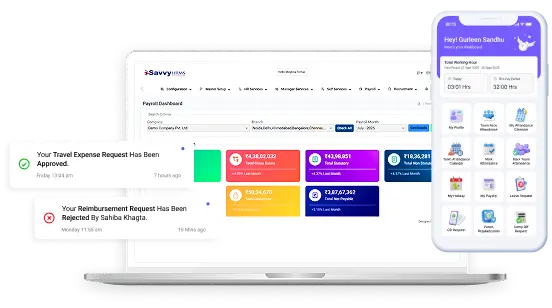
- Claim tracking: HR teams can monitor pending, approved and rejected reimbursement requests.
- Payroll coordination: Approved reimbursement information can be shared with the payroll system for appropriate processing.
- Reporting: HR teams can review reimbursement records and monitor expenses.
For organizations managing multiple employees and salary components, an integrated HRMS can reduce manual coordination between HR, finance and payroll teams.
Conclusion
Internet allowance has become a useful employee benefit as organizations adopt remote and hybrid working arrangements. It helps employees manage connectivity expenses while allowing employers to support the resources required for work.
However, employees should understand the difference between a fixed internet allowance and reimbursement against actual expenses. Their tax treatment is not necessarily the same. Similarly, employers should establish clear reimbursement policies, define eligible expenses and apply the correct tax treatment under the applicable income-tax rules.
With a structured reimbursement process and suitable HRMS support, organizations can make employee expense management more organized, transparent and easier to administer.



Looking for an Easier Way to Manage Employee Reimbursements?
Frequently Asked Questions About Internet Allowance
1. What does internet allowance mean?
Internet allowance is an amount provided by an employer to help employees manage internet connectivity expenses incurred for work. It may be paid as a fixed salary component or provided through an expense reimbursement arrangement.
2. Is internet allowance taxable in India?
A fixed internet allowance paid as part of salary is generally taxable. Employer-incurred telephone and mobile phone expenses are excluded from perquisite valuation under the applicable tax rules. Other internet-related expenses should be evaluated separately.
3. Is internet allowance taxable under the new tax regime?
A fixed cash internet allowance is generally taxable under the new tax regime. However, qualifying employer-provided benefits may receive separate treatment under the perquisite rules. Telephone and mobile phone expenses are specifically excluded from perquisite valuation under Rule 15 of the Income-tax Rules, 2026.
4. What is the internet allowance exemption limit in India?
There is no universal private-sector internet allowance exemption limit prescribed for all employees. Employers generally establish reimbursement ceilings through their internal policies. The tax treatment depends on the nature of the payment and applicable rules.
5. How much can I claim for internet expenses from my employer?
The amount you can claim depends on your employer’s reimbursement policy and the actual eligible expenses incurred. For example, if your monthly internet bill is ₹1,500 and your company’s reimbursement limit is ₹2,000, you may claim ₹1,500, subject to policy approval.
6. Is internet allowance part of CTC?
Internet allowance can be included in an employee’s CTC if the employer structures it as a salary component. Expense reimbursements are generally handled separately according to company policy.
7. Can I claim my home WiFi bill from my employer?
Yes, you may claim your home WiFi bill if your employer’s reimbursement policy allows it. You may need to submit the bill, payment receipt and other supporting documents. Reimbursement eligibility and tax exemption are separate considerations.
8. What documents are required for internet reimbursement?
Employees may need to submit broadband or mobile bills, payment receipts and an expense claim form. Additional documents may be required depending on the employer’s reimbursement policy.
9. What is the difference between internet allowance and internet reimbursement?
An internet allowance is generally a fixed amount paid to an employee, whereas internet reimbursement is linked to actual expenses submitted for approval. Their payroll and tax treatment can differ.
10. Is ₹1,800 the internet allowance exemption limit?
No. ₹1,800 is not a universal internet allowance exemption limit for private-sector employees. Employers generally determine reimbursement limits through their internal policies, subject to applicable tax rules.