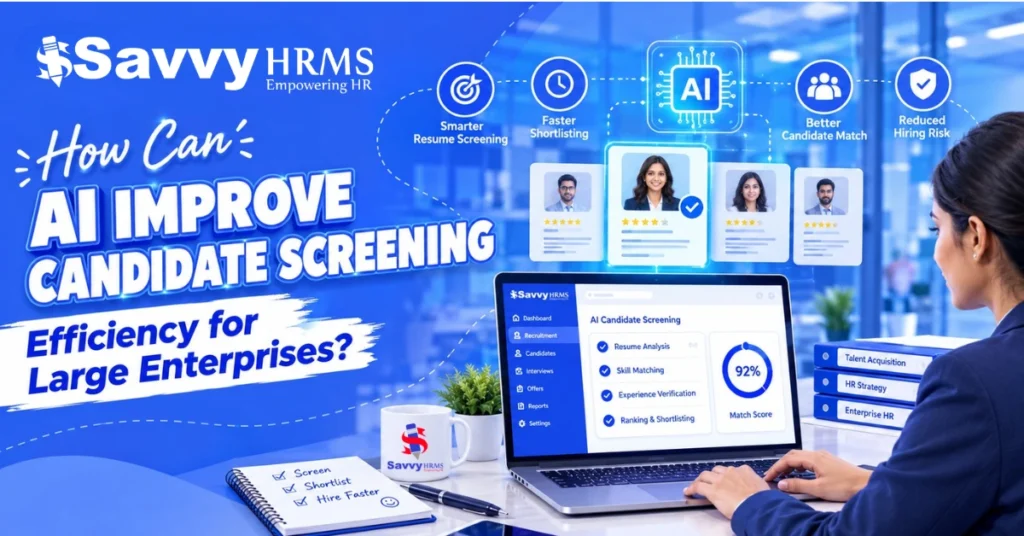
How Can AI Improve Candidate Screening Efficiency for Large Enterprises?


-
AuthorHRMS
-
 Last Updated
October 24, 2026
-
 Reading Time
14 Mins
TL;DR
AI candidate screening helps large enterprises manage high application volumes, identify relevant candidates, and improve recruitment efficiency. It automates repetitive screening tasks and helps recruiters focus on evaluating suitable applicants. However, businesses should use clear screening criteria, reliable data, and human oversight to ensure fair and effective hiring.
With AI candidate screening, enterprises can:
- Automate resume parsing and initial application reviews to speed up screening.
- Identify relevant candidate skills, qualifications, and experience based on job requirements.
- Reduce repetitive manual work and improve recruiter productivity.
- Manage multiple job openings across departments and locations.
- Apply predefined criteria to support consistent initial candidate reviews.
- Monitor screening outcomes for potential bias, protect candidate data, and maintain human oversight for fair hiring decisions.
Large enterprises often receive hundreds or thousands of applications for multiple job openings, making manual candidate screening time-consuming and difficult to manage. AI candidate screening helps enterprises process applications faster, identify relevant skills, and prioritize suitable candidates for recruiter review. It uses technologies such as natural language processing, machine learning, and resume parsing to support different stages of the screening process.
With AI-powered candidate screening, HR teams can spend less time reviewing applications manually and more time evaluating candidates, conducting interviews, and making informed hiring decisions. However, the effectiveness of AI depends on clear job requirements, reliable data, appropriate screening criteria, and human oversight.
What Is AI Candidate Screening?
AI candidate screening is the use of artificial intelligence to analyze job applications and help recruiters identify candidates who match a role’s requirements. It can extract information from resumes, compare qualifications with job descriptions, and organize applicants according to relevant criteria.
Traditional screening often requires recruiters to review each resume individually. In contrast, AI recruitment screening can process large volumes of applications and highlight information that recruiters need to make their initial assessments.
For example, if an enterprise is hiring 50 software developers across different locations, an AI screening tool can identify applicants with relevant programming skills, experience, and qualifications. Recruiters can then review these profiles instead of examining every application individually.
What Makes Candidate Screening Difficult for Large Enterprises?
Candidate screening becomes challenging for large enterprises because they must manage high application volumes, different hiring requirements, and multiple recruitment workflows simultaneously.
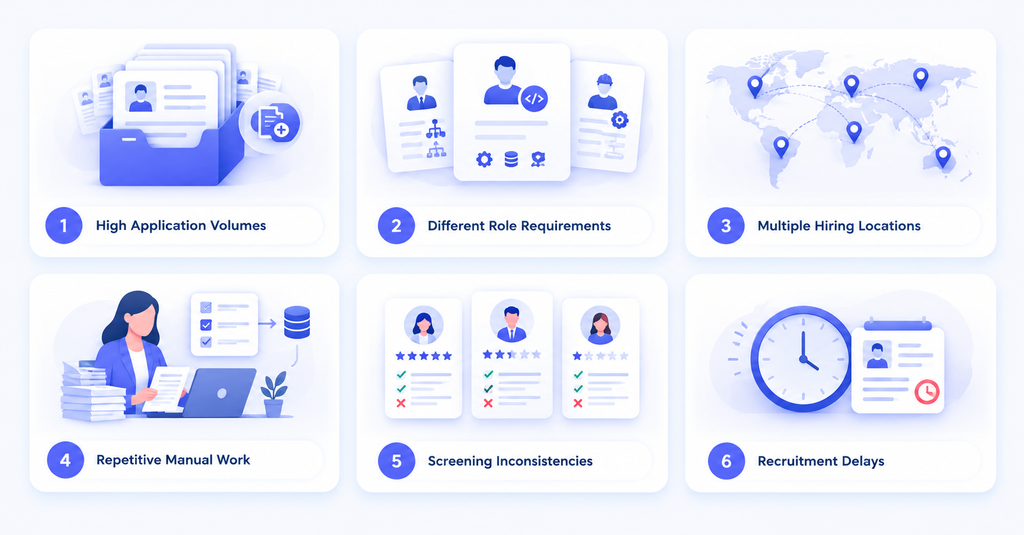
1. High Application Volumes
Popular job openings can receive hundreds or thousands of applications so reviewing each resume and finding suitable candidates takes time and effort.
2. Different Role Requirements
Technical, managerial, operational, and administrative jobs require different skills and qualifications. This makes it difficult to use the same screening criteria for every position.
3. Multiple Hiring Locations
Hiring across different offices, cities, or countries requires HR management to follow consistent screening processes while meeting the needs of each location and role.
4. Repetitive Manual Work
Recruiters spend a lot of time collecting resume details, checking qualifications, reviewing work experience, and organizing candidate information for further review.
5. Screening Inconsistencies
Different recruiters may understand job requirements and candidate qualifications differently. This can lead to differences in how applicants are evaluated for the same position.
6. Recruitment Delays
When manual screening takes too long, shortlisting and interview scheduling can be delayed. As a result, qualified candidates may accept offers from other employers.
These challenges make it important for enterprises to use screening processes that save time, reduce repetitive work, and maintain the quality of candidate evaluation.
How Can AI Improve Candidate Screening Efficiency?
AI improves candidate screening efficiency by automating repetitive tasks, matching applicant information with job requirements, and helping recruiters prioritize applications for further review.
Here are six ways enterprises can use AI to improve their screening processes.
1. Automating Resume Screening at Scale
AI resume screening helps recruiters process large numbers of resumes by extracting relevant information and organizing candidate profiles for review.
Resume parsing technology can identify educational qualifications, employment history, technical skills, certifications, and previous job responsibilities. AI tools can then compare this information with predefined job requirements.
AI is becoming more common in resume screening, with 44% of organizations using AI in HR reporting that they use it to screen resumes. This shows how businesses use AI to review applications and identify relevant candidate information more quickly.
For example, an enterprise hiring data analysts may need candidates with SQL, spreadsheet, and data visualization skills. A screening tool can identify resumes that mention these skills and highlight relevant experience for recruiter review.
This approach reduces repetitive data extraction and makes it easier to manage large applicant pools. However, recruiters should check whether the system correctly interprets different resume formats, job titles, career gaps, and equivalent skills.
2. Matching Candidate Skills With Job Requirements
AI-powered candidate screening can compare candidate profiles with job descriptions to identify relevant skills, qualifications, and experience. Depending on the technology, these systems may use keyword matching, semantic analysis, or machine learning to interpret information beyond exact keyword matches.
For example, a job description may require experience in workforce reporting, while a candidate describes their experience as HR analytics. A system with appropriate semantic matching capabilities may recognize the relationship between these skills.
This can help recruiters discover potentially suitable candidates whose resumes use different terminology from the job description. For the best results, enterprises should define role-specific requirements clearly and distinguish essential qualifications from preferred skills.
3. Prioritizing the Most Relevant Applicants
AI screening tools can organize applications according to predefined criteria, helping recruiters decide which candidates to review first.
For example, an enterprise hiring finance managers for several locations may receive applications from candidates with different levels of experience, qualifications, and industry exposure. The screening system can highlight profiles that meet the specified requirements.
Recruiters can then review these profiles, verify their qualifications, and decide whom to contact.
This approach can reduce the effort involved in manually sorting applications. However, candidate rankings should be reviewed carefully, especially when the system’s scoring criteria are not transparent or may disadvantage certain applicant groups.
4. Managing High-Volume Recruitment More Efficiently
AI helps enterprises handle high-volume recruitment by processing applications at scale and applying consistent, role-specific screening workflows.
Large organizations may recruit for several departments simultaneously, including sales, technology, finance, manufacturing, and customer support. Managing these requirements manually can create problems for HR teams.
But automated candidate screening can help organize applicants by vacancy, identify missing information, and highlight profiles that meet the relevant screening criteria.
For example, a manufacturing enterprise recruiting hundreds of production workers and engineers may use different screening rules for each position. The system can help recruiters manage these applicant groups without treating every role as having the same requirements.
This makes screening workflows easier to scale during campus recruitment, seasonal hiring, business expansion, or large recruitment drives.
5. Creating More Consistent Screening Processes
AI can improve screening consistency by applying the same predefined criteria across applications for a particular role.
In manual screening, differences in recruiter experience, workload, and interpretation may affect how candidates are assessed. A properly configured AI tool can help standardize the initial review of qualifications and skills.
For instance, an enterprise may establish essential criteria for a regional sales manager, such as relevant sales experience, team management responsibilities, and familiarity with a particular market. That‘s where a screening system can help recruiters review applications against these requirements.
However, consistency does not automatically mean fairness. If the criteria or training data contain biases, AI may reproduce or amplify them. Enterprises should regularly monitor screening outcomes and allow appropriate human oversight.
6. Reducing Repetitive Work for Recruiters
AI can reduce repetitive recruiter work by automating administrative activities such as resume data extraction, application categorization, and certain candidate communications.
Depending on the software, AI-enabled workflows may also help answer common applicant questions, identify incomplete applications, or prepare summaries of candidate profiles.
Recruiting teams experimenting with or integrating generative AI have reported saving approximately 20% of their workweek. These time savings can allow recruiters to focus more on interviews, candidate engagement, and evaluating applicants’ suitability for open positions.
This allows recruiters to spend more time on activities that require human judgment, including interviews, evaluating communication skills, discussing job expectations, and assessing team fit.
The objective is not to remove recruiters from the hiring process but to help them use their time more effectively while maintaining meaningful interactions with candidates.
How Does AI Candidate Screening Work Step by Step?
AI candidate screening works by collecting applications, extracting resume details, matching candidate profiles with job requirements, and helping recruiters identify suitable applicants for further evaluation. The process typically follows these seven steps.
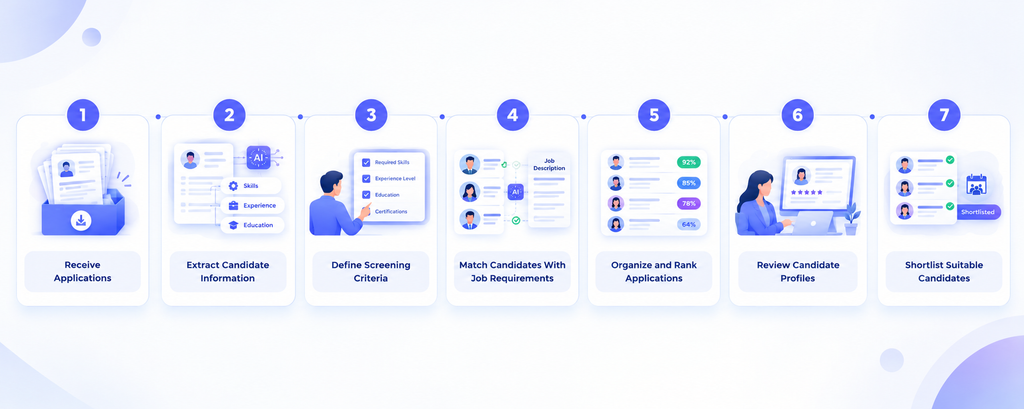
Step 1: Receive Applications
Candidates submit their resumes and application details through the company’s careers page or recruitment platform. The system collects applications in one place for screening.
Step 2: Extract Candidate Information
Then, AI resume screening tools use resume parsing to extract relevant details, such as skills, educational qualifications, work experience, and certifications.
Step 3: Define Screening Criteria
Recruiters define the essential qualifications, preferred skills, experience levels, and other job-related requirements for the position.
Step 4: Match Candidates With Job Requirements
The AI tool compares candidate profiles with the defined criteria to identify relevant qualifications, skills, and experience that align with the job description.
Step 5: Organize and Rank Applications
The system may categorize applicants, highlight relevant experience, or generate candidate match scores to help recruiters prioritize reviewing applications.
Step 6: Review Candidate Profiles
Recruiters examine the screening results, verify candidate information, and assess whether applicants meet the role’s requirements before making shortlisting decisions.
Step 7: Shortlist Suitable Candidates
Recruiters select appropriate candidates for interviews, assessments, or subsequent hiring stages based on the screening results and their professional judgment.
An Applicant Tracking System (ATS) can support this workflow by organizing applications, tracking candidate progress, and connecting screening activities with other recruitment tasks. When integrated with AI capabilities, it can help enterprises manage high-volume hiring more efficiently.
What Are the Benefits of AI Candidate Screening for Enterprises?
The growing use of AI in recruitment allows enterprises to automate selected hiring tasks, organize candidate information, and support recruiters during the initial screening process.
The efficiency benefits are also reflected in recruitment surveys, where 89% of HR professionals whose organizations use AI for recruiting reported time savings or increased efficiency. These improvements can help enterprise HR teams manage application volumes while dedicating more time to candidate evaluation and hiring decisions.
Its main benefits include:
- Faster application processing: Automated data extraction and candidate matching can reduce the time required for initial resume reviews.
- Better recruiter productivity: HR teams can spend less time on repetitive screening tasks and more time evaluating suitable applicants.
- Scalable hiring workflows: Enterprises can manage screening across multiple roles, departments, and locations using standardized processes.
- Improved process visibility: Screening tools may provide information about application volumes, candidate progress, and recruitment bottlenecks.
- More consistent initial reviews: Clearly defined criteria can help recruiters evaluate applications using a common framework.
- Better use of recruitment data: Structured candidate information can support reporting and help HR teams identify areas for process improvement.
These benefits are not automatic, as results depend on the quality of the software, the suitability of the screening criteria, recruiter adoption, and how well the technology fits the existing recruitment process.
What Are the Challenges of AI-Powered Candidate Screening?
AI-powered candidate screening can create challenges related to bias, incorrect assessments, data privacy, and overreliance on automated decisions. Therefore, enterprises should understand these risks before implementation.
1. Algorithmic bias
If past hiring data contains bias, AI may produce unfair results. Therefore, companies should regularly review screening outcomes to identify and reduce potential bias.
2. Incorrect resume interpretation
AI may misunderstand resume formats, abbreviations, employment gaps, or transferable skills.
As a result, recruiters should verify extracted information to avoid overlooking qualified candidates.
3. Limited transparency
Some tools may not clearly explain how they rank candidates.
Therefore, enterprises should understand the factors behind screening results before relying on automated recommendations.
4. Candidate privacy
AI screening tools process personal information, including work history and qualifications.
For this reason, companies should protect candidate data through access controls and clear data retention policies.
5. Overreliance on automation
Rejecting applicants based only on AI scores or missing keywords may exclude qualified candidates.
Therefore, recruiters should review applications before making final decisions.
6. Integration challenges
AI screening tools may need to connect with existing recruitment and Core HR systems. Before adoption, companies should check compatibility, data quality, and implementation requirements.
Overall, responsible AI screening needs regular reviews, strong data protection, and human involvement in hiring decisions.
How Can Large Enterprises Implement AI Candidate Screening Effectively?
Large enterprises can implement AI candidate screening by setting clear hiring requirements, choosing suitable software, testing its performance, and keeping recruiters involved in important hiring decisions.
1. Identify Screening Problems
Review the current hiring process to find delays caused by manual resume reviews, application sorting, and candidate communication. This helps identify where AI can save time.
2. Set Clear Hiring Criteria
Define the required skills, qualifications, experience, and other job-related requirements for each position. Clear criteria help AI tools assess candidates against relevant job expectations.
3. Choose Suitable Software
When evaluating AI recruitment software, enterprises should compare screening accuracy, integration options, reporting capabilities, data security, and human review features to find a solution that fits their hiring needs.
4. Test the System First
Start by testing the AI tool on a few job openings before expanding its use. This helps identify errors and improve screening accuracy.
5. Train Recruiters
Train HR teams to understand screening results, identify possible errors, and review candidates who may have been ranked incorrectly or filtered out by the system.
6. Monitor Screening Results
Compare AI recommendations with recruiter assessments to check whether the system identifies suitable candidates. Regular reviews can help detect errors and improve screening quality.
Enterprises should also define when human review is necessary and provide candidates with a clear way to ask questions or challenge relevant screening decisions.
How Can Savvy HRMS Help Businesses Improve HR Efficiency With AI?
Beyond candidate screening, businesses can use AI to simplify daily HR operations, reduce repetitive work, and gain better insights into their workforce. Savvy HRMS offers AI-enabled capabilities designed to support these needs across the employee lifecycle.
1. Simplify Employee Onboarding
Savvy HRMS supports onboarding automation to help businesses manage document submissions and approvals. This can reduce manual coordination, streamline onboarding tasks, and help your HR teams manage new employee formalities more efficiently.
2. Identify Potential Employee Attrition Risks
Savvy HRMS offers employee attrition prediction capabilities that help your businesses identify potential resignation risks. These insights can help your HR teams understand workforce trends and plan employee retention initiatives more effectively.
3. Gain Better Attendance Insights
With attendance data intelligence, businesses can better understand attendance patterns and identify trends that need attention. This helps HR teams make more informed decisions when reviewing attendance-related issues and workforce patterns.
4. Keep HR Workflows Moving
At Savvy HRMS, we offer embedded AI workflows that help businesses manage routine HR activities and pending tasks when employees change roles. This helps maintain workflow continuity, reduce manual follow-ups, and keep HR operations running smoothly.
Conclusion
AI candidate screening can help large enterprises process applications faster, reduce repetitive recruiter work, and manage high-volume recruitment more effectively. By automating resume parsing, supporting candidate-job matching, and organizing applicants for review, it can make the initial screening process easier to manage across multiple roles and locations.
However, successful implementation requires more than adopting an AI tool. Enterprises need clear screening criteria, reliable data, suitable software, ongoing performance monitoring, and human oversight to identify errors and reduce the risk of unfair outcomes.
When used responsibly, AI can support recruiters in making more informed hiring decisions while allowing them to focus on candidate evaluation and meaningful interactions.

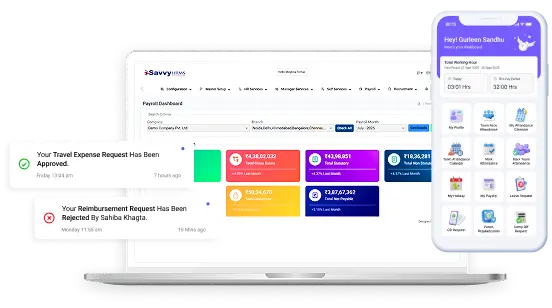


Looking to Bring AI Into Your HR Operations?
With Savvy HRMS, businesses can explore AI-enabled HR capabilities that support onboarding, workforce insights, and routine HR processes.
Frequently Asked Questions
1. What is AI candidate screening?
AI candidate screening uses artificial intelligence to analyze job applications, extract relevant candidate information, and help recruiters identify applicants who match a role’s requirements.
2. How does AI resume screening save time?
AI resume screening can automate information extraction, organize applications, and highlight relevant skills and experience, reducing the amount of manual work required during the initial review.
3. Can AI candidate screening eliminate hiring bias?
No. AI can reproduce or amplify biases in its data, criteria, or design. Enterprises should test screening tools, monitor outcomes, and maintain appropriate human oversight.
4. Is AI candidate screening suitable for large enterprises?
Yes. AI candidate screening can be useful for enterprises managing high application volumes, multiple job openings, and recruitment across different departments or locations, provided the tools meet their requirements.
5. What should enterprises look for in AI recruitment software?
Enterprises should assess resume parsing, candidate matching, integration capabilities, reporting, data security, transparency, customization, and options for human review before selecting a solution.
6. What is the difference between an ATS and AI candidate screening?
An Applicant Tracking System manages applications and recruitment stages, while AI candidate screening analyzes candidate information to support initial evaluation. An ATS may include AI screening capabilities or integrate with a separate AI tool.