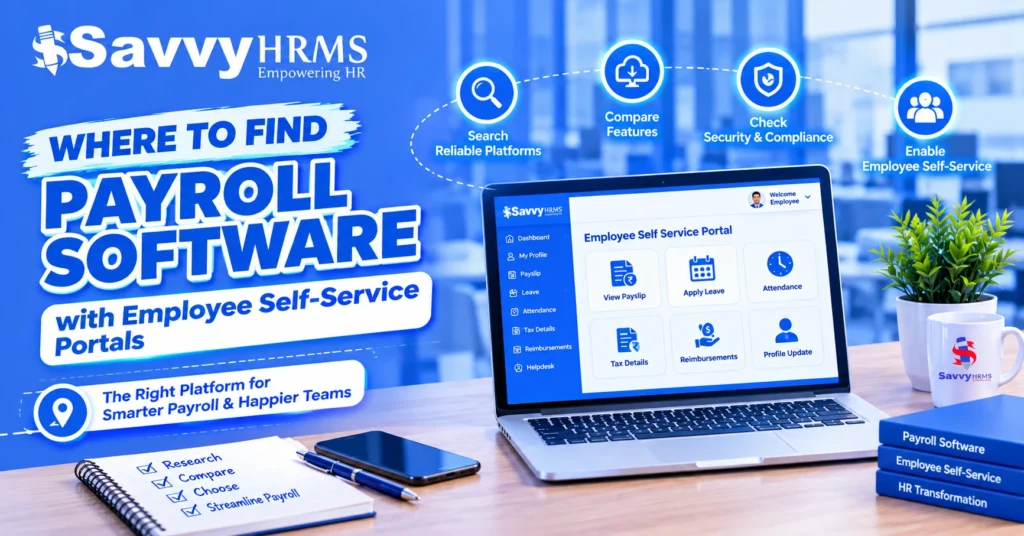
Where to Find Payroll Software with Employee Self-Service Portals


-
AuthorChandra Shekhar Verma
-
 Last Updated
October 21, 2026
-
 Reading Time
11 Mins
TL;DR
Payroll software with an employee self-service (ESS) portal helps businesses process salaries while allowing employees to access payslips, tax documents, attendance records, and other HR services online.
- Explore official vendor websites, software comparison platforms, and product demos to find suitable options.
- Compare Savvy HRMS, greytHR, Zoho Payroll, Kredily, and Keka based on payroll features, employee self-service, integrations, and pricing.
- Look for payslip access, tax documents, attendance and leave integration, mobile access, payroll compliance support, and approval workflows.
- Evaluate payroll accuracy, data security, statutory requirements, implementation costs, and the features included in each plan.
Payroll management does more than just calculate salaries and transfer payments. HR teams also need to manage attendance records, deductions, payslips, employee queries, and payroll documents. When these tasks rely on spreadsheets and repeated emails, payroll processing can take longer and increase administrative work.
In a May 2025 survey, 75% of surveyed Indian businesses reported that a shortage of payroll professionals affected their payroll services. The survey covered senior payroll leaders at multinational companies with more than 1,000 employees, so the finding should be viewed in that context.
Payroll software with an employee self-service (ESS) portal helps businesses manage payroll while allowing employees to access their own salary information and complete selected HR tasks online.
In this guide, you will find where to find payroll software, what an employee self-service portal offers, which providers to consider, and how to select the right solution for your organization.
What Is Payroll Software with an Employee Self-Service Portal?
Payroll software is a digital system that helps businesses calculate salaries, manage deductions, generate payslips, and maintain payroll records. An employee self-service portal is a connected feature that gives employees access to their own payroll information and selected HR services.
Instead of contacting HR every time they need a payslip or salary statement, employees can log in to the portal and retrieve available information themselves.
For example, an employee applying for a home loan may need recent payslips. With an ESS portal, the employee can download the required documents without waiting for HR to email them manually. The portal can also give HR teams a central place to manage employee requests and share payroll-related information.
How Does an Employee Self-Service Portal Work?
An ESS portal typically connects employee records, payroll information, and HR workflows through a shared system.
The process usually works as follows:
- Employee login: Employees sign in using their authorized account.
- Information access: The portal displays the payroll documents and employee details available to that individual.
- Self–service requests: Employees submit supported requests, such as reimbursement claims or personal information changes.
- Review and approval: HR or authorized managers review requests that require approval.
- Record updates: Approved changes are reflected in the relevant records or workflows.
The exact process depends on the software. Some systems provide only payslip access, while others connect payroll with attendance, leave, expense claims, and broader employee management.
What Can Employees Do Through a Payroll Self-Service Portal?
An employee self-service portal can support several routine payroll and HR activities. The available features depend on the software and the permissions set by the employer. Let’s explore some of the best payroll software companies as defined below:
1. View and Download Payslips
Employees can access their monthly payslips to review earnings, allowances, deductions, and net salary. This makes it easier to check salary details and retrieve documents when needed.
2. Access Tax and Payroll Documents
Some portals provide tax worksheets, investment declarations, tax statements, and other payroll-related documents where employees can use these records to review their tax information and complete relevant declarations.
3. Update Personal Information
Depending on the system, employees may be able to update contact details, addresses, emergency contacts, or other personal information, as sensitive changes may require HR approval or additional verification.
4. Submit Reimbursement Claims
Employees can submit eligible expense claims and supporting documents through the portal. HR or finance teams can then review the submissions, approve them, and process eligible payments through the relevant workflow.
5. Check Attendance and Leave Information
When the portal connects with payroll attendance software and leave management, employees can view attendance records, check leave balances, apply for leave, and request attendance corrections.
This integration is especially useful when attendance records and approved leave affect salary calculations.
6. Access Information Through Mobile Devices
Mobile access allows employees to retrieve payroll documents and complete supported tasks without using an office computer. It can be especially helpful for remote employees, field staff, and shift-based workforces.
Key Employee Self-Service Features in Payroll Software
An employee self-service portal offers several features that help employees access payroll information and complete routine HR tasks independently. The table below highlights common ESS features and their potential benefits for HR teams.
| ESS feature | How employees use it | Potential benefit for HR |
| Payslip access | View and download monthly payslips | Fewer routine payslip requests |
| Tax documents | Access available tax statements and declarations | Easier document sharing and tracking |
| Personal information updates | Submit changes to personal details | Less manual data entry |
| Reimbursement claims | Submit expense claims and supporting documents | More organised review and approval |
| Attendance and leave | Check attendance, leave balances, and request status | Better coordination between attendance and payroll |
| Mobile access | Complete supported tasks through a mobile app | Easier access for remote and field employees |
Before purchasing payroll software, confirm which ESS features are included in the selected plan, whether a mobile app is available, and how employee permissions and approvals work.
Which Payroll Software Companies Offer Employee Self-Service Portals?
Several payroll software companies offer employee self-service capabilities alongside payroll processing. However, they differ in their feature sets, integration options, pricing models, and suitability for different businesses.
The following list highlights providers worth considering in India. Compare their payroll capabilities, employee self-service features, attendance integration, and pricing to find the right payroll software for HR requirements.
1. Savvy HRMS
Savvy HRMS offers payroll management alongside employee self-service, attendance, leave management, and other HR functions. Our payroll capabilities include configurable salary structures, salary processing, loans and advances, statutory calculations, payroll reports, and payslip generation. We also support statutory compliance requirements through features such as PF, configurable PF limits, automatic TDS calculations, and income tax computation reports.
Businesses can evaluate Savvy HRMS if they want payroll operations to work alongside employee records, attendance data, and HR workflows rather than managing each process separately.
Where it stands out:
- Salary structures, deductions, and payroll processing.
- Attendance and leave integration.
- Payslip generation and employee access to payroll information.
- Payroll compliance and reporting.
- Employee requests and approval workflows.
How Businesses Use Savvy HRMS to Simplify Payroll Management
At Savvy HRMS, we help businesses manage payroll and related HR processes through our integrated systems. The following customer case studies highlight how organizations use the platform to improve payroll accuracy, attendance management, and workforce visibility.
1. Liberty Shoes: SAP-Integrated Payroll Across 12+ Locations
With more than 4,000 employees across 12+ locations, Liberty Shoes faced challenges integrating SAP data into payroll, which previously required significant manual effort. So we at Savvy HRMS enabled payroll processing directly from SAP and supported multiple formula-based salary structures configured according to company policies. This helped Liberty improve payroll consistency and accuracy while reducing the need for constant manual intervention.
2. Haldiram Foods International: Centralized Attendance for 10,000 Employees and Faster Payroll Processing
Haldiram Foods International needed a centralized way to manage attendance across eight plants, handle more than 100 shift types, and reduce payroll processing time. Savvy HRMS helped the company centralize attendance for over 10,000 employees, automate shift and roster management, and integrate biometric attendance data with its internal ERP system. These improvements reduced payroll processing time and enhanced attendance accuracy and workforce visibility across locations.
How Is Savvy HRMS Different from Other Payroll Software Providers?
Savvy HRMS can be evaluated as an integrated HRMS solution that connects payroll with attendance, leave, and employee management. Other payroll software providers also offer employee self-service and payroll automation software, but their specific features, integrations, and pricing vary by product and plan.
| Feature | Savvy HRMS | Other Payroll Software |
| Payroll Processing | Manages salary structures, deductions, payroll calculations, and payslip generation. | Most providers support salary calculations, deductions, and payslips, with features varying by platform. |
| Employee Self-Service (ESS) | Allows employees to access available payroll information and HR services through self-service functionality. | Typically provides payslip access and selected employee services, depending on the provider and plan. |
| Attendance Management | Connects attendance management with payroll and other HR processes. | Attendance integration varies; some providers offer it natively, while others rely on integrations. |
| Leave Management | Supports leave management alongside payroll and employee records. | May be included in an HRMS suite or available as a separate module. |
| Payroll Compliance | Provides payroll-related statutory calculations and reporting capabilities. | Compliance features and supported statutory requirements vary by provider. |
| Best For | Businesses seeking an integrated platform for payroll, attendance, leave, and employee management. | Businesses choosing a provider based on their specific payroll needs, HR requirements, integrations, and budget. |
2. greytHR
greytHR combines payroll processing with an employee self-service portal that provides access to payslips, payroll documents, attendance, leave, and selected HR services. The platform is worth evaluating if HR teams want employees to handle routine requests independently while keeping payroll and attendance processes connected.
Where it stands out:
- Payroll processing and statutory reporting.
- Employee payslip and payroll document access.
- Leave and attendance self-service.
- Expense claims and investment declarations.
- Web and mobile portal access.
3. Zoho Payroll
Zoho Payroll provides payroll processing software and an employee self-service portal through which employees can access payslips and supported tax documents. Businesses can consider Zoho Payroll when comparing salary processing and employee document access.
Where it stands out:
- Automated salary calculations and payslip generation.
- Employee access to payroll and tax documents.
- Reimbursement and investment declaration workflows.
- Payroll reports and statutory calculations.
- Integration with relevant HR, expense, and accounting applications.
4. Kredily
Kredily offers an HRMS platform that connects employee records, self-service, attendance, leave, and payroll. It is worth investigating for businesses that want to bring everyday HR activities and payroll-related processes together in one system.
Where it stands out:
- Employee records and self-service.
- Payroll and attendance integration.
- Leave and expense workflows.
- Employee app functionality.
- Features available under each pricing plan.
5. Keka
Keka is an HR and payroll platform that brings together payroll processing, employee self-service, attendance, and leave management. It is worth considering for businesses looking to manage payroll and routine HR activities through a single platform.
How to Compare Payroll Software with Employee Self-Service
Choosing the right payroll software involves more than comparing prices. The following table highlights the key factors to consider before making a decision.
| Comparison factor | What to verify |
| Payroll processing | Salary structures, deductions, payslips, and payroll reports |
| Employee self-service | Payslip access, tax documents, employee updates, and requests |
| Attendance integration | Transfer of attendance, shifts, overtime, and leave data |
| Compliance support | Relevant tax calculations, statutory records, and reporting |
| Mobile access | Availability of the employee app and supported features |
| Security | Access permissions, authentication, audit trails, and data protection |
| Pricing | Employee limits, modules, implementation costs, and support fees |
The best choice depends on your business requirements. A small company may prioritize ease of use and predictable costs, while a larger organization may need multi-location payroll, complex approval workflows, and integrations with existing systems.
Conclusion
Overall, finding the right payroll software with an employee self-service portal starts with understanding what your business needs from both payroll processing and employee access. Official vendor websites, software comparison platforms, and product demos are useful places to research available options.
Look for a system that supports accurate salary calculations, connects attendance and payroll where required, provides convenient employee self-service, and protects sensitive payroll information. Also, compare features, pricing, integrations, and support before making a decision.

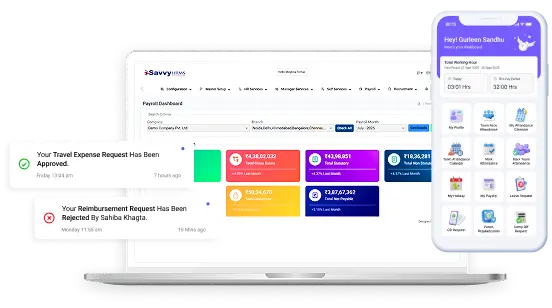


Ready to Simplify Payroll for Your HR Team?
Book a Free Demo
Frequently Asked Questions About Payroll Software
1. Where can I find payroll software with an employee self-service portal?
You can find payroll software through official vendor websites, software comparison platforms, HR technology directories, and product demos. Check the provider’s documentation to confirm that the selected plan includes the employee self-service features you need.
2. Which payroll software allows employees to download payslips online?
Several providers offer online payslip access. For example, Savvy HRMS, greytHR, Zoho Payroll, and Kredily describe payroll or employee self-service capabilities on their official websites. Compare their available features, access methods, and pricing before choosing a solution.
3. Does cloud-based payroll software include an employee self-service portal?
Many cloud-based payroll products offer an employee self-service portal, but this is not guaranteed for every product or subscription. So, always verify whether employees can access payslips, tax documents, and other required services through the selected plan.
4. Can payroll software integrate with attendance management?
Yes. Payroll software can integrate with attendance management systems to use working hours, shifts, overtime, and approved leave in payroll calculations.
5. How much does payroll software with employee self-service cost?
Pricing varies according to employee count, available modules, payroll complexity, integrations, and support requirements. Some providers offer free plans or trials, while others use subscriptions or customised quotations.
6. What is the difference between payroll software and payroll software for HR?
Payroll software focuses on salary processing, deductions, payslips, and related records. Payroll software for HR may also connect payroll with employee records, attendance, leave management, onboarding, and self-service workflows.