


Eligibility of Nominees in EPF, EDLI & EPS: Rules, Family Members & Benefits Explained



-
AuthorSalilendra Kumar
-
 Last Updated
October 15, 2026
Last Updated
October 15, 2026
-
 Reading Time
22 Mins
Reading Time
22 Mins
Employees in India often contribute to the Employees’ Provident Fund (EPF) and receive social security coverage under the Employees’ Deposit Linked Insurance (EDLI) and Employees’ Pension Scheme (EPS). But have you ever wondered who will receive these benefits if an employee passes away? Understanding nomination rules can help employees protect their families and avoid confusion during an already difficult time.
The eligibility of nominees in EPF/EDLI/EPS depends on the scheme, the employee’s family situation, and the applicable rules. While EPF nominations help identify who can receive the member’s provident fund savings, EDLI provides insurance benefits in the event of a covered employee’s death, and EPS provides pension benefits to eligible family members or other eligible beneficiaries under specific conditions.
In this guide, we explain who can be nominated under each scheme, which family members may qualify, what happens when an employee has no eligible family members, and how to update an EPF nomination online. Whether you are an employee, employer, or HR professional, this guide will help you understand the rules and make more informed decisions.
TL;DR
- An employee who has a family, as defined under the EPF Scheme, must generally nominate one or more eligible family members. A person without an eligible family may nominate another person.
- The nomination under the EPF Scheme generally applies to EDLI as well. The actual payment of insurance benefits depends on the EDLI Scheme’s provisions.
- Pension benefits are governed by separate rules. A spouse and eligible children may qualify for family pension, while nominee pension may apply in specified cases where the member has no family as defined under EPS.
- The meaning of “family” differs between EPF and EPS, so the same person may not have identical rights under both schemes.
- Naming someone as a nominee does not automatically make that person eligible for every benefit.
- Marriage, the birth or adoption of children, and other changes can affect nomination validity or benefit eligibility.
- Employees should check their nomination details and update them when necessary.
- Always verify the latest EPFO rules and claim requirements before making a nomination or filing a claim.
What Is the Eligibility of Nominees in EPF/EDLI/EPS?
The eligibility of nominees in EPF/EDLI/EPS refers to the rules that determine who may be nominated or who may receive benefits under India’s three major employee social security schemes. These schemes are administered through the Employees’ Provident Fund Organisation (EPFO), but they do not provide identical benefits or follow exactly the same eligibility rules.
To understand nominee eligibility, it is important to know what each scheme does.
- EPF (Employees’ Provident Fund): Helps employees build retirement savings through contributions and interest. The collected amount may be payable to eligible nominees or other entitled persons if the member dies.
- EDLI (Employees’ Deposit Linked Insurance): Provides an insurance benefit when a covered EPF member dies, subject to the scheme’s conditions.
- EPS (Employees’ Pension Scheme): Provides pension benefits, including retirement, disability, and survivor or family pensions, subject to the applicable eligibility requirements.
The EPF Scheme, 1952 contains the main nomination provisions for provident fund savings. The EDLI Scheme, 1976 contains provisions for deposit-linked insurance benefits. The EPS, 1995 separately defines family members and the conditions for pension benefits.
This difference is important because the person nominated to receive EPF savings is not automatically entitled to receive an EPS family pension. Similarly, the person who receives EDLI benefits must qualify under the relevant provisions of the EDLI Scheme.
For example, an unmarried employee without an eligible family may be able to nominate a sibling under the applicable EPF rules. If the employee subsequently marries, the existing EPF nomination may become invalid and need to be replaced. EPS has its own rules for family details and nominee pension.
The official EPFO website provides the relevant scheme documents and guidance for employees and employers.
Who Is Eligible to Be a Nominee Under EPF Rules?
Under Paragraph 61 of the Employees’ Provident Fund Scheme, 1952, the eligibility to nominate someone depends largely on whether the member has a family as defined by the scheme when making the nomination.
1. Employees who have an eligible family
If an employee has a family under the EPF Scheme, the nomination must generally be made in favour of one or more members of that family. A nomination made in favour of a person outside the defined family is invalid under the scheme.
The EPF Scheme’s definition of family includes specified relationships, such as:
- A spouse.
- Children, whether married or unmarried.
- Dependent parents, subject to the applicable definition.
- The widow and children of a deceased son, as specified in the scheme.
The definition also contains provisions relevant to female members, including the treatment of a member’s husband’s dependent parents. The applicable wording and conditions should be checked in the current scheme text.
Employees should not assume that every relative automatically qualifies. For example, a brother, sister, cousin, or friend is not automatically an eligible EPF nominee when the employee has a family as defined by the scheme.
2. Employees who do not have an eligible family
If an employee has no family under the EPF Scheme at the time of making a nomination, the employee may nominate one or more other persons.
For example, an unmarried employee who has no eligible family under the scheme may nominate a sibling or another person. However, if the employee subsequently acquires a family, the existing nomination becomes invalid under the relevant provision, and a fresh nomination in favour of eligible family members must be made.
This is why employees should revisit their nomination details after significant family changes.
3. Can an employee nominate multiple people?
Yes. An EPF member can generally nominate one or more eligible persons and distribute the provident fund amount among them at their option, subject to the scheme’s provisions.
For example, an employee may choose to divide the eligible EPF amount between two eligible family members. The employee should enter the intended share for each nominee correctly and review the submitted details.
4. What happens to an EPF nomination after marriage?
Paragraph 61 of the EPF Scheme states that a fresh nomination must be made upon marriage and that a nomination made before marriage is considered invalid.
Employees should therefore review and submit a new nomination after marriage instead of assuming that an earlier nomination will remain valid.
Key takeaway: EPF nominee eligibility depends on the scheme’s definition of family and the employee’s circumstances. Before naming someone, check whether that person qualifies under Paragraph 2 and Paragraph 61 of the EPF Scheme, 1952.
Who Can Be Nominated for EDLI Benefits?
The Employees’ Deposit Linked Insurance Scheme, 1976 provides an insurance benefit when a covered employee dies, subject to the applicable scheme conditions.
EDLI is different from EPF because it is an insurance benefit rather than the employee’s accumulated provident fund balance. The EDLI nomination generally follows the nomination made under the EPF Scheme.
However, the right to receive the insurance benefit is determined under the applicable EDLI provisions. It is important not to assume that every person named in a document is automatically entitled to receive every benefit.
Who may receive EDLI benefits?
Depending on the circumstances and applicable provisions, the benefit may be payable to:
- A valid nominee.
- Eligible family members under the scheme’s payment provisions.
- The person legally entitled to receive the amount where the scheme’s specified conditions require that outcome.
The EDLI Scheme contains provisions addressing payment to nominees and family members, as well as cases where the amount is payable to the person legally entitled to it. The outcome depends on the facts and the relevant provisions.
Does EDLI provide a separate nomination facility?
EPFO guidance states that the nomination made under the EPF Scheme also applies to EDLI. Employees should therefore ensure that their EPF nomination is accurate and up to date.
Example: An employee’s family needs to claim EDLI benefits
Suppose an employee covered under EPF and EDLI dies while in service. The family should check the employee’s nomination details, establish the applicable claimant’s eligibility, and submit the prescribed claim documents through the employer or as directed by EPFO.
The claimant should not assume that the EDLI payment will be identical to the EPF balance or EPS pension. Each benefit has its own calculation and eligibility rules.
What documents may be required?
Depending on the claim and EPFO’s current requirements, the claimant may need:
- The prescribed EDLI claim form, commonly Form 5IF.
- The deceased employee’s details and relevant membership records.
- Proof of the claimant’s identity and relationship, where required.
- Bank account details and other supporting documents requested by the authorities.
The required documents may vary depending on the case. Employers and claimants should confirm the latest instructions from EPFO before filing.
Key takeaway: EDLI benefits are governed by the EDLI Scheme, and the EPF nomination generally applies. The claimant’s eligibility and payment rights must still be checked under the applicable EDLI provisions.
Who Is Eligible to Receive EPS Pension Benefits?
The Employees’ Pension Scheme, 1995 provides different types of pension benefits, including member pension, disability pension, widow or widower pension, children’s pension, and orphan pension. In specified circumstances, it also provides nominee pension or pension to dependent parents.
EPS is particularly important to understand because nomination eligibility and pension entitlement are not the same thing.
1. Spouse eligibility
A member’s spouse may qualify for widow or widower pension following the member’s death, subject to the applicable EPS provisions.
The rules distinguish between a spouse who qualifies for family pension and a person nominated to receive a benefit when the member has no family as defined by EPS. A nominee cannot simply replace an otherwise eligible spouse’s statutory pension rights by being named in the EPF nomination.
2. Children’s pension eligibility
Eligible children may receive children’s pension under EPS following the member’s death, subject to the scheme’s conditions.
The Employees’ Pension Scheme generally provides children’s pension for up to two children at a time until they reach 25 years of age. The scheme also provides for certain disabled children to receive benefits under special conditions.
For example, if an employee dies leaving a spouse and eligible children, the spouse may qualify for widow or widower pension, while eligible children may qualify for children’s pension under the applicable rules.
The precise entitlement and amount should be checked against the current EPS provisions and the member’s circumstances.
3. Orphan pension
EPS provides orphan pension in specified circumstances when there is no eligible spouse or when the spouse’s pension entitlement ends under the scheme’s rules.
The scheme generally provides orphan pension for up to two eligible orphans at a time until the age of 25, with separate provisions for eligible disabled orphans.
4. Can someone be nominated for EPS pension?
EPS has separate provisions for nomination. A member who does not have a family as defined under EPS may nominate a person to receive nominee pension, subject to the conditions of the scheme.
Where the member has an eligible family, pension benefits are generally governed by the scheme’s family pension provisions rather than by a freely chosen nominee.
EPS defines family differently from EPF. Under EPS, the relevant definition generally focuses on the member’s spouse and children. This is one reason a person eligible for nomination under EPF may not have the same entitlement under EPS.
5. What happens if there is no eligible family or nominee?
The EPS provides for pension to dependent parents in specified circumstances where there is no eligible family or nominee. The exact order of eligibility and conditions should be verified under the current scheme.
Employees should therefore not treat EPS as a simple extension of the EPF nominee form. They should ensure that spouse and children’s details are correctly recorded and that any nomination is valid under EPS.
Key takeaway: EPS pension entitlement follows the Employees’ Pension Scheme, 1995. A spouse, eligible children, a qualifying nominee, or dependent parents may be relevant in different circumstances, but the rules and order of eligibility matter.
What Is the Difference Between EPF, EDLI and EPS Nomination Rules?
Although EPF, EDLI, and EPS are related, they serve different purposes. The following table summarises their key differences.
| Feature | EPF | EDLI | EPS |
| Full form | Employees’ Provident Fund | Employees’ Deposit Linked Insurance | Employees’ Pension Scheme |
| Main purpose | Retirement savings | Insurance benefit on covered employee’s death | Retirement, disability and survivor pension |
| Main rules | EPF Scheme, 1952 | EDLI Scheme, 1976 | EPS, 1995 |
| Nomination approach | Generally requires eligible family nominees when the member has a family | EPF nomination generally applies | Separate pension nomination and family provisions |
| Main potential beneficiaries | Valid nominees or other persons entitled under applicable rules | Eligible nominees, family members or other persons entitled under the scheme | Eligible spouse, children, nominee in specified cases, or dependent parents under applicable conditions |
| Does a nominee automatically get every benefit? | No; the applicable rules and entitlement matter | No; EDLI provisions govern payment | No; pension eligibility is governed by EPS |
| What should employees review? | Nominee details and family status | Valid EPF nomination and claim eligibility | Family details and EPS-specific eligibility |
The table is a general guide, not a substitute for the scheme provisions. The exact outcome depends on the employee’s family circumstances, the validity of the nomination, and the relevant scheme rules.
Why is this difference important?
Imagine that an employee has nominated a sibling under EPF when the employee had no eligible family. Later, the employee marries.
The employee must review the EPF nomination because the earlier nomination may become invalid. At the same time, EPS family pension eligibility is determined under EPS rules, not simply by the name entered in the EPF nomination.
This illustrates why employers and HR teams should treat EPF, EDLI, and EPS as related but legally distinct benefits.
Can an Employee Nominate Someone Outside Their Family?
Yes, but only in some particular circumstances. The answer depends on the scheme and the employee’s family status.
1. Under EPF
If the member has no family as defined under the EPF Scheme, the member may nominate another person or persons. If the member subsequently includes a family, the nomination becomes invalid under the relevant provision and a new nomination must be made.
If the member already has a family under the EPF Scheme, a nomination in favour of a person outside that family is generally invalid.
2. Under EDLI
The nomination under the EPF Scheme generally applies to EDLI. However, payment of EDLI benefits is subject to the separate provisions of the EDLI Scheme. An employee should not assume that nominating an outsider under circumstances that do not permit it will automatically create an entitlement to EDLI benefits.
3. Under EPS
EPS has separate rules governing the definition of family and nominee pension. A person may be nominated in specified cases where the member has no family as defined under EPS. However, a nomination does not override the pension rights of eligible family members.
Example
Suppose an unmarried employee has no eligible family under the relevant EPF definition and nominates a close friend. The nomination may be permissible at that time under EPF rules.
If the employee later marries, the EPF nomination must be reviewed and replaced in accordance with the scheme. The employee should also update relevant family details for EPS, where the spouse’s pension eligibility is governed by separate provisions.
Practical advice: Do not choose a nominee only because that person is trusted. First check whether the person is legally eligible under the specific scheme.
What Happens If an EPF Member Has No Eligible Family Members?
An employee who has no eligible family members under the EPF Scheme can nominate one or more persons, subject to the applicable rules.
This provision can be helpful for unmarried employees or others who do not have a family as defined under the scheme. However, the absence of an eligible family should not be assumed merely because the employee has no spouse or children. The scheme’s definition may include other specified relationships.
What if the employee later acquires a family?
If the employee later acquires a family, the existing EPF nomination becomes invalid under Paragraph 61(4) and the employee must make a fresh nomination in favour of one or more eligible family members.
Family changes that should prompt a review include:
- Marriage.
- The birth or adoption of a child.
- Changes in dependent family circumstances.
- Any other change that affects eligibility under the scheme.
What if the employee dies without a valid nomination?
The claim is not necessarily lost. The amount is handled under the applicable scheme provisions, which may require payment to eligible family members or other persons legally entitled to it.
The claimant should contact the employer and EPFO to establish the correct process and documentation. The outcome may differ between EPF savings, EDLI insurance benefits, and EPS pension.
What HR teams should do
HR teams can help employees by reminding them to review their nominations during onboarding and after major family changes. They should also provide accurate guidance about the difference between EPF nominations and EPS family details.
A simple annual review can help identify outdated records before a claim becomes necessary.
Who Can Claim EPF, EDLI and EPS Benefits After an Employee’s Death?
The person who can claim benefits depends on the type of benefit, the member’s circumstances, and the relevant scheme.
1. EPF: Provident fund balance
The collected EPF amount, including applicable interest, is paid according to the nomination and payment provisions of the EPF Scheme.
Where there is a valid nomination, the nominee or nominees may be entitled to receive the amount. Where there is no valid nomination, the applicable rules determine who can receive the amount.
2. EDLI: Insurance benefit
EDLI provides an insurance benefit following the death of a covered member, subject to the scheme’s conditions.
The claimant must establish eligibility under the EDLI Scheme and submit the prescribed claim documentation. The EDLI benefit is different from the member’s EPF savings.
3. EPS: Pension benefits
EPS may provide a recurring pension rather than a one-time payment. Depending on the case, benefits may include widow or widower pension, children’s pension, orphan pension, nominee pension, or pension to dependent parents under the scheme’s conditions.
The beneficiary and amount depend on the applicable EPS provisions. The EPF nominee form alone does not determine all pension rights.
How does the claim process work?
The following simplified flowchart shows the general process. The precise forms and requirements depend on the benefit being claimed.
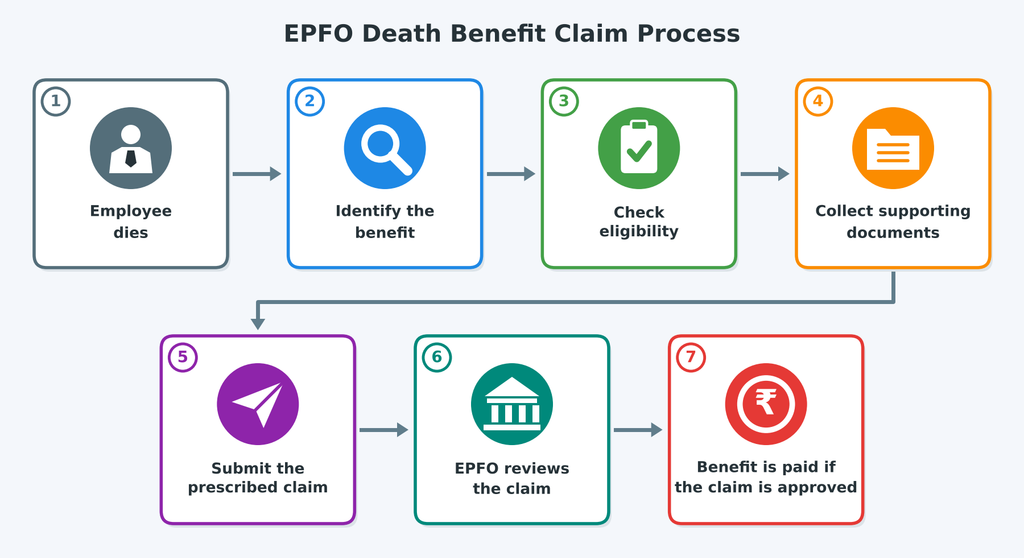
More specifically:
- Inform the employer and obtain the relevant membership and service details.
- Identify whether the claim relates to EPF savings, EDLI insurance, EPS pension, or more than one benefit.
- Check the nomination, family details, and applicable eligibility rules.
- Complete the relevant claim forms and provide the required supporting documents.
- Submit the claim through the applicable employer or EPFO process.
- Respond to any request for clarification or missing documentation.
Which forms may be relevant?
The form depends on the benefit:
- Form 20: Commonly used for final EPF settlement in the event of a member’s death.
- Form 5IF: Used for claiming EDLI insurance benefits in applicable cases.
- Form 10D: Used for pension claims under EPS in applicable circumstances.
These forms and procedures can change, and different situations may require different documentation. Always check the latest EPFO instructions before filing.
How Can Employees Update Their EPF Nomination Online?
Employees can use EPFO’s online member services to review and submit their e-nomination, subject to the portal’s current requirements and available functionality.
Keeping the nomination updated helps ensure that the records reflect the employee’s current circumstances.
Step 1: Access the EPFO member portal
Visit the official EPFO website and navigate to the member e-Sewa portal. Use the official portal rather than an unofficial third-party website.
Step 2: Sign in
Log in using the required credentials and complete the authentication steps available on the portal.
Step 3: Check personal and family details
Review the personal information and family details displayed in the account. If the information is incorrect, check the applicable EPFO process for correcting it before proceeding.
Step 4: Open the e-nomination section
Locate the e-nomination option in the member profile or services menu. The exact menu names and sequence may change as the portal is updated.
Step 5: Add eligible family or nominee details
Enter the required information for the eligible nominee or nominees. This may include names, dates of birth, relationship details, addresses, and other requested information.
Before entering anyone’s details, check that the person is eligible under the applicable scheme.
Step 6: Allocate shares and upload details if required
Where the portal asks for nominee shares, allocate them carefully and ensure the total is consistent with the portal’s instructions. Provide any required documents or details.
Step 7: Complete authentication and submission
Follow the portal’s prescribed process to authenticate and submit the nomination. Check whether additional verification is required.
Step 8: Verify the status
After submission, revisit the relevant section to confirm that the nomination has been recorded or that no further action is pending. Save a copy or confirmation for your records where available.
When should an employee update the nomination?
Employees should review their nominations after marriage, the birth or adoption of a child, changes in family circumstances, or any other event that may affect eligibility.
Important: Online submission does not make an otherwise invalid nomination valid. Employees should verify the legal eligibility of the nominee and check the current EPFO instructions before submitting the form.
What Common Mistakes Should Employees Avoid When Making EPF Nominations?
Even a simple nomination process can create confusion if employees overlook important details. The following mistakes are worth avoiding.
1. Assuming the same person can be nominated under every scheme
EPF, EDLI, and EPS have related but different provisions. A person eligible under one scheme is not automatically eligible for every benefit under the others.
2. Keeping an old nomination after marriage
The EPF Scheme specifically requires a fresh nomination after marriage. Employees should not assume that a nomination made before marriage remains valid.
3. Nominating someone outside the eligible family
If an employee has a family under the EPF Scheme, the nomination must generally be made in favour of eligible family members. A nomination that does not follow the scheme’s rules may be invalid.
4. Forgetting to review family details for EPS
EPS pension rights depend on the applicable family and pension provisions. Employees should ensure that their spouse and children’s details are correctly recorded and that relevant changes are reflected.
5. Entering incorrect nominee details
Incorrect names, dates of birth, relationship details, or other information can create verification problems. Review the information before submission.
6. Confusing a nominee with a legal pension beneficiary
A nominee’s role is governed by the relevant scheme and applicable law. Nomination alone does not automatically resolve every question about ownership, inheritance, or statutory pension entitlement.
7. Assuming a claim is automatic
A valid nomination does not remove the need to submit the prescribed claim and supporting documents. Claimants should follow the applicable process.
8. Not checking the current EPFO rules
Scheme provisions, forms, portal processes, and administrative instructions may change. Employees and employers should depend on current official guidance instead of outdated articles or informal advice.
A simple nomination review checklist
Before finalizing or updating a nomination, check the following:
- My personal and family details are accurate.
- I have checked who qualifies as family under the relevant scheme.
- My nominee or nominees are eligible under the applicable rules.
- I have reviewed the allocation of shares, where applicable.
- I have updated my nomination after relevant family changes.
- I understand that EPS pension eligibility may differ from EPF nomination eligibility.
- I have retained the submission confirmation or checked the nomination status.
Conclusion
Understanding the eligibility of nominees in EPF/EDLI/EPS helps employees make informed decisions about their provident fund savings, insurance benefits, and pension entitlements. Although these schemes are connected, they follow different rules. EPF nomination eligibility generally depends on the member’s family status, EDLI benefits are governed by the insurance scheme, and EPS pension benefits depend on the scheme’s specific family and beneficiary provisions.
Employees should review their nomination details regularly, particularly after marriage or other family changes. Employers and HR teams can support this process by maintaining accurate employee records, sharing official guidance, and reminding employees to complete the relevant steps. For complex cases involving disputed claims, inheritance, or pension eligibility, the applicable scheme provisions and qualified professional advice should take priority over assumptions.










Simplify employee records and HR processes with Savvy HRMS
Explore how Savvy HRMS can help your organization simplify employee information management and reduce manual HR administration, so your team can focus more on employee support and compliance.
Frequently Asked Questions (FAQs)
1. Who is eligible to be a nominee under EPF, EDLI and EPS?
Eligibility depends on the scheme and the employee’s family status. Under EPF, members with an eligible family must generally nominate family members. EDLI follows the applicable insurance rules, while EPS pension benefits are governed by separate family and nominee eligibility provisions.
2. Can I nominate someone outside my family for EPF benefits?
Yes, if you have no family as defined under the EPF Scheme, you may nominate another person. If you subsequently acquire a family, your earlier nomination becomes invalid under the applicable rules, and you must make a fresh nomination.
3. Is an EPF nominee automatically eligible for EPS pension?
No. EPS pension eligibility is determined by the Employees’ Pension Scheme, 1995. A valid EPF nominee does not automatically qualify for EPS pension because spouse, children, and other eligible beneficiaries have specific rights under the scheme.
4. What happens if an employee dies without a valid EPF nomination?
The EPF balance is handled according to the applicable scheme provisions, which determine who is entitled to receive the amount. Eligible family members or other legally entitled persons may be able to claim the benefits by submitting the required documents.
5. How can I update my EPF nomination online?
Log in to the official EPFO member e-Sewa portal, access the e-nomination section, verify your family details, enter eligible nominee information, allocate shares where required, and complete the prescribed authentication and submission process. Check the portal for confirmation that your nomination has been recorded.