



A contract labour management system is a digital solution that helps businesses manage contract workers, contractors, attendance, work orders, documents, wages, compliance, and workforce information from one place. Instead of depending on spreadsheets, paperwork, emails, and disconnected records, organizations can use a centralized system to keep track of their entire contract workforce.
For businesses working with multiple contractors or large numbers of temporary and outsourced workers, contract labour management can quickly become complicated. HR teams need to monitor worker onboarding, attendance, shift schedules, contractor details, documents, statutory requirements, wage information, and contract validity. A CLMS (Contract Labour Management System) brings these activities together and gives HR, administration, plant managers, and contractors better visibility.
In this guide, we will explain what contract labour management is, why it matters, what a CLMS does, how it works, how it differs from traditional workforce management systems, its key features and benefits, and which industries can use it. We will also look at best practices and what businesses should consider when choosing a contract labour management system.
TL;DR
- Contract Labour Management System (CLMS) helps businesses manage contractors and contract workers from one centralized platform.
- It simplifies worker onboarding, attendance, work orders, documents, compliance, billing, and reporting.
- CLMS provides better visibility into contractor performance, manpower, shifts, overtime, and workforce deployment.
- It reduces dependency on spreadsheets, paperwork, emails, and manual processes.
- Businesses can use CLMS to improve workforce planning, data accuracy, compliance tracking, and operational efficiency.
- It is especially useful for industries such as manufacturing, construction, logistics, healthcare, hospitality, and energy.
- The right CLMS should support contractor self-service, integrations, analytics, multiple locations, and scalable workforce management.
What Is Contract Labour Management?
Contract labour management is the process of managing workers who are engaged through external contractors or staffing agencies rather than being directly employed by the organization.
Think about a manufacturing company that has 500 permanent employees but also works with five contractors providing 300 workers for security, housekeeping, maintenance, production support, logistics, or other activities.
The HR and administration teams still need visibility into those 300 contract workers.
They may need to know:
- Who is working at the site?
- Which contractor is responsible for each worker?
- When does the worker’s contract expire?
- Has the required documentation been submitted?
- Is the worker authorized to enter the premises?
- How many days or hours did the worker actually work?
- What shifts did they work?
- Is overtime applicable?
- Are contractor payments supported by accurate attendance data?
- Are required statutory and safety records available?
This entire process is broadly referred to as contract labour management.
In simple words:
“Contract labour management means organizing, monitoring, and controlling the complete lifecycle of contract workers and their contractors.”
It can involve contractor onboarding, manpower planning, worker verification, attendance, access control, work orders, wage information, compliance tracking, safety records, contractor billing, and reporting.
Why has contract labour management become more important?
Contract workers are used across a wide range of industries. India’s Ministry of Labour & Employment describes contract labour as an important and growing form of employment and identifies its use in sectors including construction, agriculture, plantations, ports and docks, oil fields, factories, telecom, shipping, airlines, and road transport.
That makes contract workforce visibility more than an administrative issue. It can directly affect operations, workforce planning, compliance, safety, and cost control.
Why Is Contract Labour Management Important for Businesses?
Managing contract workers manually may appear manageable when the workforce is small. The challenge usually starts when the organization has multiple contractors, locations, shifts, and thousands of worker records.
A single spreadsheet may contain contractor information. Another may contain attendance. Documents may sit in email folders, while payroll or billing information is maintained separately.
This creates a fragmented workforce-management process.
Common challenges without a CLMS
| Challenge | What can happen |
| Manual worker records | Duplicate or outdated information |
| Spreadsheet-based attendance | Errors and reconciliation work |
| Expiring documents | Missed renewals or compliance gaps |
| Multiple contractors | Limited centralized visibility |
| Manual wage calculations | Higher risk of calculation errors |
| Paper-based onboarding | Slow worker deployment |
| Disconnected reports | Difficult workforce analysis |
| Manual access control | Risk of unauthorized entry |
The regulatory environment also makes structured records increasingly important. India’s four Labour Codes were implemented from 21 November 2025, according to the Ministry of Labour & Employment.
The government’s 2026 compliance handbook highlights the scale of the simplification: the framework consolidates 29 Central labour laws into four Labour Codes, with the number of sections reduced from 1,228 to 480. It also describes a move from 31 returns to a single electronic return, 181 forms to 73, and 84 registers to 8.
Is contract labour management only an HR responsibility?
No.
A contract workforce generally involves multiple teams, including:
HR + Administration + Procurement + Finance + Security + EHS + Plant/Operations + Contractors
That is why a centralized contract labour management system can be useful. It connects information that would otherwise remain scattered across departments.
What Is a Contract Labour Management System (CLMS)?
A Contract Labour Management System (CLMS) is software designed specifically to manage contract workers and contractors throughout the workforce lifecycle.
A CLMS can create a centralized database containing information about:
- Contractors
- Contract workers
- Work orders
- Worker documents
- Contractor licenses and registrations
- Attendance
- Shifts and rosters
- Work locations
- Safety and training records
- Wages and overtime
- Contractor billing
- Compliance records
- Workforce reports
In simple terms:
“A CLMS converts contract labour management from a largely manual process into a structured digital workflow.”
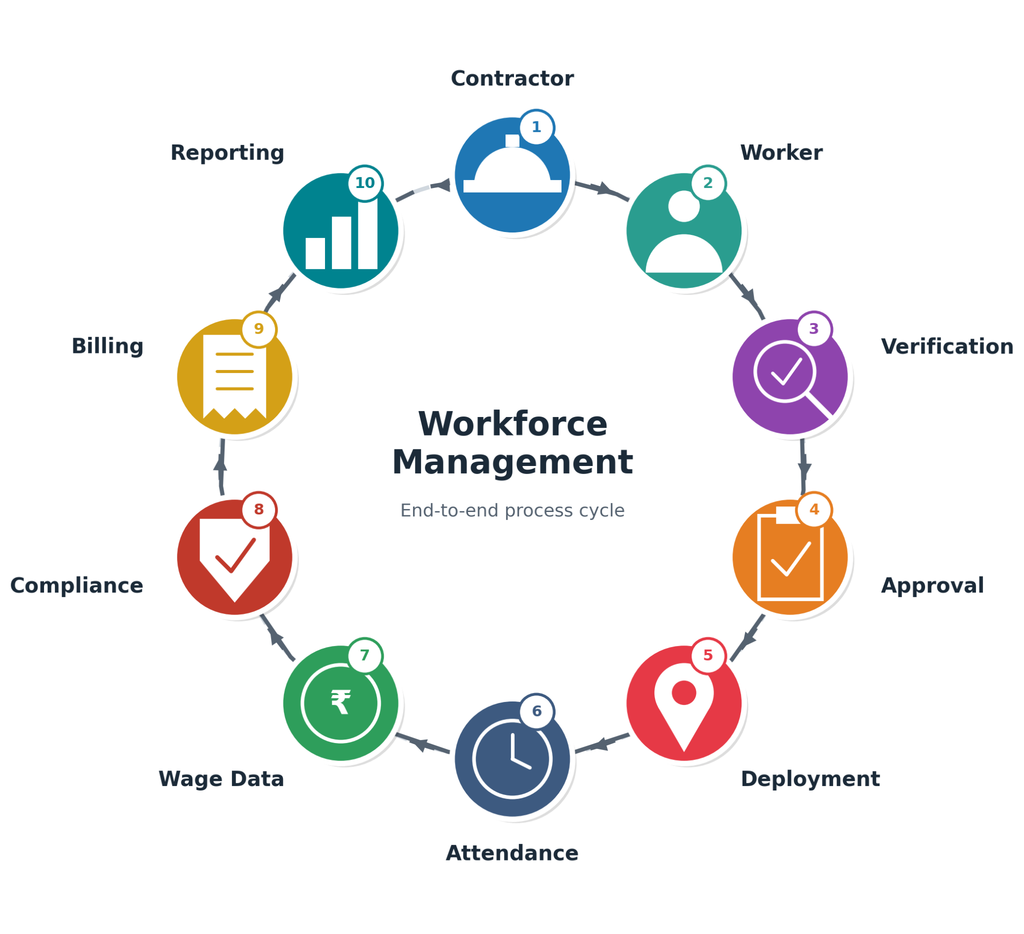
The exact workflow differs from organization to organization, but the objective remains the same: create better visibility and control over the contract workforce.
How Does a Contract Labour Management System Work?
A general CLMS follows a lifecycle-based approach.
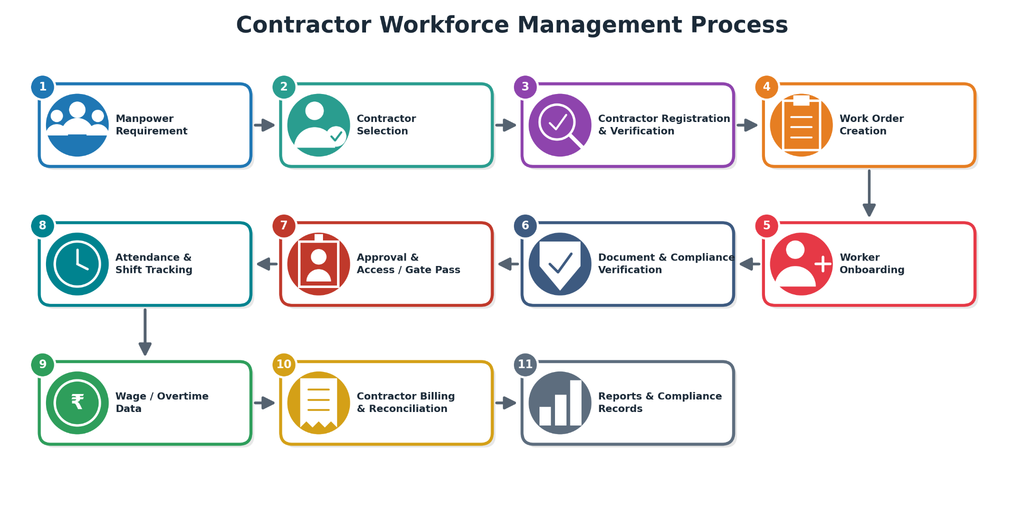
This process can be automated through configurable workflows.
Step 1: Contractor registration
The organization creates contractor profiles and records important details such as:
- Contractor name
- Contact information
- Contract validity
- Work category
- Location
- Required documentation
- Compliance information
Step 2: Work order management
The organization creates a work order specifying the work to be performed, contractor, validity period, manpower requirement, location, and approval requirements.
Step 3: Worker onboarding
The contractor submits worker details through a portal or designated workflow. The organization can verify the required documents before allowing deployment.
Step 4: Attendance and deployment
Once approved, workers can be assigned to locations, departments, shifts, or work orders. Attendance can be captured through biometric devices, mobile applications, face recognition, access-control systems, or other integrated methods.
Step 5: Wage and overtime information
Attendance and working-hour data can support wage calculations, overtime processing, contractor billing, and reconciliation.
Step 6: Compliance monitoring
The system can maintain records and alerts related to documents, contracts, licenses, statutory information, safety training, and other organization-specific requirements.
Step 7: Reporting
Managers can access dashboards and reports to understand manpower levels, attendance, absenteeism, contractor deployment, work-order status, and other workforce metrics.
How Is CLMS Different From a Traditional Workforce Management System?
A traditional workforce management system generally focuses on managing the organization’s broader workforce, including employees, schedules, attendance, shifts, productivity, and workforce planning.
A CLMS is more specifically designed around the complexity of external contractors and contract workers.
| Area | Traditional Workforce Management | CLMS |
| Primary focus | Overall workforce | Contract workforce |
| Worker relationship | Mostly direct employees | Contractors + contract workers |
| Contractor management | Limited | Core functionality |
| Work orders | Usually limited | Central workflow |
| Contractor documents | Basic/limited | Dedicated document tracking |
| Worker deployment | General | Contractor/work-order/location based |
| Gate pass/access | May require integration | Often integrated into CLMS workflows |
| Contractor billing | Usually outside system | Can be connected to attendance/workforce data |
| Compliance tracking | Employee-focused | Contract workforce-focused |
| Contractor portal | Not always available | Common CLMS capability |
| Contract expiry | Basic | Dedicated monitoring and alerts |
| Workforce visibility | Employee-focused | Contractor and worker-focused |
Is CLMS the same as HRMS?
No.
An HRMS generally manages the employee lifecycle, such as recruitment, onboarding, attendance, leave, payroll, performance, and employee records.
A CLMS focuses specifically on contract labour and contractor-related processes.
Some modern HR platforms can provide both HRMS and CLMS capabilities within one system.
What Are the Key Features of a Contract Labour Management System?
The features can vary between platforms, but a comprehensive contract labour management system commonly includes the following:
1. Contractor Management
Manage contractor profiles, agreements, manpower details, contract validity, documents, and compliance information from one centralized platform for better visibility and simplified contractor coordination.
2. Worker Database & Digital Onboarding
Maintain complete contract worker records and simplify onboarding by allowing contractors to submit worker details and documents digitally for faster verification, approval, and deployment.
3. Work Order Management
Create, approve, monitor, extend, and close work orders digitally while tracking contractor assignments, workforce requirements, locations, and contract periods through a centralized system.
4. Attendance & Shift Management
Track contract worker attendance, shifts, working hours, overtime, and deployment using integrated attendance systems, helping organizations maintain accurate workforce records and improve operational visibility.
5. Document & Compliance Management
Store worker and contractor documents digitally, monitor expiry dates, receive timely alerts, and maintain compliance-related records and audit trails to support more organized contract labour management.
6. Contractor Portal
Provide contractors with controlled self-service access to submit worker information, upload documents, manage workforce records, view work orders, and complete approved activities without constant HR intervention.
7. Contractor Billing & Reconciliation
Use verified attendance, working hours, overtime, and workforce data to support contractor billing, identify discrepancies, and simplify reconciliation between organizations and their contractors.
8. Reports, Analytics & Integrations
Access workforce dashboards and reports covering manpower, attendance, absenteeism, overtime, compliance, and contractor performance while integrating CLMS with biometric devices, mobile apps, HRMS, or other systems.
What Are the Benefits of Using a Contract Labour Management System?
The biggest advantage of CLMS is not simply automation. It is visibility.
When contractor information, worker records, attendance, documents, and compliance information are connected, managers can make decisions using a more consistent source of data.
1. Centralized contract workforce data
Instead of searching through multiple spreadsheets and folders, HR teams can access contract workforce information from one platform.
2. Better contractor visibility
Organizations can compare contractor-wise manpower, attendance, deployment, documentation, and other operational information.
3. Reduced manual work
Automating repetitive tasks such as worker onboarding, attendance collection, document reminders, and reporting can reduce administrative effort.
4. Better attendance accuracy
Digital attendance can provide a more reliable basis for working-hour calculations and contractor billing.
5. Faster onboarding
Instead of repeatedly exchanging physical documents, organizations can establish digital workflows for worker registration and approval.
6. Improved compliance visibility
A CLMS can help teams monitor required records, document validity, and compliance-related activities.
Importantly, software does not itself guarantee legal compliance. Organizations still need to configure the system according to applicable laws, rules, contracts, locations, and internal policies.
7. Better workforce planning
Managers can see how many contract workers are deployed by contractor, plant, department, project, or work order.
8. Better contractor billing control
Connecting attendance and worker data with contractor billing can make reconciliation easier and help identify discrepancies.
9. Improved audit readiness
Centralized records and activity logs make it easier to retrieve relevant information when internal or external reviews are required.
10. Real-time workforce insights
Instead of waiting for manually prepared reports, managers can use dashboards to monitor workforce information more quickly.
Data Snapshot: Why Digital Compliance Management Matters
India’s current labour-code framework is designed to simplify compliance administration.
Labour compliance framework: before vs consolidated framework
| Metric | Earlier framework | Labour Codes framework |
| Central labour laws consolidated | 29 | 4 Codes |
| Sections | 1,228 | 480 |
| Returns | 31 | Single electronic return |
| Forms | 181 | 73 |
| Registers | 84 | 8 |
Source: Ministry of Labour & Employment, 2026 Compliance Handbook.
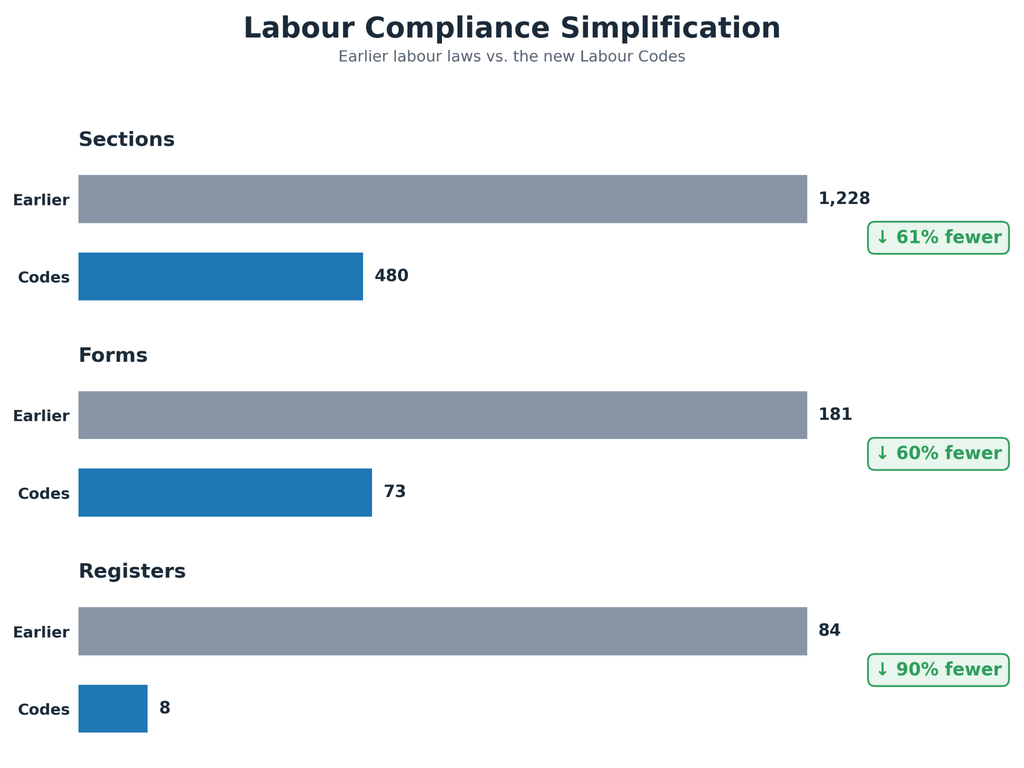
The numbers show why organizations are increasingly looking for structured digital compliance and workforce-management processes rather than maintaining disconnected records.
What Are the Best Practices for Effective Contract Labour Management?
Technology works best when it supports a well-defined process.
Here are some practical contract labour management best practices:
1. Maintain a Centralized Contractor Database
Keep contractor profiles, agreements, workforce details, documents, and contract validity in one centralized system. Assign clear ownership so records remain accurate, updated, and easily accessible.
2. Standardize Worker Onboarding
Create a consistent onboarding checklist covering:
- Worker identity verification
- Required documents
- Contractor approval
- Safety and training requirements
- Access authorization
- Work location and department
3. Track Contracts and Document Expiry
Use automated alerts to monitor important dates and avoid last-minute compliance issues.
- Contract expiry
- Worker documents
- Licenses
- Work orders
- Authorizations
4. Connect Attendance With Billing
Accurate attendance data can make contractor billing and reconciliation easier. Connect attendance, working hours, overtime, and approved workforce data wherever appropriate to reduce discrepancies.
5. Define Responsibilities and Approval Workflows
Clearly establish responsibilities between contractors and the organization, while using role-based approvals to control who can submit, verify, approve, or modify contract workforce information.
6. Monitor Performance, Compliance & Analytics
Regularly review contractor performance and workforce trends using metrics such as:
- Absenteeism
- Overtime
- Manpower fulfillment
- Worker turnover
- Safety records
- Compliance status
- Work-order completion
- Billing variances
Which Industries Benefit From a Contract Labour Management System?
A CLMS can be particularly useful wherever organizations depend on large, distributed, seasonal, or multi-contractor workforces.
1. Manufacturing
Factories may use contract workers for production support, maintenance, housekeeping, security, packaging, logistics, and other functions.
2. Construction and Infrastructure
Construction projects often involve multiple contractors, changing manpower requirements, work orders, locations, and worker documentation.
3. Warehousing and Logistics
Warehouses and logistics operations may experience fluctuating manpower requirements and multiple shifts.
4. Oil, Gas and Energy
Large projects and industrial facilities may have complex contractor, safety, access, and workforce-management requirements.
5. Retail and E-commerce
Contract workers can be used for warehousing, delivery, facility management, security, and other operational functions.
6. Hospitality
Hotels, resorts, and large facilities may work with outsourced housekeeping, security, maintenance, and support staff.
7. Healthcare
Hospitals and healthcare facilities may engage contractors for housekeeping, security, maintenance, facility management, and support operations.
8. Pharmaceuticals and Chemicals
These industries may require structured worker authorization, documentation, training, safety, and access management.
A TeamLease/ISF study cited manufacturing and machinery as having the largest contract workforce among eight reviewed sectors, with 2.9 million contract workers out of a total workforce of 8.1 million in the study. The same study reported flexi-staffing penetration of 10.5% in ITeS, 8.65% in IT, 8.01% in e-commerce, and 5.65% in BFSI. These figures are from the study period, so they should be treated as historical industry data rather than current 2026 workforce estimates.
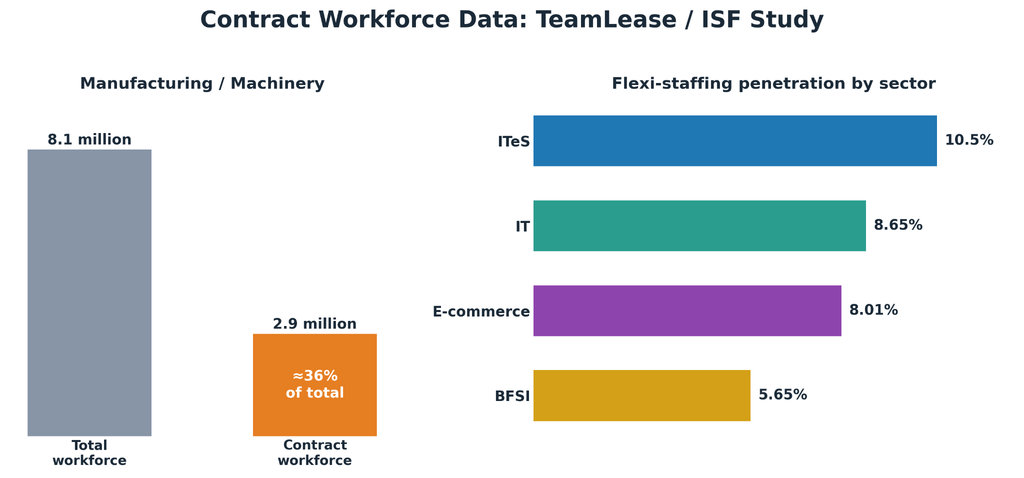
This illustrates the variety of sectors where structured contract workforce processes can become important.
How to Choose the Right Contract Labour Management System?
Choosing a CLMS should start with your business process rather than the feature list.
Ask these questions before selecting a platform:
1. How many contractors do we manage?
A business with five contractors may have very different requirements from one managing hundreds of contractors across multiple locations.
2. How many contract workers are involved?
Consider both the current workforce and expected growth.
3. Do we need contractor self-service?
If contractors regularly submit worker information, documents, attendance corrections, or other information, a contractor portal can reduce communication overhead.
4. Does the system support attendance integration?
Check whether it supports your existing biometric devices, access-control systems, mobile attendance, or other workplace technology.
5. Can it handle multiple locations?
For organizations operating across plants, warehouses, offices, and project sites, location-based workforce visibility is important.
6. Can it support compliance monitoring?
Look for configurable document tracking, expiry alerts, records, workflows, and reporting.
7. Does it integrate with payroll or ERP?
A CLMS becomes more useful when relevant data can flow into existing HRMS, payroll, ERP, finance, or access-control systems.
8. Does it provide analytics?
Look beyond basic attendance reports. Check whether the system can show manpower trends, contractor performance, absenteeism, overtime, compliance status, and billing-related insights.
9. Is mobile access available?
Mobile capabilities can be valuable for supervisors, contractors, and workers operating across locations.
10. Is the system scalable?
Your CLMS should be able to handle more contractors, workers, locations, and transactions as your business grows.
What Does a Good CLMS Implementation Look Like?
A successful implementation usually follows this approach:
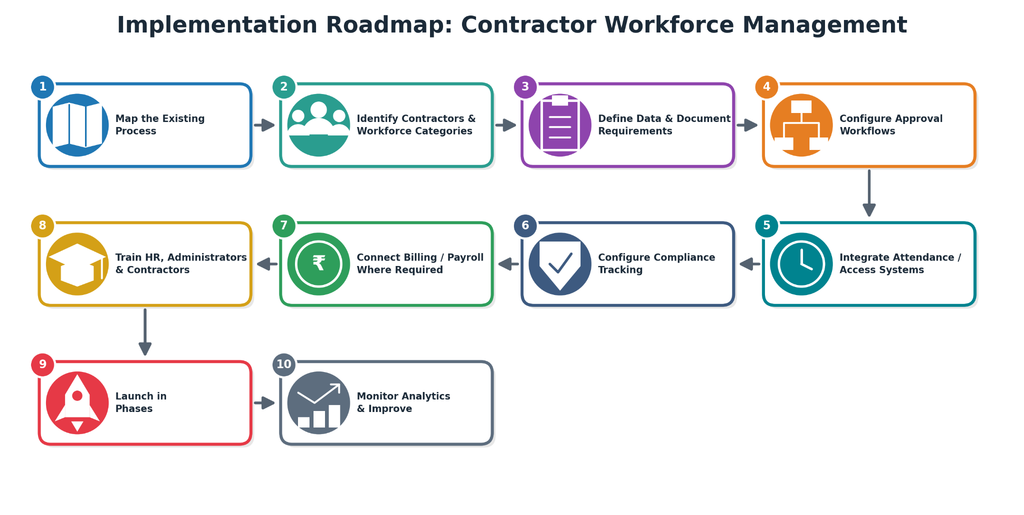
The important point is that CLMS implementation is not just software installation. It involves redesigning how contract workforce information moves between contractors, HR, operations, security, finance, and management.
Conclusion
A contract labour management system gives businesses a structured way to manage the growing complexity of contractor-based workforces. From contractor registration and worker onboarding to attendance, work orders, documentation, compliance, billing, and analytics, CLMS brings multiple processes together in one centralized system. For organizations managing large or distributed contract workforces, this can improve visibility, reduce manual administration, and make workforce information easier to track.
The right approach is not simply to digitize existing spreadsheets. Businesses should first define their contractor lifecycle, compliance requirements, workforce processes, and reporting needs, and then select a CLMS that fits those requirements. As workforce operations become more data-driven, having accurate and accessible contract workforce information can help HR and operations teams respond faster and manage contractors more systematically.
Looking to simplify contract labour management?
Savvy HRMS Contract Labour Management brings contractor management, work orders, manpower planning, digital onboarding, attendance, payroll-related processes, compliance tracking, contractor billing, and workforce analytics into a centralized platform.
Frequently Asked Questions (FAQs)
1. What is a contract labour management system?
A contract labour management system (CLMS) is software that helps businesses manage contractors and contract workers, including onboarding, attendance, documents, work orders, compliance, billing, and workforce reporting.
2. Why is contract labour management important?
Contract labour management helps organizations maintain accurate worker records, monitor contractor performance, track attendance and documents, streamline onboarding, and improve visibility into contract workforce operations.
3. How does a CLMS help with compliance?
A CLMS can centralize compliance-related documents, track expiry dates, provide alerts, maintain records, and create audit trails. However, organizations must configure and use the system according to applicable legal requirements.
4. Can a contract labour management system manage worker attendance?
Yes. Depending on the platform, CLMS can track contract worker attendance, shifts, working hours, overtime, and deployment through biometric devices, mobile applications, or integrated attendance systems.
5. What is the difference between CLMS and HRMS?
An HRMS primarily manages an organization’s employee lifecycle, while CLMS focuses specifically on contractors and contract workers, including contractor management, work orders, worker onboarding, deployment, and related compliance processes.