



How can businesses operating across multiple Indian states stay compliant with changing labour laws, payroll requirements, and statutory obligations?
Managing labour law compliance across multiple states involves more than following central regulations. Businesses must also monitor state-specific requirements, employee records, wages, statutory deductions, working conditions, registrations, filings, and compliance deadlines across every applicable location.
As organisations expand from one state to several, compliance becomes increasingly difficult to manage manually. HR teams need accurate employee data, state-wise payroll configurations, attendance records, statutory calculations, regulatory updates, and documentation to maintain consistent processes across locations.
HRMS can simplify this complexity by centralising employee information, supporting state-wise payroll, automating repetitive calculations, tracking compliance activities, and generating reports. This blog explores Labour Codes, Central and State requirements, compliance challenges, HRMS automation, KPIs, analytics, and practical checklists.
Key Takeaways
- India has consolidated 29 Central labour laws into 4 Labour Codes.
- The Government reports a reduction from 1,228 sections to 480.
- Rules were reduced from 1,436 to 351 draft rules in the Government’s published comparison.
- Returns were reduced from 31 to 1 electronic return.
- Forms were reduced from 181 to 73, while registers were reduced from 84 to 8.
- Labour remains a Concurrent List subject, making Central and State rule-making relevant to employers.
- EPFO’s published schedule lists a standard 12% employee EPF contribution rate, subject to applicable provisions and exceptions.
- ESIC lists 3.25% employer and 0.75% employee ESI contribution rates where the scheme applies.
- HRMS analytics can help organisations monitor data completeness, compliance coverage, filing timeliness, payroll exceptions, audit readiness, and rule-update turnaround.
- Businesses should distinguish between internal compliance KPIs and actual legal compliance status.
- HRMS can automate and organise compliance processes, but organisations remain responsible for ensuring that their configurations reflect applicable and current legal requirements.
What Is Multi-State Labour Law Compliance?
Multi-state labour law compliance means managing the employment, payroll, wage, social security, working conditions, record-keeping, reporting, and other applicable requirements for employees and establishments operating across more than one Indian state.
For example, a company with offices in Maharashtra, Karnataka, Gujarat, Tamil Nadu, and Delhi may have one corporate HR policy but still need to monitor different state-level requirements, notifications, rates, registrations, holidays, and implementation practices.
India’s labour framework is particularly important for multi-state employers because labour is a subject in the Concurrent List, meaning both the Central and State Governments have legislative and rule-making roles in applicable areas.
What Does Multi-State Labour Compliance Cover?
| Compliance area | What businesses need to manage |
| Payroll compliance | Salary, deductions and statutory calculations |
| Minimum wages | Applicable wage rates and categories |
| Social security | PF, ESI and other applicable benefits |
| Professional Tax | State-specific applicability and deductions |
| Leave | Applicable leave requirements |
| Holidays | State/location-specific calendars |
| Working hours | Working-time and overtime requirements |
| Establishments | Applicable registrations and records |
| Returns | Statutory filing requirements |
| Employee records | Accurate and audit-ready information |
| Regulatory updates | Changes to rules, rates and notifications |
The key point is that multi-state labour compliance is an ongoing management process, not simply a one-time registration exercise.
As the number of employees, states, establishments, and payroll groups increases, the volume of compliance-related data also increases.
How Can Businesses Measure Their Compliance Coverage?
A business can create an internal compliance coverage KPI:
Compliance Coverage % = Configured Applicable Locations ÷ Total Applicable Locations × 100
For example, if a company operates across 20 applicable locations and 18 are correctly configured in its HRMS:
18 ÷ 20 × 100 = 90% compliance configuration coverage
This does not mean the company is legally 90% compliant. It is an internal technology/configuration KPI that helps HR teams identify coverage gaps.
Why Is Labour Law Compliance Challenging for Multi-State Businesses?
Multi-state labour compliance becomes challenging because businesses have to maintain a central HR structure while also accounting for location-specific requirements.
The four Labour Codes have significantly consolidated India’s Central labour-law framework, but the Government has also clarified that both Central and State Governments have rule-making responsibilities under the Codes.
What Creates Multi-State Compliance Complexity?
1. Multiple states and locations
Every additional state can introduce another layer of applicable requirements, authorities, notifications, and operational processes.
2. Multiple establishments
A company may have offices, factories, warehouses, branches, shops, or other establishments, creating additional configuration requirements.
3. Different wage requirements
Applicable minimum-wage requirements can depend on state, category, skill level, employment type, industry, and other factors.
4. Payroll complexity
Payroll may involve basic salary, allowances, overtime, bonus, PF, ESI, professional tax, TDS, reimbursements, and other components.
5. Employee transfers
When employees move between locations, HR teams need to ensure that the employee’s location, establishment, payroll group, and applicable configurations are updated.
6. Regulatory changes
Compliance teams must monitor new notifications, revised rates, rule changes, and effective dates.
7. Manual reconciliation
When attendance, payroll, employee data, and compliance records are maintained separately, HR teams spend more time reconciling information.
How Quickly Can Complexity Increase?
Consider this illustrative management model:
Compliance data combinations = Employees × States
| Employees | States | Illustrative employee-state combinations |
| 100 | 2 | 200 |
| 500 | 5 | 2,500 |
| 1,000 | 10 | 10,000 |
| 5,000 | 15 | 75,000 |
These are not legal obligations. They simply demonstrate why centralised HR data becomes increasingly valuable as an organisation grows.
If establishments and employee categories are added, the number of potential management intersections increases further.
An illustrative complexity model can therefore be expressed as:
Compliance Complexity Index = States × Establishments × Employee Categories × Compliance Areas
For example:
8 states × 12 establishments × 4 employee categories × 10 compliance areas = 3,840 management intersections
This is an analytical framework, not a statutory formula.
What Are the Four Labour Codes and How Do They Affect Multi-State Employers?
India’s four Labour Codes consolidate and rationalise 29 Central labour laws into four broad Codes covering wages, industrial relations, social security, and occupational safety and working conditions.
The Government’s current compliance handbook states that 1,228 sections were simplified into 480, while 1,436 rules were reduced to 351 draft rules. It also reports that 31 returns were replaced by a single electronic return, forms reduced from 181 to 73, and registers from 84 to 8.
What Are the Four Labour Codes?
| Labour Code | Main focus | HRMS relevance |
| Code on Wages, 2019 | Wages, minimum wages, payment of wages and bonus | Payroll and wage management |
| Industrial Relations Code, 2020 | Industrial relations and disputes | Employee relations and records |
| Code on Social Security, 2020 | Social security and related benefits | PF, ESI, gratuity and social-security processes |
| Occupational Safety, Health and Working Conditions Code, 2020 | Working conditions, safety and welfare | Attendance, working hours and workforce records |
What Do the Labour Code Numbers Tell Us?
| Measure | Earlier framework | Labour Code framework | Calculated reduction |
| Central labour laws | 29 | 4 Codes | 86.2% fewer instruments |
| Sections | 1,228 | 480 | 60.9% reduction |
| Rules | 1,436 | 351 | 75.6% reduction |
| Returns | 31 | 1 electronic return | 96.8% reduction |
| Forms | 181 | 73 | 59.7% reduction |
| Registers | 84 | 8 | 90.5% reduction |
Percentages are calculated from the Government’s published figures and rounded to one decimal place. The underlying figures are from the Ministry of Labour and Employment’s 2026 compliance handbook.
For more info, visit: https://www.labour.gov.in/
These figures show the scale of consolidation. However, consolidation does not mean that every employee across India should be placed under one identical payroll or HR configuration.
For multi-state businesses, the practical challenge is to translate the broader legal framework into correct employee, establishment, payroll, and location-level processes.
How Do Central and State Labour Laws Differ for Businesses?
Central and State labour requirements should not be treated as two completely separate systems. Instead, businesses should understand how the Central framework interacts with applicable State rules and administration.
The Ministry confirms that labour is in the Concurrent List and that both Central and State Governments have powers to make rules under the Labour Codes.
What Does This Mean for Employers?
| Area | Central framework | State-level consideration |
| Labour Codes | Four national Codes | State rules support implementation |
| Wages | Code on Wages framework | Applicable wage rates/categories may vary |
| Social security | Central statutory framework | Location and establishment processes may apply |
| Working conditions | OSH & Working Conditions framework | State implementation matters |
| Professional Tax | Not uniformly applicable under Central labour Codes | State-specific |
| Holidays | Applicable statutory framework | State/location calendars may differ |
| Establishments | Code-based framework | State administration and requirements |
| Returns | Consolidated approach | Applicable implementation must be monitored |
The Ministry’s July 2025 update reported that 32 States/UTs had pre-published draft rules under the four Labour Codes, while also noting differences among jurisdictions.
This illustrates why multi-state employers should maintain a state-wise compliance matrix instead of assuming that one configuration automatically covers every location.
Which Labour Compliance Areas Must Multi-State Businesses Manage?
Multi-state businesses need to monitor several interconnected compliance areas.
1. Minimum Wages
Businesses need to ensure that applicable minimum-wage requirements are correctly mapped to relevant employees, categories, locations, and effective dates.
2. Payroll Processing
Payroll should correctly process earnings, deductions, statutory contributions, overtime, bonuses, reimbursements, and applicable taxes.
3. Provident Fund
EPFO’s published contribution schedule lists 12% as the standard employee EPF contribution rate, with specified exceptions and conditions.
For an illustrative PF wage of ₹20,000:
Employee EPF contribution = ₹20,000 × 12% = ₹2,400
This is only an example. Actual contribution calculations must follow applicable statutory rules, wage ceilings, exclusions, and employee/establishment circumstances.
4. ESI
ESIC’s published information states contribution rates of 3.25% for the employer and 0.75% for the employee, where the ESI scheme applies.
That gives a combined contribution rate of:
3.25% + 0.75% = 4%
For illustrative wages of ₹20,000:
- Employer contribution = ₹20,000 × 3.25% = ₹650
- Employee contribution = ₹20,000 × 0.75% = ₹150
- Combined contribution = ₹800
Actual applicability and calculation should always be checked against the current statutory provisions.
5. Professional Tax
Professional Tax is an important state-wise payroll consideration because applicability and rates are not uniform across India.
6. Attendance and Working Hours
HR teams should accurately record working days, shifts, attendance, overtime, and related information according to applicable requirements.
7. Leave and Holidays
Leave policies and holiday calendars should be configured appropriately for the relevant locations.
8. Statutory Records and Returns
Businesses need reliable records and reporting processes for applicable statutory obligations.
9. Employee Classification
Employee type, establishment, wage structure, location, and employment category can influence the applicable compliance configuration.
10. Regulatory Updates
HR teams need a repeatable process to identify and implement changes.
How Can an HRMS Help Businesses Manage Multi-State Labour Compliance?
An HRMS can provide a central technology layer connecting employee data, attendance, leave, payroll, statutory calculations, compliance workflows, reports, and analytics.
Instead of maintaining separate spreadsheets for every location, businesses can maintain a central employee database and associate each employee with relevant organisational and location information.
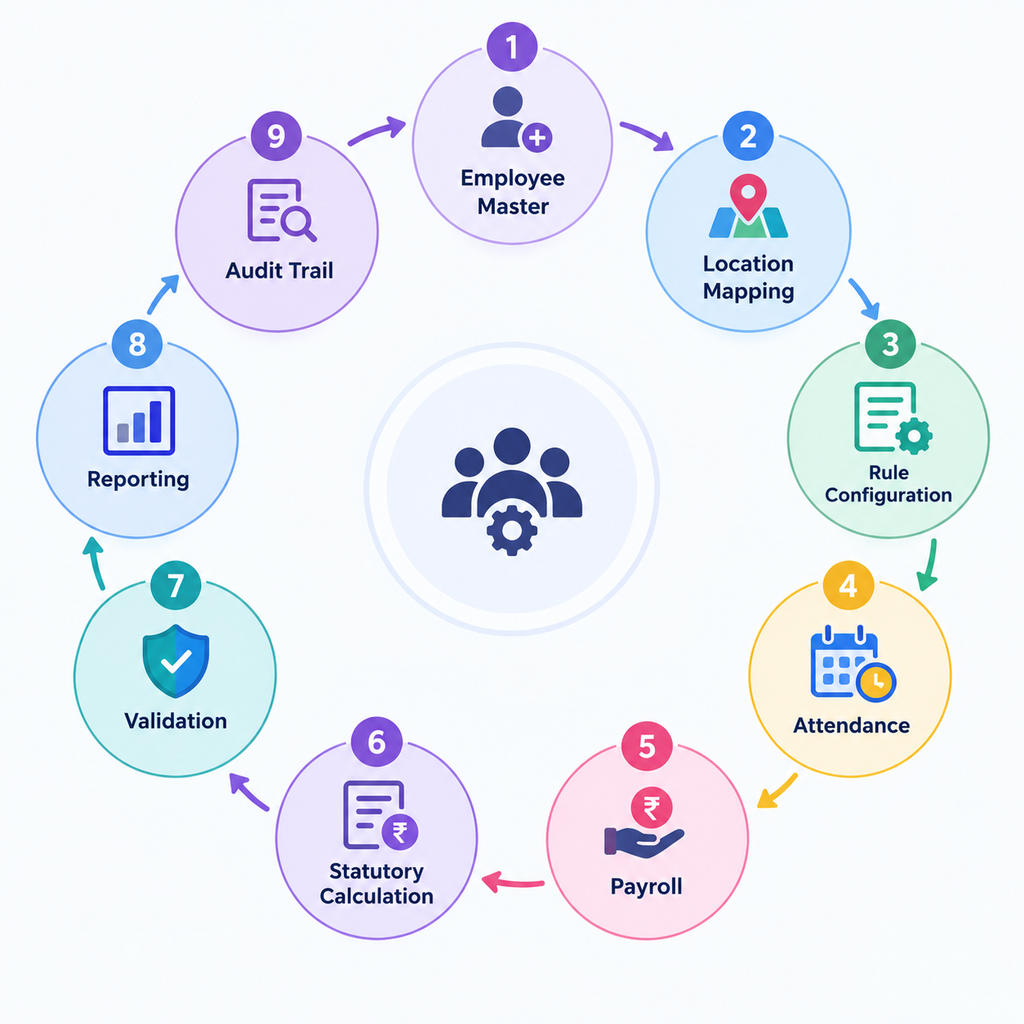
How Does an HRMS-Based Compliance Workflow Work?
What Can HRMS Centralise?
| HRMS capability | Business benefit |
| Employee database | Centralised workforce information |
| Location mapping | Better state/establishment control |
| Payroll | Automated recurring calculations |
| Attendance | Working-day and hours data |
| Leave management | Centralised leave records |
| Statutory compliance | Structured compliance processing |
| Reports | Faster information retrieval |
| Alerts | Deadline visibility |
| Audit trail | Better traceability |
| Analytics | Measurable compliance monitoring |
What Is the Potential Operational Impact?
Consider an illustrative scenario where a company operates across 10 states with 1,000 employees.
The basic employee-state combination is:
1,000 × 10 = 10,000 combinations
If HR teams manually maintain separate records, each location change, salary change, payroll adjustment, or compliance update may require multiple manual actions.
An HRMS does not remove the legal responsibility, but it can reduce duplicated data entry and connect information across processes.
How Can HRMS Simplify State-Wise Payroll and Statutory Compliance?
State-wise payroll becomes easier when employee location, establishment, payroll group, and statutory configuration are connected.
Imagine a company operating across five states.
Instead of maintaining:
5 separate employee files + 5 payroll workbooks + separate compliance trackers
an HRMS can create:
1 central employee database + location-based configurations + central reporting
What Can State-Wise Payroll Configuration Cover?
| Payroll element | HRMS approach |
| Employee location | State and establishment mapping |
| Salary structure | Configurable components |
| Attendance | Location-linked attendance |
| Leave | Applicable configuration |
| PF | Automated calculation where applicable |
| ESI | Automated calculation where applicable |
| Professional Tax | State-specific configuration |
| TDS | Tax calculation and payroll processing |
| Overtime | Attendance-linked calculation |
| Payslips | Automated generation |
| Reports | Centralised reporting |
What Happens When an Employee Changes Location?
Consider an employee moving from State A to State B.
The HR team should be able to update:
Employee → Work Location → Establishment → Payroll Group → Applicable Configuration
This creates a traceable process.
Without centralised HR software, location changes may require updates across multiple spreadsheets and payroll files, increasing the possibility of inconsistent records.
How Does HRMS Automate Labour Law Compliance Processes?
HRMS automation connects repetitive HR and payroll tasks into a structured workflow.
What Does the Automated Process Look Like?
Step 1: Employee Onboarding
Employee information such as personal details, employment type, joining date, designation, department, salary structure, and statutory information is captured centrally, creating a reliable foundation for payroll and compliance processes.
Step 2: Location Assignment
Each employee is mapped to the appropriate state, city, establishment, department, and payroll group. This location-based structure helps apply relevant configurations and supports accurate state-wise payroll and compliance management.
Step 3: Salary Configuration
Salary components, including basic pay, allowances, deductions, reimbursements, and other applicable earnings, are configured according to the employee’s role, location, employment structure, and applicable payroll requirements.
Step 4: Attendance Capture
The HRMS records working days, absences, shifts, overtime, holidays, and other attendance information. These records can then support accurate payroll processing and help maintain consistent employee work-time data.
Step 5: Payroll Processing
The system processes employee salaries using configured payroll rules, combining attendance, earnings, deductions, reimbursements, and applicable statutory components to generate accurate and consistent payroll results for each location.
Step 6: Statutory Calculation
Applicable statutory components such as PF, ESI, Professional Tax, TDS, and other payroll-related deductions are calculated based on configured rules and employee information, subject to applicable statutory requirements.
Step 7: Exception Checking
HR teams can review unusual payroll results, missing employee information, incorrect configurations, incomplete records, or calculation exceptions before finalising payroll and completing related compliance activities.
Step 8: Reporting
The HRMS generates payroll, employee, attendance, statutory, and compliance reports, giving HR teams a centralised view of workforce information and helping them analyse state-wise compliance data more efficiently.
Step 9: Audit Trail
Changes, approvals, payroll activities, employee updates, and relevant transactions can be digitally recorded, creating greater traceability and helping HR teams retrieve supporting information during internal reviews or audits.
What Is the Value of Automation?
The value is not simply “doing things faster.”
It is about creating a repeatable process.
For example, if payroll is processed every month:
12 payroll cycles × 1,000 employees = 12,000 employee payroll records per year
If the organisation has 5,000 employees:
12 × 5,000 = 60,000 employee payroll records per year
These are not separate legal obligations; they demonstrate the volume of recurring payroll data that HR systems may need to process.
What Compliance Data Should Businesses Track Through an HRMS?
Data accuracy is fundamental to HRMS-based compliance.
Incorrect employee location, salary structure, employment category, or statutory information can result in incorrect downstream calculations.
What Data Should an HRMS Maintain?
| Data category | Examples |
| Employee information | Employee ID, joining date, personal details |
| Employment | Employment type, status, designation |
| Organisation | Legal entity, department, reporting structure |
| Location | State, city, branch, establishment |
| Compensation | Basic salary, allowances, gross salary |
| Attendance | Working days, absence, overtime |
| Leave | Entitlement, usage, balance |
| Social security | PF, ESI and applicable identifiers |
| Tax | PAN and TDS information |
| Payroll | Earnings and deductions |
| Compliance | Registrations, returns, deadlines |
| Audit | Approvals, changes and timestamps |
Why Is Location Data So Important?
A simple location hierarchy can look like:
Employee → Legal Entity → Establishment → State → City → Department → Employment Type → Payroll Group
This makes it easier for HR teams to identify where an employee belongs within the organisation’s compliance structure.
What Happens If Data Is Incomplete?
Suppose a business has 1,000 employees but 20 employee records are missing a required location field.
Data completeness = 980 ÷ 1,000 × 100 = 98%
The HR team therefore has:
2% incomplete employee records
Again, this is an internal data-quality KPI, not a legal compliance percentage.
Which Compliance Metrics and KPIs Should HR Teams Monitor?
HR leaders should measure compliance continuously rather than waiting for an audit or inspection.
Which KPIs Are Most Useful?
| KPI | Formula | Illustrative result |
| Compliance configuration coverage | Configured locations ÷ applicable locations × 100 | 90% |
| Filing timeliness | On-time filings ÷ total filings × 100 | 94% |
| Data completeness | Complete records ÷ total records × 100 | 98% |
| Payroll exception rate | Exceptions ÷ payroll records × 100 | 1.2% |
| Audit readiness | Available records ÷ required records × 100 | 95% |
| State coverage | Configured states ÷ applicable states × 100 | 90% |
| Rule update turnaround | Configuration date − notification date | 3 days |
How Can HR Calculate Payroll Exception Rate?
Suppose an HRMS processes 1,000 payroll records and 12 require manual correction.
Payroll Exception Rate = 12 ÷ 1,000 × 100 = 1.2%
HR can then compare this metric month over month.
For example:
| Month | Payroll records | Exceptions | Exception rate |
| January | 1,000 | 20 | 2.0% |
| February | 1,000 | 15 | 1.5% |
| March | 1,000 | 12 | 1.2% |
| April | 1,000 | 8 | 0.8% |
This would show an illustrative improvement from 2.0% to 0.8%, or a 60% relative reduction in the exception rate.
The figures above are an example for explaining analytics, not actual HRMS performance data.
What Should a Compliance Dashboard Show?
A multi-state HRMS dashboard can track:
- Total states
- Total establishments
- Employee count by state
- Compliance coverage %
- Data completeness %
- Filing timeliness %
- Open compliance issues
- Payroll exceptions
- Upcoming deadlines
- Rule-update turnaround time
- Audit-readiness score
This turns labour compliance into a measurable HR management process.
How Does HRMS Compare With Manual Labour Compliance Management?
Manual spreadsheets may be workable for small and simple organisations, but the administrative burden can increase as the workforce and geographic footprint expand.
HRMS vs Manual Compliance
| Factor | Manual / Spreadsheet | HRMS |
| Employee data | Multiple files | Centralised database |
| State mapping | Manual | Location-based |
| Payroll calculations | Repetitive | Automated |
| Statutory calculations | Manual/configured separately | Integrated |
| Compliance alerts | Calendar/email dependent | System-driven |
| Reporting | Manual consolidation | Centralised |
| Audit trail | File-based | Digital |
| Exception tracking | Manual | Dashboard-based |
| Analytics | Manual calculations | Automated KPIs |
| Scalability | Becomes harder with growth | Better suited to larger datasets |
How Does the Workload Scale?
Consider an illustrative company with 1,000 employees across 10 states.
1,000 employees × 10 states = 10,000 employee-state combinations
Now add:
- 20 establishments
- 4 employee categories
- 10 compliance areas
The theoretical management intersection becomes:
10 states × 20 establishments × 4 categories × 10 areas = 8,000 intersections
This does not mean the company has 8,000 legal obligations. It demonstrates why a centralised data model can be useful when the organisation becomes geographically complex.
Can HRMS Reduce Manual Work?
Suppose an HR team spends 30 hours per compliance cycle consolidating information manually.
If an HRMS-supported process reduces the manual consolidation requirement by an illustrative 60%:
30 × 60% = 18 hours saved
Remaining manual effort:
30 − 18 = 12 hours
This is an illustrative productivity model, not a measured claim about any specific HRMS product.
What Are the Most Common Multi-State Labour Compliance Mistakes?
1. Applying One Configuration to Every State
Different states may have different applicable requirements, wage structures, statutory provisions, and implementation rules. Applying one standard configuration across all locations can create payroll inaccuracies and compliance gaps.
2. Not Updating Wage Information
Wage requirements can change based on government notifications and applicable categories. Failing to update wage configurations when changes become effective can result in incorrect salary calculations, underpayments, or compliance issues.
3. Ignoring Employee Transfers
When employees move between states or establishments, their location, payroll group, and applicable configurations may need updating. Ignoring these changes can lead to incorrect payroll processing and inaccurate compliance records.
4. Missing Compliance Deadlines
Managing multiple states creates various recurring compliance activities and deadlines. Depending entirely on manual calendars or spreadsheets increases the possibility of missed filings, delayed actions, incomplete documentation, and avoidable compliance risks.
5. Not Monitoring Regulatory Updates
Labour laws, rules, wage rates, and statutory requirements can change over time. Without a structured process for monitoring and implementing regulatory updates, existing HR and payroll configurations can become outdated.
How Can Businesses Choose the Right HRMS for Multi-State Compliance?
Businesses should evaluate an HRMS based on their current and expected geographic footprint.
What Should HR Teams Ask HRMS Vendors?
| Vendor evaluation question | Why it matters |
| Does the system support multiple states? | Important for geographic expansion |
| Can employees be mapped to establishments? | Supports location-based management |
| Can payroll be configured by location? | Helps manage state-wise processing |
| Does it support statutory payroll? | Reduces repetitive calculations |
| Can compliance reports be generated? | Improves reporting |
| Are alerts available? | Helps track deadlines |
| Is there an audit trail? | Improves traceability |
| How are regulatory changes handled? | Important for changing rules |
| Can employee transfers be managed? | Supports workforce mobility |
| Are compliance KPIs available? | Enables analytics |
| Is implementation support available? | Helps reduce setup risk |
| Can the platform scale? | Supports business growth |
What Should a Multi-State HRMS Technology Stack Connect?
A strong HRMS should ideally connect:
Recruitment → Onboarding → Employee Database → Attendance → Leave → Payroll → Compliance → Payslips → Reporting → Analytics
This creates a connected employee-management ecosystem instead of separate HR applications.
What Should a Multi-State Labour Compliance Checklist Include?
A structured checklist helps HR teams identify gaps before payroll processing, filing, audits, and internal reviews.
Multi-State Labour Compliance Checklist
A structured checklist helps HR teams systematically review state-wise labour requirements, payroll configurations, employee records, statutory deductions, filings, and regulatory updates. It also helps identify gaps before payroll processing, audits, or compliance reviews.
- Employee Information: Verify employee details, employment status, and joining information.
- State & Establishment Mapping: Ensure employees are correctly mapped to their state and establishment.
- Wage Configuration: Check applicable wage rates and salary structures.
- Payroll Compliance: Validate PF, ESI, Professional Tax, TDS, and other applicable deductions.
- Attendance & Leave: Review working days, shifts, overtime, leave, and holiday configurations.
- Statutory Filings: Track applicable returns, forms, records, and filing deadlines.
- Regulatory Updates: Monitor changes in labour laws, rules, wage rates, and notifications.
- Employee Transfers: Update payroll and compliance configurations when employees change locations.
- Compliance Reports: Generate and review state-wise payroll and statutory reports.
- Audit Records: Maintain approvals, supporting documents, changes, and relevant compliance records.
What Should HR Teams Review Every Month?
A practical monthly compliance cycle can follow:
1. Review → 2. Validate → 3. Calculate → 4. Reconcile → 5. Report → 6. Resolve → 7. Record
This creates a repeatable compliance-management process.
What Should HR Teams Measure Quarterly?
HR leaders can review:
| Quarterly metric | Example target* |
| Employee data completeness | ≥ 98% |
| Compliance configuration coverage | 100% of applicable locations |
| On-time compliance actions | ≥ 95% |
| Unresolved exceptions | Downward trend |
| Audit documentation availability | ≥ 95% |
| Regulatory update turnaround | ≤ 7 days |
*These are illustrative internal management targets, not statutory requirements. Each organisation should set targets based on its risk profile, processes, and legal obligations.
Conclusion
Why does labour compliance become harder as organisations expand across states? More locations create more employee records, establishments, payroll configurations, deadlines, regulatory updates, and data points to monitor. The four Labour Codes simplify the Central framework, but businesses still need strong processes for location-level implementation.
How can HRMS help? By connecting employee data, attendance, leave, payroll, statutory calculations, reports, alerts, audit trails, and analytics, HRMS can make multi-state compliance more structured and measurable. The objective is not simply automation, but creating a scalable compliance-management process.
Disclaimer: Labour-law applicability can depend on the employer, establishment, employee category, location, applicable rules, notifications, and effective dates. The statutory figures and Government data cited above should be verified against the latest official notifications before being used for a compliance decision.

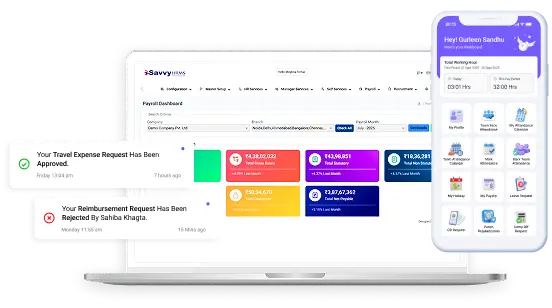









Ready to simplify multi-state HR, payroll, and compliance management?
Explore Savvy HRMS and bring employee management, payroll, attendance, leave, compliance, and HR analytics together on one connected platform.
Frequently Asked Questions (FAQs)
What Is Multi-State Labour Law Compliance?
Multi-state labour law compliance means managing applicable labour, wage, payroll, social security, working-condition, record-keeping, and reporting requirements for employees and establishments operating across multiple Indian states.
Why Is Multi-State Labour Compliance Challenging?
It can be challenging because businesses must manage different locations, establishments, employee categories, wage requirements, statutory deductions, compliance deadlines, records, and state-level implementation requirements simultaneously.
How Do the Four Labour Codes Affect Multi-State Businesses?
The four Labour Codes consolidate 29 Central labour laws into four broader Codes covering wages, industrial relations, social security, and occupational safety and working conditions. Businesses must still monitor applicable Central and State rules.
Can HRMS Manage Multi-State Payroll and Compliance?
Yes. A properly configured HRMS can support employee location mapping, state-wise payroll, statutory calculations, attendance, leave, payslips, reporting, compliance tracking, and other HR processes across multiple locations.
What Compliance KPIs Should HR Teams Track?
HR teams can monitor compliance coverage, filing timeliness, employee-data completeness, payroll exception rate, audit readiness, state coverage, open compliance issues, and regulatory-update turnaround time to identify potential gaps.
How Can HRMS Reduce Manual Multi-State Compliance Work?
HRMS can centralise employee information, automate recurring payroll calculations, connect attendance with payroll, generate reports, track compliance activities, maintain digital records, and reduce repetitive manual data entry across multiple locations.