



Managing contract and temporary employees can become complicated when businesses handle multiple contracts, attendance records, payroll inputs, documents, renewals, and compliance requirements. Spreadsheets and manual processes often make it difficult to maintain accurate and up-to-date workforce information.
The right HR software for contract and temporary employees can bring employee records, attendance, leave, payroll, documents, contract details, and compliance workflows into one system. This helps HR teams reduce repetitive administration while giving managers better visibility into their temporary workforce.
In this blog, we compare 5 HR software solutions in India based on contract workforce management, HR automation, payroll, attendance, employee records, scalability, integrations, and overall suitability. The shortlist includes Savvy HRMS, ZingHR, PeopleStrong, Zimyo, and Kredily.
What Is Contract and Temporary Employee Management?
Contract and temporary employee management is the process of managing workers who are engaged for a defined period, project, assignment, or contractual arrangement rather than as permanent employees.
It can include employee onboarding, contract documentation, joining and exit formalities, attendance, leave, shift scheduling, payroll, statutory deductions, document collection, contract renewals, and workforce reporting.
For businesses with large numbers of temporary or contractual workers, managing these activities manually can create administrative workload and increase the possibility of missed renewals, inaccurate attendance, payroll discrepancies, or incomplete records.
An HRMS can centralize workforce information and connect attendance, payroll, employee records, and workflows, making temporary workforce management more organized and efficient.
Why Do Businesses Need HR Software to Manage Contract & Temporary Employees?
Contract and temporary employees often have different joining dates, pay structures, work locations, shifts, managers, contracts, and end dates. Managing these details manually can create administrative workload and increase the possibility of missed renewals, inaccurate attendance, payroll discrepancies, or incomplete records.
HR software for contract employees provides a centralized system where HR teams can maintain employee information and automate repetitive processes.
Key benefits include:
- Centralized employee records: Store employee information, documents, contracts, and employment details in one place.
- Contract tracking: Monitor contract start and end dates and create renewal reminders.
- Attendance automation: Capture attendance through biometric, mobile, GPS, or other supported methods.
- Payroll accuracy: Connect attendance, leave, salary structures, and deductions with payroll processing.
- Faster onboarding: Standardize document collection, approvals, and employee setup.
- Better workforce visibility: Track temporary and contractual employees across locations and departments.
- Reduced manual work: Automate recurring HR workflows and administrative tasks.
- Improved compliance management: Maintain relevant employee and payroll information required for applicable statutory processes.
For organizations managing a large contingent workforce, these capabilities can make temporary workforce management software significantly more practical than disconnected spreadsheets and manual registers.
How Do We Rank This HR Software for Managing Contract and Temporary Employees?
We rank the shortlisted HR software based on how effectively each platform can support the complete lifecycle of contract and temporary employees rather than looking at the number of features alone.
| Ranking Criteria | What We Evaluate | Weightage |
| Contract Workforce Management | Contract tracking, workforce categorization, renewals and related workflows | 20% |
| Attendance & Workforce Tracking | Attendance, shifts, overtime, locations and workforce visibility | 15% |
| Payroll Management | Salary processing, deductions, payroll automation and reporting | 15% |
| Employee Records & Documents | Centralized profiles, contracts, documents and employee information | 15% |
| Compliance Support | Statutory processes, records, alerts and compliance-oriented workflows | 10% |
| Automation & Workflows | Approvals, notifications, reminders and automated HR processes | 10% |
| Integrations & Scalability | Integrations, flexibility and ability to support growing workforces | 10% |
| Ease of Use & Overall Fit | Usability, implementation suitability and overall value | 5% |
The ranking is an editorial assessment based on product capabilities and suitability for this particular use case. Pricing, integrations, implementation scope, and feature availability can vary by plan and organization.
At a Glance: 5 Best HR Software for Contract & Temporary Employees
| Rank | HR Software | Best For | Overall Fit |
| 1 | Savvy HRMS | Contract labour, payroll, attendance and compliance | Excellent |
| 2 | ZingHR | Large contractual, gig and distributed workforces | Excellent |
| 3 | PeopleStrong | Enterprises managing complex employee lifecycles | Very Good |
| 4 | Zimyo | Growing businesses needing integrated HRMS capabilities | Very Good |
| 5 | Kredily | SMEs seeking payroll and core HR management | Good |
1. Savvy HRMS
Overview
Savvy HRMS is a comprehensive HRMS with dedicated Contract Labor Management alongside core HR, attendance, leave, payroll, statutory compliance, recruitment, and employee management capabilities. Its broad module coverage makes it suitable for organizations managing contract and temporary workforces.
Key Features
- Dedicated contract labour management helps organize non-permanent workforce processes centrally.
- Attendance management helps track working hours across different employee categories.
- Payroll management connects workforce information with salary processing and deductions.
- Statutory compliance features support compliance-oriented payroll and HR processes.
- Core HR centralizes employee records, organizational information, and workforce data.
- Leave management helps apply leave policies across different workforce groups.
- Recruitment management supports hiring workflows before employees enter the workforce.
- Mobile and biometric capabilities support flexible workforce attendance tracking.
- Employee lifecycle modules help manage employees beyond basic payroll administration.
Who Should Choose Savvy HRMS?
Businesses should consider Savvy HRMS when they manage contract labour alongside permanent employees and want HR, attendance, payroll, leave, compliance, and contract workforce processes within one platform. It can be particularly relevant for organizations seeking dedicated contract-labour functionality instead of depending only on generic employee records.
Who Might Not Need Savvy HRMS?
Businesses with only a handful of temporary employees and very simple payroll requirements may not need a broad HRMS. Similarly, organizations already using specialized workforce-management and payroll platforms may prefer extending their existing technology stack rather than implementing another comprehensive HR system.
Best For
Businesses in India looking for an integrated HRMS with dedicated contract labour management, attendance, payroll, leave, statutory compliance, and broader employee lifecycle capabilities.
2. ZingHR
Overview
ZingHR is an enterprise HCM platform offering workforce management for field force, gig workforce, and contractual labour, with attendance, leave, payroll, and contract management capabilities.
Key Features
- Contract management supports automated workflows around contract renewal and expiry.
- Workforce management covers contractual, gig, and field-based workforce requirements.
- Attendance supports biometric, mobile, geofenced, IP, and supervisor-based capture.
- Payroll combines attendance, leave, salary inputs, and statutory registers.
- Automated renewal workflows help reduce missed contract expiration deadlines.
- Workforce analytics provides visibility into contract labour costs and workforce trends.
Who Should Choose ZingHR?
Businesses should consider ZingHR when they manage large, distributed, field-based, gig, or contractual workforces requiring centralized workforce visibility. It can be especially relevant for staffing organizations and enterprises that need contract management, attendance, payroll, and workforce analytics connected in one environment.
Who Might Not Need ZingHR?
Smaller organizations with straightforward payroll and only a limited number of temporary employees may find an enterprise-oriented HCM platform more extensive than necessary. Businesses looking primarily for basic payroll, attendance, and employee records may prefer a simpler HR solution.
Best For
Enterprises, staffing organizations, and businesses managing large contractual, gig, field, or distributed workforces with complex workforce-management requirements.
3. PeopleStrong
Overview
PeopleStrong is an HCM platform covering core HR, payroll, attendance, workforce management, talent, analytics, and employee lifecycle processes, including capabilities for managing contractual employees.
Key Features
- Contract lifecycle workflows support employee signing, renewal, extension, and termination.
- Automated reminders help teams monitor contract renewal and expiry dates.
- Core HR centralizes employee information across departments and workflows.
- Payroll and attendance support connected workforce administration processes.
- Employee lifecycle tools provide centralized visibility from hiring through exit.
- Enterprise architecture supports complex organizational and workforce requirements.
Who Should Choose PeopleStrong?
Businesses should consider PeopleStrong when contract employees form part of a broader, complex workforce and HR teams need enterprise-grade lifecycle management. It is particularly relevant when organizations want contractual employee workflows connected with core HR, payroll, attendance, talent, analytics, and other HCM processes.
Who Might Not Need PeopleStrong?
Small businesses with relatively simple workforce structures may not require the breadth of an enterprise HCM platform. If the primary requirement is only temporary employee payroll, attendance, and basic documentation, a more focused or lightweight HRMS may be sufficient.
Best For
Mid-sized and large organizations that want contractual employee management integrated into a broader enterprise HCM and employee lifecycle ecosystem.
4. Zimyo
Overview
Zimyo is an integrated HRMS offering employee management, payroll, attendance, leave, onboarding, documents, workflows, and other HR capabilities. Its broad platform makes it suitable for growing organizations managing different employee categories.
Key Features
- Employee management centralizes workforce profiles, records, roles, and permissions.
- Payroll supports customizable salary rules and multiple compliance workflows.
- Attendance connects working-time information with payroll calculations.
- Onboarding supports contracts, policies, documents, approvals, and employee setup.
- Workflow automation reduces repetitive employee-management and approval activities.
- Contract workforce capabilities support organizations with workforce complexity.
Who Should Choose Zimyo?
Businesses should consider Zimyo when they want contract and temporary employee management alongside broader HR automation. Its combination of employee management, payroll, attendance, onboarding, documents, workflows, and reporting can work well for growing organizations that want one integrated HR platform.
Who Might Not Need Zimyo?
Organizations with very basic temporary workforce requirements may not need a platform covering such a broad range of HR functions. Companies that already have separate, mature payroll, attendance, and document systems may also find a comprehensive HRMS unnecessary.
Best For
Growing organizations that need integrated employee management, payroll, attendance, onboarding, documents, workflows, and broader HR automation.
5. Kredily
Overview
Kredily provides HR and payroll capabilities covering employee management, onboarding, attendance, leave, payroll, salary structures, and statutory settings, making it suitable for businesses seeking core workforce administration.
Key Features
- Employee management maintains centralized profiles and organizational information.
- Payroll processes salary using attendance, leave, and salary structures.
- PF, ESI, and PT settings can be configured during payroll setup.
- Attendance and leave provide inputs required for payroll processing.
- Employee onboarding helps organizations add workers to the HR system.
- Custom employee fields can support organization-specific workforce information.
Who Should Choose Kredily?
Businesses should consider Kredily when they primarily need straightforward employee management, payroll, attendance, leave, and statutory settings for their workforce. It can be a practical option for SMEs that want to digitize core HR administration without immediately adopting a highly complex enterprise HCM environment.
Who Might Not Need Kredily?
Organizations requiring highly specialized contract workforce management, advanced workforce analytics, or complex multi-client contractual workforce workflows may need a more specialized platform. Large enterprises with extensive distributed workforce requirements may also prefer an enterprise HCM solution.
Best For
Small and growing businesses looking for core HR, attendance, payroll, leave, onboarding, and statutory payroll-management capabilities.
| HR Software | Best For | Biggest Advantage | Potential Integration | Ideal Employee Size |
| Savvy HRMS | Contract labour and integrated HR management | Dedicated contract labour management with broad HR modules | Payroll, attendance, biometric and HR ecosystem | Small to large businesses |
| ZingHR | Large contractual and distributed workforces | Workforce, contract, attendance and payroll automation | Enterprise HR, payroll and business systems | Mid-sized to enterprise |
| PeopleStrong | Enterprise workforce management | Contract lifecycle integrated with HCM | Enterprise HR, payroll and workforce systems | Mid-sized to enterprise |
| Zimyo | Growing organizations | Broad integrated HRMS and workflow automation | SSO, BGV, ATS and finance-related systems | SMB to enterprise |
| Kredily | SMEs | Straightforward payroll and core HR administration | Payroll, attendance and employee-management ecosystem | Small to mid-sized |
Employee-size ranges are indicative rather than official vendor limits. Actual suitability depends on workforce complexity, modules selected, implementation requirements, and organizational structure.
What Challenges Do Companies Face When Managing Contract and Temporary Workers?
Managing contract and temporary employees creates several challenges because their employment lifecycle can differ from that of permanent employees.
1. Tracking Contract Expiry Dates
HR teams may need to monitor hundreds of contract start and end dates. Manual tracking can make renewals difficult and potentially result in missed deadlines.
2. Maintaining Accurate Employee Records
Contract workers may frequently join, leave, change locations, or move between assignments. Maintaining accurate information in spreadsheets can become difficult.
3. Managing Attendance Across Locations
Temporary and contract workers may operate across factories, warehouses, project sites, offices, or customer locations. This can make attendance collection more complicated.
4. Connecting Attendance With Payroll
Incorrect attendance, overtime, leave, or loss-of-pay information can affect temporary employee payroll. An integrated HRMS can reduce duplicate data entry.
5. Document Management
HR teams may need to collect identity information, contracts, joining documents, bank details, declarations, and other records. Scattered documents make retrieval and auditing harder.
6. Managing Workforce Changes
Contract employees can be added or removed frequently. HR teams need processes that can handle high-volume onboarding and offboarding without excessive manual work.
7. Compliance Management
Applicable wage, social security, occupational safety, and employment-related requirements need to be considered based on the worker’s classification and arrangement.
What Features Should You Look for in HR Software for Contract Employees?
The best HR software for contract employees should support more than basic employee records. Look for features that cover the employee lifecycle and the specific challenges of temporary workforce management.
1. Contract Management
Look for contract start and end dates, renewal reminders, extension workflows, termination processes, and contract-related document management.
2. Workforce Categorization
The system should allow HR teams to distinguish between permanent, temporary, contractual, fixed-term, gig, or other workforce categories where relevant.
3. Attendance and Shift Management
Look for biometric, mobile, GPS, geofencing, shift, overtime, and location-based attendance capabilities when required by the workforce.
4. Payroll Integration
Attendance and leave data should flow into payroll to minimize duplicate entries and reduce payroll errors.
5. Document Management
Centralized employee records should allow HR teams to store and retrieve contracts, employee documents, policies, and other workforce information.
6. Automated Notifications
Automated reminders can help HR teams track contract expirations, missing documents, approvals, onboarding activities, and other important events.
7. Compliance Support
Look for payroll and HR features that support applicable statutory processes, records, calculations, reporting, and audit trails.
8. Reporting and Analytics
Workforce reports should help HR teams understand headcount, attendance, payroll costs, contract status, turnover, and other relevant metrics.
9. Role-Based Access
Temporary employee information can include sensitive personal and payroll data, so administrators should be able to control who can access or modify information.
How Can HR Software Simplify Attendance, Leave & Payroll for Temporary Employees?
An HRMS can connect attendance, leave, and payroll instead of making HR teams manage each process independently.
For example, an employee’s attendance can be captured through a supported attendance method. The system can then apply configured attendance and leave rules, calculate relevant working-time information, and pass the required inputs into payroll.
This creates a connected workflow:
Employee → Attendance → Leave/Overtime → Payroll Calculation → Review → Approval → Payslip
For temporary employees working different shifts or locations, this can reduce manual reconciliation. It can also help HR teams identify attendance anomalies before payroll is finalized.
An integrated temporary employee payroll software can therefore help HR teams reduce repetitive data entry while improving payroll consistency.
How Does HR Software Help Manage Contracts, Documents & Employee Records?
Contract and temporary employees generate a continuous flow of information, from onboarding documents to contracts, attendance records, payroll data, and exit information.
A centralized HRMS can create a single employee profile containing relevant information and documents. HR teams can then use workflows and reminders to manage activities associated with the employee lifecycle.
A general process can look like:
Contract Creation → Document Collection → Employee Onboarding → Attendance → Payroll → Contract Renewal → Extension/Exit
Contract management becomes particularly useful when the organization has a large temporary workforce. Instead of manually checking spreadsheets for contract expiry, HR teams can use automated reminders and workflows where supported.
This approach also makes employee information easier to retrieve when HR teams need to verify contracts, review workforce records, process payroll, or complete employee exits.
What Are the Compliance Requirements for Contract Employees in India?
India’s labour compliance framework has undergone significant changes, with the four Labour Codes becoming an important part of the country’s labour-law framework.
For contract and temporary workforce management, businesses should consider applicable requirements relating to:
- Wages and timely payment
- Minimum wage requirements
- Social security
- Provident Fund and applicable social-security obligations
- ESI and other applicable benefits
- Occupational safety and working conditions
- Working hours and overtime
- Records and registers
- Contract labour requirements
- Employee classification and applicable employment arrangements
The exact compliance obligations can vary depending on the nature of the employment relationship, establishment, industry, workforce size, location, and applicable rules.
Therefore, businesses should not treat HR software as a substitute for legal advice. Instead, HR and payroll software for contract employees should help maintain accurate records, automate applicable calculations, provide reminders, and generate relevant reports.
Organizations should regularly verify applicable central and state requirements before configuring their HRMS because labour regulations and implementation rules can change.
How Much Does HR Software for Contract & Temporary Employees Cost in India?
The cost of HR software for managing contract and temporary employees depends on factors such as employee count, modules, payroll requirements, implementation, integrations, customization, support, and contract-management capabilities.
Some providers use per-employee pricing, while others may provide customized enterprise pricing.
Businesses should avoid choosing HR software based only on the lowest per-user price. A cheaper platform may not provide the contract management, attendance, payroll automation, reporting, or compliance capabilities required by a growing workforce.
Before comparing quotes, calculate the total cost of ownership, including:
- Software subscription
- Payroll module
- Contract management
- Attendance devices or integrations
- Implementation
- Data migration
- Customization
- Training
- Support
- Additional users or modules
- Third-party integrations
For a business with a large temporary workforce, a slightly higher subscription may still provide better value if it reduces manual payroll work, contract tracking, attendance reconciliation, and compliance administration.
How to Choose the Right HR Software for Contract & Temporary Employees?
Choosing the right platform starts with understanding your workforce rather than simply comparing feature lists.
1. Define Your Workforce Structure
Before selecting an HRMS, identify the number and type of non-permanent workers you manage. Understanding your workforce structure helps determine which employee-management, attendance, payroll, and contract features your business actually needs.
- Permanent employees
- Contract employees
- Temporary workers
- Fixed-term employees
- Gig workers
- Outsourced workers
2. Identify Your Biggest Operational Problem
Start by identifying the areas creating the most administrative work for your HR team.
- Contract expiry and renewal
- Attendance tracking
- Payroll processing
- Employee documentation
- Onboarding and offboarding
- Compliance management
- Workforce visibility
3. Check Contract Management
If your business manages various contracts, choose software that can organize contract information and simplify renewals. Automated reminders, expiry tracking, extensions, and centralized records can help HR teams manage contracts more efficiently.
4. Evaluate Attendance Requirements
Your workforce location and working pattern should influence your HRMS choice. Check whether the software supports the attendance methods, shifts, locations, and working arrangements used by your contract and temporary employees.
- Biometric attendance
- Mobile attendance
- GPS or location-based attendance
- Shift management
- Overtime tracking
- Multiple work locations
5. Check Payroll Capabilities
Choose an HRMS that can connect attendance, leave, overtime, salary structures, deductions, and applicable statutory calculations. This can reduce manual payroll work and help HR teams process temporary employee salaries more consistently.
6. Review Document Management
Contract employees often require multiple documents throughout their employment lifecycle. Look for centralized document management that makes it easier to upload, organize, retrieve, and update contracts and employee records.
7. Evaluate Automation
Automation can significantly reduce repetitive HR administration and help teams manage large temporary workforces more efficiently.
- Contract expiry reminders
- Approval workflows
- Automated notifications
- Onboarding workflows
- Payroll processing
- Employee alerts
8. Consider Integrations
An HRMS becomes more useful when it works with the other systems your organization already uses. Check whether the software supports relevant integrations with attendance, payroll, finance, ERP, banking, and other business applications.
9. Think About Scalability
Select software that can support your business as the temporary workforce grows. A scalable HRMS should allow you to add employees, locations, departments, workflows, and modules without requiring frequent system changes.
10. Request a Demo
Before making a final decision, ask vendors to demonstrate real-world temporary employee workflows. This helps HR teams understand whether the software can handle their specific operational requirements effectively.
For example, ask the vendor to demonstrate:
Temporary employee joins → Documents collected → Attendance tracked → Overtime calculated → Payroll processed → Contract renewal reminder → Employee exits
Conclusion
Managing contract and temporary employees requires more than maintaining an employee list. Businesses need connected processes for contracts, onboarding, attendance, leave, payroll, documentation, compliance, renewals, and exits to maintain an accurate workforce.
The best HR software for managing contract and temporary employees depends on organizational requirements. Savvy HRMS is a strong option for businesses seeking dedicated contract labour management alongside core HR, attendance, payroll, leave, and compliance capabilities.
ZingHR, PeopleStrong, Zimyo, and Kredily can also suit different workforce-management requirements. The right choice should ultimately depend on workforce size, contract complexity, payroll needs, integrations, automation requirements, and overall HR strategy.

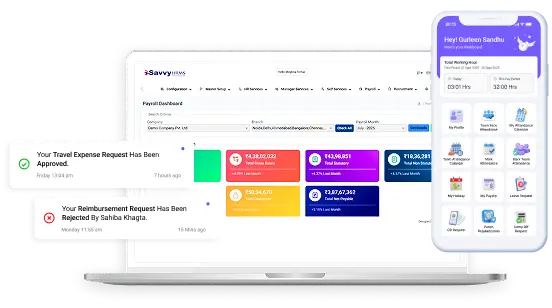









Simplify contract workforce management with Savvy HRMS and manage contract labour, attendance, payroll, compliance, and employee processes from one integrated HRMS platform.
Frequently Asked Questions (FAQs)
1. What is the best HR software for managing contract and temporary employees in India?
The best HR software depends on your workforce size and requirements. Savvy HRMS, ZingHR, PeopleStrong, Zimyo, and Kredily are options to consider for contract workforce management, payroll, attendance, employee records, and HR automation.
2. Can HR software manage contract employee attendance and payroll?
Yes. HR software can connect attendance, leave, overtime, salary structures, and payroll processes. This helps businesses reduce manual data entry and improve payroll accuracy for contract and temporary employees.
3. Can HR software track contract expiry and renewal dates?
Yes. HRMS platforms with contract management capabilities can maintain contract dates and provide reminders for upcoming expiries or renewals. This helps HR teams avoid missing important contract-related deadlines.
4. What features should HR software have for temporary employees?
Important features include contract management, employee records, attendance, shift management, leave, payroll, document management, compliance support, automated reminders, reporting, and role-based access.
5. Is HR software suitable for businesses with both permanent and contract employees?
Yes. An HRMS can help businesses manage permanent and non-permanent employees within the same platform while applying different policies, attendance rules, salary structures, workflows, and employment-related processes where required.