

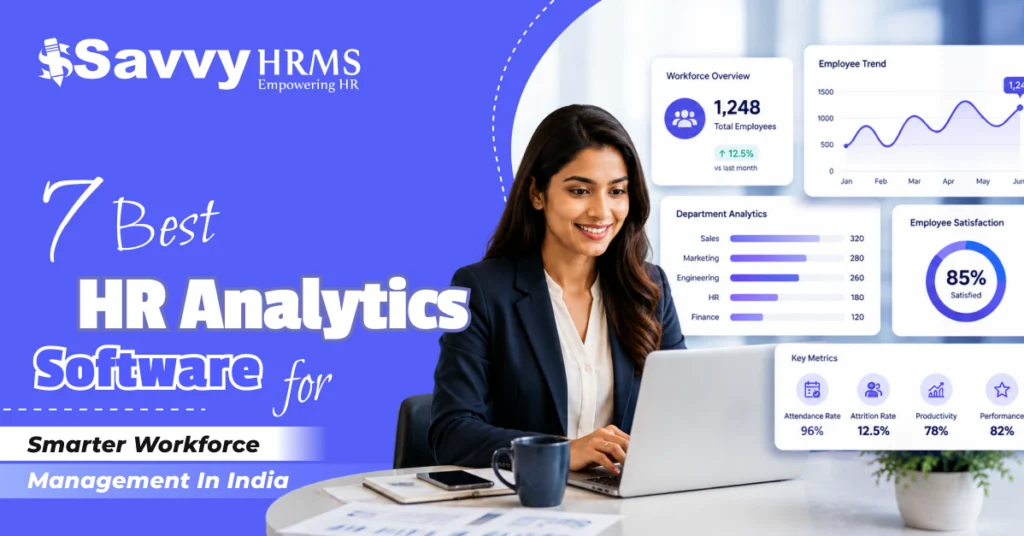
7 Best HR Analytics Software for Smarter Workforce Management in India (2026)


-
AuthorRaghvendra Bhardwaj
-
 Last Updated
August 18, 2026
Last Updated
August 18, 2026
-
 Reading Time
21 Mins
Reading Time
21 Mins
Picture an HR team that knows headcount but can’t say why three engineers quit in one week, why a branch has an attendance problem, or why payroll queries doubled. The data exists, scattered across spreadsheets, payroll, attendance systems, and email, but nobody can connect it. That’s the gap HR Analytics Software closes.
The 7 best HR Analytics Software for Indian businesses in 2026 are Savvy HRMS, Zoho People, Keka HR, ZingHR, factoHR, BambooHR, and greytHR. Savvy HRMS stands out, combining 20+ integrated modules- payroll, attendance, performance, recruitment, lifecycle management- with an AI layer (Savvy AI) that surfaces turnover risk and workforce anomalies from that same data. Where most platforms bolt analytics on, Savvy HRMS builds it in.
HR Analytics Software isn’t about more dashboards; those are just the visible layer. The real value is turning scattered HR data into decisions: who to retain, where to hire, what’s quietly costing money. That shift, from “here’s a report” to “here’s what to do next,” is what separates data storage from real HR analytics.
Our Evaluation Approach
We evaluated all 7 platforms against the same criteria:
- HR & workforce analytics: depth of insight beyond basic reporting
- Reporting & dashboards: quality and usability of data visualization
- Payroll data integration: how tightly payroll connects to other HR data
- Workforce planning: support for forecasting and staffing decisions
- Employee engagement insights: measurement beyond gut feel
- Turnover & attrition analysis: identifying risk before it’s too late
- Predictive analytics: moving from historical to forward-looking data
- Attendance & performance analytics: pattern detection across teams/locations
- Employee self-service: how much employees can access independently
- Automation: reduction of manual HR admin work
- Ease of use: usability for non-technical HR managers
- Data security: encryption, access controls, audit trails
- India statutory compliance support: PF, ESI, PT, TDS, and state-specific rules
- Scalability: ability to grow with the business
- Integrations: connectivity with other business systems
- Customer support: responsiveness and availability
- Pricing/value: cost relative to capability delivered
These factors matter because Indian businesses need software built for their specific complexity, multi-state compliance, mixed office/field workforces, and analytics a non-technical HR manager can actually use.
What Is HR Analytics Software?
HR Analytics Software is a system that collects data from across the employee lifecycle- attendance, payroll, performance, recruitment, engagement, and more- and turns it into reports, dashboards, and predictive insights that help HR teams and business leaders make better people decisions.
The distinction that matters here is between storing HR data and using it. A traditional HR database can tell you how many employees you have, what their salaries are, and when they took leave. HR Analytics Software goes a step further: it looks at attendance trends alongside performance scores, checks whether absenteeism is rising in a specific department, or flags that employees with a certain tenure pattern are more likely to leave. It pulls in data from employee records, attendance, leave, payroll, recruitment, performance reviews, engagement surveys, attrition history, workforce planning inputs, productivity metrics, and employee demographics, then looks for patterns across all of it together.
Here’s a simple example. A retail chain with stores across four cities notices its overall attrition rate looks “normal” on paper. But when HR Analytics Software breaks that number down by location, it turns out one city is losing staff at nearly twice the rate of the others, a signal that would stay invisible in a single company-wide spreadsheet, but jumps out the moment the data is segmented and analyzed properly.
How Do We Select the 7 Best HR Analytics Software?
Our selection is based on analytics depth, workforce management capability, and India-specific relevance, built specifically around what Indian businesses need to move from data storage to real decision-making.
1. Analytics Depth & Predictive Capability
We looked at whether each platform goes beyond static reports to offer predictive insights, turnover risk, attendance trend forecasting, and workforce pattern detection, rather than just historical dashboards.
2. Data Visualization & Reporting
Dashboards need to be usable by a non-technical HR manager, not just a data analyst. We evaluated how clearly each platform presents workforce, payroll, and performance data.
3. Workforce Management & Payroll Integration
Analytics is only as good as the data behind it. We prioritized platforms where payroll, attendance, and performance data are natively connected rather than siloed across separate tools.
4. Employee Lifecycle Coverage
We assessed how much of the employee journey, recruitment, onboarding, performance, engagement, exit- each platform captures and analyzes as connected data.
5. India-Specific Requirements
Multi-state statutory compliance (PF, ESI, PT, TDS), biometric attendance, and support for shift-based or field workforces were weighted heavily, since these are core needs for Indian businesses.
6. Ease of Use & Scalability
We considered how quickly HR teams can adopt each platform, and whether it can scale from a growing SME to a multi-location enterprise without losing usability.
7. Security & Support
Data protection, access controls, and the quality of vendor support were factored in, given how sensitive HR data is.
8. Overall Value
Finally, we weighed capability against cost, since the right platform should deliver measurable value relative to its price point.
Why Do Businesses Need HR Analytics Software in India?
Short answer: because spreadsheets and disconnected systems make it almost impossible to catch workforce problems before they get expensive.
Here’s the thing: most HR teams aren’t short on data. They’re short on connected data. You’ve got attendance in one tool, payroll in another, performance reviews sitting in a shared drive, and exit interview notes buried in someone’s inbox. Individually, none of it tells you much. Put together, it tells you almost everything.
This is where the cracks usually show up as a business grows:
- Payroll gets messier: different states mean different PT slabs, different compliance rules, more room for error
- Attendance problems hide in plain sight: one branch might be struggling, but nobody’s comparing it to the others
- Turnover creeps up quietly: one department bleeding talent doesn’t always move the company-wide number
- Hiring becomes reactive: teams scramble to backfill instead of planning ahead
- Engagement gets guessed at: because nobody’s actually measuring it
- HR spends hours every month just compiling numbers: time that could go toward fixing the actual problems those numbers reveal
If your HR team is still pulling reports manually every month, this probably sounds familiar.
The real shift HR Analytics Software creates is moving from “here’s what happened” to “here’s why it happened, and here’s what we should do next.” That’s not a small difference; it’s the difference between HR reacting to problems and HR helping the business avoid them.
How Does HR Analytics Software Work?
HR Analytics Software works by collecting employee data from across HR systems, integrating it into one place, cleaning and organizing it, and then applying reporting and analytics tools to surface trends, risks, and opportunities that guide people decisions.
The general flow looks like this:
Employee Data → Data Collection → Data Integration → Analysis → Dashboards → Insights → People Decisions.
Breaking that into steps:
- Data collection: attendance punches, leave applications, payroll runs, and performance reviews are captured as they happen.
- Data integration: data sitting in different modules or tools gets pulled into a single connected system.
- Data cleaning and organization: duplicate or inconsistent records are standardized so analysis stays accurate.
- Reporting: the system generates structured reports: headcount, attrition, attendance, payroll costs.
- Analytics: the software looks for relationships in the data, such as whether overtime correlates with resignations.
- Trend identification: recurring patterns surface, like a department consistently missing attendance targets.
- Predictive analytics: historical patterns are used to estimate what’s likely to happen next.
- Decision-making: HR and business leaders act on these insights, whether adjusting staffing or fixing a payroll process.
Predictive analytics sounds technical, but the idea is simple: if a group of employees who left the company shared similar patterns beforehand- falling engagement scores, rising absenteeism, stagnant performance ratings- the software can flag current employees showing the same pattern as a turnover risk. The same logic applies to absenteeism trends, hiring needs based on projected attrition, workforce planning for seasonal demand, payroll cost patterns, and employee engagement dips before they show up in an exit interview.
What Are the Benefits of Using HR Analytics Software?
The core benefit of HR Analytics Software is that it replaces guesswork with evidence, which leads to faster, better-informed people decisions across the organization.
1. Better People Decisions
Hiring, promotion, and retention calls get backed by actual data instead of instinct alone. HR teams can point to patterns and trends, making decisions more defensible and consistently aligned with what’s really happening across the workforce.
2. Better Turnover Risk Identification
Early warning signs, dipping engagement, rising absenteeism, still performance, let HR intervene with at-risk employees while retention is still realistically possible, rather than finding out only after the resignation letter arrives.
3. Smarter Workforce Planning
Instead of scrambling to backfill roles, businesses can anticipate hiring needs based on attrition trends and growth projections, giving recruitment teams a realistic runway to plan ahead rather than react under pressure.
4. Payroll Visibility
Leaders can see exactly where payroll costs are rising and why, whether it’s overtime, compliance penalties, or headcount changes, instead of discovering the full picture only when the month-end numbers land on their desk.
5. Faster HR Reporting
Dashboards replace hours of manual spreadsheet work every month. What used to take a full day of pulling and formatting numbers now takes minutes, freeing HR teams to focus on solving problems instead of reporting them.
6. Better Attendance Management
Attendance trends broken down by location, team, or shift surface problems that a single company-wide number would completely hide, helping HR catch and address issues at the specific branch or team level.
7. Better Compliance Visibility
HR teams can track statutory obligations across states and flag gaps before they turn into penalties, giving businesses a proactive view of compliance risk instead of finding out during an audit or inspection.
8. Predictive Workforce Planning
Future staffing and cost needs can be forecast using historical patterns rather than guessed at, helping businesses budget more accurately and plan hiring cycles around real, data-backed workforce projections.
Each of these matters because HR decisions affect real costs, recruitment spend, payroll accuracy, productivity, and retention, and businesses that see these patterns early are better positioned to act than those depending on year-end reviews of scattered spreadsheets.
7 Best HR Analytics Software for Smarter Workforce Management in India
1. Savvy HRMS
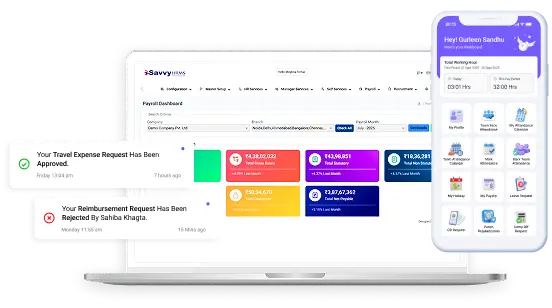
Savvy HRMS is a cloud-based HRMS built around 20+ integrated modules spanning payroll, attendance, performance, recruitment, and employee lifecycle management, all feeding into a shared analytics layer. Real-time dashboards and Savvy AI turn attendance, payroll, and performance data into workforce insights HR teams can act on directly.
For Indian businesses specifically, Savvy HRMS supports multi-location and multi-shift workforces, biometric and facial-recognition attendance, and payroll-attendance integration that removes manual reconciliation. This combination of breadth and India-specific workforce handling is what makes it a strong fit across company sizes and industries.
Key Features
- Savvy AI analyzes attendance, payroll, and performance data to detect trends, anomalies, and turnover risk automatically across the workforce.
- Real-time analytical dashboards give HR teams and managers instant visibility into attendance, productivity, and workforce patterns.
- Attendance analytics break down late arrivals, early departures, and absenteeism by location, shift, and employee type.
- Payroll is directly integrated with attendance data, reducing manual calculation errors and improving payroll accuracy and visibility.
- Voice Assist lets HR staff query leave balances, attendance details, and employee records instantly using natural language commands.
- Performance management includes structured, automated appraisal reporting to track employee growth and development over time.
- The mobile application extends analytics, approvals, and reporting access to HR teams and managers working outside the office.
- 20+ integrated modules mean workforce, payroll, and performance data stay connected instead of scattered across separate systems.
Best For
Savvy HRMS is best suited for Indian SMEs, mid-sized businesses, growing multi-location organizations, and large organizations that want HR, payroll, attendance, and analytics inside one connected platform rather than stitching together separate tools. It’s a particularly strong fit for businesses with field staff, shift workers, or multiple branches, since its attendance and workforce analytics are built around exactly that kind of complexity. Organizations that want centralized workforce visibility, without needing a separate business intelligence tool layered on top of their HRMS, will find Savvy HRMS’s built-in analytics layer especially useful.
2. Zoho People
Zoho People is Zoho’s HRMS platform, well known for its deep integration with the wider Zoho product ecosystem and its flexible, customizable approach to HR workflows. It offers reporting and analytics on attendance, leave, and performance, with an AI layer (Zia) that adds predictive and conversational analytics for teams that want to go further.
Key Features
- Customizable reports covering attendance, leave, and performance metrics for HR decision-making.
- Zia AI enables natural-language queries and predictive analytics, including attrition forecasting.
- Workflow automation for approvals, notifications, and repetitive HR administrative tasks.
- Strong integration with other Zoho apps like Zoho Books and Zoho Recruit.
- Employee self-service portal for personal data, leave requests, and policy access.
Best For
Zoho People is best for businesses already using Zoho products, and for SMEs and mid-sized companies that want an affordable, customizable HRMS. Its analytics are useful for core reporting, though several independent reviews note that advanced analytics depth is more limited compared to specialist workforce analytics platforms.
3. Keka HR
Keka positions itself as an employee-experience-first HR and payroll platform, built originally for Indian small and mid-sized businesses. It combines payroll, attendance, and performance management with customizable, real-time dashboards for workforce monitoring.
Key Features
- Customizable real-time dashboards for workforce metrics across attendance, payroll, and performance.
- Deep native handling of Indian statutory payroll components, including PF, ESI, PT, and TDS.
- Gamified attendance tracking with web clock-in, location tracking, and biometric integration.
- Performance management with OKRs, continuous feedback, and skill analytics.
- Pre-built and customizable reports for HR and finance teams.
Best For
Keka HR works well for Indian SMBs and mid-market companies, generally in the 50- 1,000 employee range, that want a modern, employee-centric interface alongside strong statutory payroll handling. It’s less suited to organizations needing multi-country payroll or native global Employer of Record capabilities.
4. ZingHR
ZingHR is a Mumbai-based, cloud-based HCM platform aimed at larger and more complex organizations, with analytics that extend across the full “hire to rehire” employee lifecycle. It emphasizes automation, AI-based screening, and board-level workforce reporting for enterprise HR teams.
Key Features
- Customizable dashboards analyzing workforce metrics such as attrition and payroll trends.
- AI-powered screening and robotic interviews built into the recruitment workflow.
- Zero-touch payroll automation across multiple entities and jurisdictions.
- Compliance automation with alerts for labor law and statutory requirement changes.
- Geofencing and mobile-first attendance tools for distributed and remote workforces.
Best For
ZingHR is best suited for larger enterprises, including those in regulated sectors like BFSI and manufacturing, that need board-level analytics and compliance automation across a large, complex, multi-location workforce. Smaller businesses may find its feature depth more than they need.
5. factoHR
factoHR is a Rajkot-headquartered HR and payroll platform built specifically around Indian statutory compliance, with pre-configured reports and dashboards covering attendance, leave, payroll, and performance data.
Key Features
- Native Indian payroll handling for PF, ESI, PT, TDS, gratuity, bonus, and Form 16 generation.
- Pre-configured dashboards and custom report builder across attendance, leave, and payroll.
- GPS-enabled mobile attendance with geo-fencing and biometric integration.
- Multi-entity consolidated reporting for businesses operating across Indian states.
- Self-service portal for payslips, leave applications, and personal HR data access.
Best For
factoHR is a good fit for Indian SMEs and mid-market businesses that prioritize statutory compliance depth and multi-state payroll accuracy over broader HR platform breadth. Its regional Indian support team is a practical advantage for businesses that want hands-on help with compliance configuration.
6. BambooHR
BambooHR is a US-headquartered HRIS platform known for its clean interface and centralized employee records, with analytics tools that scale up through its Core, Pro, and Elite pricing tiers, including a recently expanded Elite analytics offering.
Key Features
- Customizable dashboards and reports on turnover, benefits, and workforce metrics.
- AI-powered insights, including sentiment analysis, available on higher-tier plans.
- Predictive analytics and compensation planning included in the Elite tier.
- Employee self-service with strong access-permission controls for sensitive data.
- Integrations with tools like Slack, Greenhouse, and global payroll partners.
Best For
BambooHR suits global or US-anchored businesses, including Indian teams operating as part of an international organization, that want a clean, easy-to-use system of record. It is worth noting that BambooHR’s payroll depth is strongest in the US, so Indian-only businesses should verify statutory payroll coverage before choosing it as a primary platform.
7. greytHR
greytHR, from Bengaluru-based Greytip Software, is one of the more established payroll-first HRMS platforms in India, with a strong reputation for statutory compliance and a large library of pre-built and custom reports.
Key Features
- 150+ pre-built and custom reports covering payroll, attendance, and compliance data.
- Automated statutory compliance for PF, ESI, income tax, and state-specific rules.
- Real-time data flow between attendance, leave, and payroll to reduce manual reconciliation.
- Multi-entity, multi-state processing for businesses with distributed operations.
- 24/7 customer support via phone, email, and chat.
Best For
greytHR is best suited for Indian businesses, from growing mid-market companies to large enterprises, that prioritize payroll accuracy and statutory compliance reporting as their primary HR software need, with analytics functioning mainly as an extension of payroll and attendance reporting rather than a standalone predictive layer.
HR Analytics Software Comparison: Which Platform Fits Your Business?
| HR Analytics Software | Best For | Key Analytics Capabilities | Workforce Management | Payroll | Reporting | India Focus | Overall Fit |
| Savvy HRMS | Indian SMEs, mid-sized and large enterprises | AI-driven analytics (Savvy AI) for turnover risk, attendance patterns, anomalies | 20+ modules covering full employee lifecycle | Integrated with attendance, automated calculations | Real-time dashboards + Voice Assist queries | Strong (biometric, multi-shift, multi-location built-in) | Strongest all-round fit for Indian businesses |
| Zoho People | SMEs and Zoho ecosystem users | Zia AI for predictive analytics and NLP queries | Core HR + performance + engagement | Basic; integrates via API with payroll tools | Customizable reports and dashboards | Moderate | Good value, lighter advanced analytics |
| Keka HR | Indian SMBs and mid-market (50-1,000 employees) | Real-time customizable dashboards | Strong performance + attendance | Deep native Indian statutory payroll | Pre-built and custom reports | Strong | Best for employee-experience-led HR |
| ZingHR | Large enterprises, regulated industries | Board-level analytics, AI recruitment screening | Enterprise-scale, multi-entity | Zero-touch, multi-jurisdiction payroll | Customizable enterprise dashboards | Strong | Best for large, complex enterprises |
| factoHR | Indian SMEs/mid-market focused on compliance | Pre-configured payroll and attendance dashboards | Solid core HR + attendance | Deep Indian statutory depth (PF, ESI, PT, TDS) | Custom report builder, multi-entity reporting | Very strong | Best for compliance-first buyers |
| BambooHR | Global/US-anchored businesses | Elite tier: predictive analytics, sentiment analysis | Strong core HR record-keeping | Primarily US-focused; add-on | Custom dashboards (higher tiers) | Limited | Best for global teams, not India-first |
| greytHR | Payroll-first Indian businesses of all sizes | Payroll and compliance-linked reporting | Core HR + attendance + payroll | Extensive Indian statutory automation | 150+ pre-built/custom reports | Very strong | Best for payroll-and-compliance priority |
How to Select the Best HR Analytics Software in India?
The right HR Analytics Software for your business depends on matching platform capabilities to your company’s size, complexity, and specific analytics needs, not simply picking the platform with the most features.
Start with the basics: employee count and HR complexity. A 50-person single-location business has very different needs than a 2,000-person company spread across 10 states. From there, check how deeply the platform integrates payroll with attendance and performance data; analytics built on disconnected data will always be shallower than analytics built on one unified dataset. Check whether it supports real workforce planning and predictive analytics, or just historical reporting, and whether dashboards make sense to managers outside HR too.
Data security and India-specific statutory compliance support are non-negotiable. Confirm the platform can scale as headcount grows, integrates with systems you already use, and offers support matching your team’s technical comfort level. Finally, weigh pricing against actual value delivered, not just the feature list on a sales page.
A quick checklist before you decide:
- Does it integrate HR and payroll data?
- Does it provide useful dashboards?
- Can managers access workforce insights?
- Does it support India-specific requirements?
- Can it scale with employee growth?
- Is employee data protected?
- Can HR teams actually use the analytics?
What Are the Compliance and Data Privacy Requirements for HR Analytics in India?
1. Why This Matters for HR Analytics Specifically
HR Analytics Software handles sensitive data, salaries, PF/ESI numbers, biometric records, and performance reviews. Strong access controls, encryption, and clear retention policies are essential, not optional.
2. The DPDP Act, 2023 and What It Covers
India’s DPDP Act is now operative, with the DPDP Rules, 2025 notified by MeitY in November 2025 and rolling out in phases through 2027. Employee data falls squarely within its scope, with penalties up to ₹250 crore per violation.
3. Access Controls and Role-Based Permissions
Not every manager needs to see every employee’s salary or performance data. Role-based access limits visibility to those who genuinely need it.
4. Audit Trails and Data Retention
Knowing who accessed what data, and when, supports accountability and compliance. Retention periods should be defined and followed, not left open-ended.
5. Software Capability vs. Employer Responsibility
A platform with strong security features gives you the tools to comply, but consent, retention decisions, and breach response remain the employer’s responsibility, not the software’s.
6. A Practical Note
This isn’t legal advice. Some DPDP provisions are still pending further notification. Consult a qualified data privacy or employment law professional to confirm your specific obligations.
How Much Does HR Analytics Software Cost, and How Can You Measure Its ROI?
Short answer: it depends. Pricing varies based on employee count, modules selected, and how much analytics and payroll depth you actually need. There’s no single “market rate” you can point to.
Most vendors, including the platforms covered in this guide, price things a few different ways:
- Per employee, per month: scales with headcount
- Flat monthly subscription: fixed regardless of small headcount changes
- Per module: pay only for what you use (payroll, analytics, performance, etc.)
- Annual subscription: often discounted vs. monthly billing
- Custom enterprise pricing: for larger, more complex deployments
Here’s the honest part: pricing isn’t publicly listed for most of these platforms, including Savvy HRMS, Zoho People, Keka HR, ZingHR, factoHR, BambooHR, and greytHR. You’ll need to contact the vendor directly for a quote based on your employee count and requirements.
Now, about ROI, this is where a lot of businesses think too narrowly. It’s tempting to just compare subscription cost against “time saved,” but that’s only part of the picture. The indicators that actually matter include:
- Reduced HR reporting and payroll processing time
- Lower administrative workload for HR staff
- Reduced employee turnover
- Improved retention among high performers
- Faster hiring cycles
- Better workforce utilization
- Reduced absenteeism
- Improved engagement scores
- Fewer compliance-related errors
Here’s the real way to think about it: if HR analytics helps you retain even a handful of good employees who might otherwise have walked, or catches a payroll error before it becomes a compliance headache, the software has already paid for itself, well beyond whatever the subscription costs. The real return isn’t just hours saved. It’s the quality of the decisions your business is now able to make.
Conclusion
Workforce management in 2026 can’t run on spreadsheets and gut instinct anymore. As businesses grow across locations and roles, seeing attrition, payroll, attendance, and engagement patterns in one place becomes a real advantage: better retention, accurate payroll, and stronger compliance visibility, all while keeping employee data secure under India’s evolving privacy requirements.
Among the seven platforms reviewed, Savvy HRMS stands out as the recommended choice for Indian businesses looking for a broader HRMS that brings workforce management, payroll, analytics, and employee lifecycle capabilities together in one connected system.









Ready to turn HR data into smarter people decisions?
Explore Savvy HRMS and see how its HR, payroll, workforce management, and analytics capabilities can help your business make better decisions.
Frequently Asked Questions (FAQs)
1. What are the four types of HR analytics?
The four types of HR analytics are descriptive, diagnostic, predictive, and prescriptive analytics. They help HR teams understand what happened, why it happened, what may happen next, and what actions should be taken.
2. What are HR analytics tools?
HR analytics tools are software solutions that collect and analyze employee data such as attendance, payroll, performance, recruitment, engagement, and attrition. They turn this data into reports, dashboards, trends, and predictive insights for better workforce decisions.
3. Why do businesses need HR Analytics Software?
Businesses use HR Analytics Software to connect data from different HR systems and identify workforce trends that may be difficult to spot in spreadsheets, such as rising absenteeism, employee turnover, payroll costs, and hiring needs.
4. How does HR Analytics Software work?
HR Analytics Software collects employee data, integrates and organizes it, generates reports, analyzes patterns, identifies trends, and can use predictive analytics to support workforce decisions.
5. What are the benefits of using HR Analytics Software?
Key benefits include better people decisions, turnover-risk identification, smarter workforce planning, improved payroll visibility, faster HR reporting, better attendance management, compliance visibility, and predictive workforce planning.
6. How do I choose the best HR Analytics Software in India?
Consider analytics depth, payroll and attendance integration, reporting capabilities, predictive analytics, India-specific compliance support, scalability, security, ease of use, integrations, customer support, and overall value.