


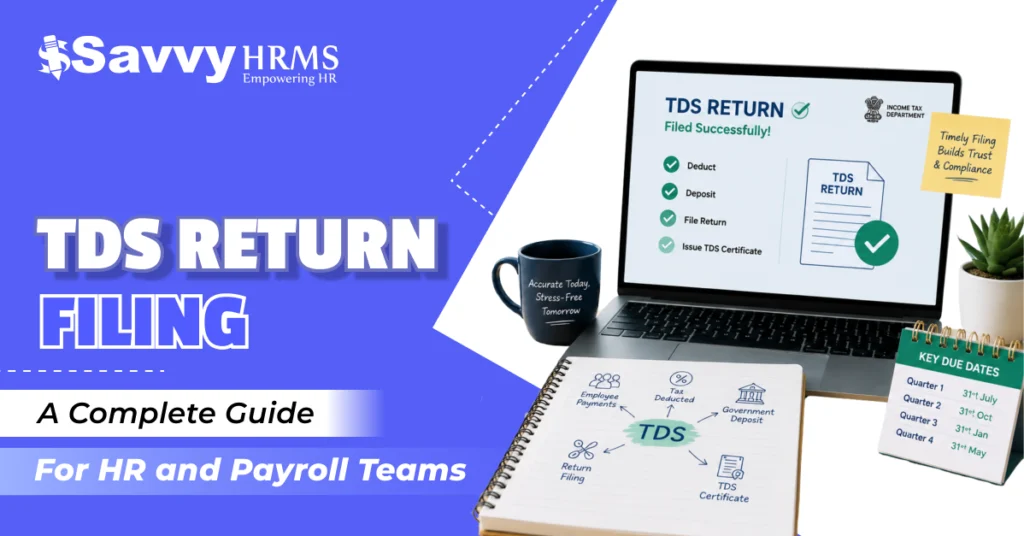

Payroll compliance goes beyond processing salaries on time. Every organization that deducts Tax Deducted at Source (TDS) is also responsible for depositing the tax with the government and completing TDS return filing within the prescribed deadlines. Filing accurate TDS returns is important for staying compliant, avoiding penalties, and ensuring employees and vendors receive the correct tax credit.
For HR and payroll teams, TDS filing can seem confusing due to multiple return forms, quarterly due dates, and changing tax regulations. However, with a clear understanding of the filing process and the right payroll system, it becomes much easier to manage.
This blog covers everything you need to know about TDS Return Filing, including its purpose, applicability, return forms, required documents, filing process, due dates, common mistakes, and how HRMS software can simplify the entire compliance process.
What is TDS Return Filing?
TDS Return Filing is the process of submitting a quarterly statement to the Income Tax Department that reports the Tax Deducted at Source (TDS) on specified payments, such as salaries, professional fees, rent, interest, and contractor payments.
Whenever an employer or deductor deducts TDS, they must deposit the deducted tax with the government and file a TDS return containing details such as the deductor’s TAN, deductee’s PAN, payment amount, TDS deducted, challan details, and the applicable TDS section.
Depending on the nature of the payment, TDS returns are filed using different forms, such as Form 24Q, Form 26Q, Form 27Q, and Form 27EQ. Timely and accurate TDS return filing helps ensure tax compliance, enables deductees to claim tax credit, and reduces the risk of penalties.
Why is TDS Return Filing Important?
Many businesses assume that depositing the deducted tax is enough. However, depositing TDS is only one part of the compliance process. Filing the corresponding TDS return is equally important because it officially reports the deduction to the Income Tax Department.
Here are some of the key reasons why TDS return filing is important:
1. Ensures Legal Compliance
The Income Tax Act requires eligible deductors to file quarterly TDS returns within the prescribed due dates. Timely filing helps organizations remain compliant and avoid legal complications.
2. Enables Employees and Vendors to Claim Tax Credit
The details submitted through TDS filing are reflected in the deductee’s tax records, allowing employees, contractors, and vendors to claim the correct TDS credit while filing their income tax returns.
3. Helps Avoid Penalties
Delayed or incorrect TDS return filing may attract late filing fees, interest, or penalties. Filing returns accurately and on time reduces compliance risks.
4. Improves Financial Transparency
Accurate TDS returns create a clear record of tax deductions and deposits, making payroll and financial reporting more transparent and easier to audit.
5. Builds Trust with Employees
Employees expect the TDS deducted from their salaries to appear correctly in their tax records. Timely filing ensures there are no discrepancies when they file their income tax returns.
What is the Purpose of TDS Return Filing?
The main purpose of TDS Return Filing is to ensure that taxes deducted at the source of income are accurately reported and deposited with the government. It creates a transparent system where taxes are collected throughout the financial year rather than only at the time of filing income tax returns.
Some of the major objectives of TDS filing include:
- Reporting all TDS deductions made during a quarter.
- Confirming that the deducted tax has been deposited with the government.
- Providing deductees with accurate tax credit information.
- Helping the Income Tax Department track tax compliance.
- Reducing tax evasion by ensuring taxes are collected at the source.
- Maintaining proper payroll and taxation records.
- Supporting accurate reconciliation between deducted tax and deposited tax.
For HR and payroll teams, TDS return filing is an important compliance activity that ensures salary-related tax deductions are reported correctly while minimizing the risk of notices, penalties, and employee grievances.
Who is Required to File TDS Returns?
Not every individual or business is required to file TDS returns. However, if you deduct Tax Deducted at Source (TDS) while making specified payments under the Income Tax Act, TDS return filing becomes a mandatory compliance requirement.
Generally, every deductor holding a valid Tax Deduction and Collection Account Number (TAN) and deducting TDS must file quarterly TDS returns within the prescribed due dates.
The following entities are commonly required to complete TDS return filing:
- Employers deducting TDS from employee salaries.
- Private limited companies and public limited companies.
- Partnership companies and Limited Liability Partnerships (LLPs).
- Sole proprietors who are liable to deduct TDS.
- Government departments and public sector undertakings.
- Trusts, societies, educational institutions, and non-profit organizations.
- Banks and financial institutions deduct TDS on interest payments.
- Individuals and Hindu Undivided Families (HUFs) are required to deduct TDS under applicable provisions of the Income Tax Act.
Apart from salaries, TDS filing may also be applicable for payments such as professional fees, contractor payments, rent, commission, brokerage, interest, dividends, and payments made to non-residents.
In short, if your organization deducts tax at source on any eligible payment, filing a quarterly TDS return is a statutory obligation.
Types of TDS Return Forms (Form 24Q, 26Q, 27Q & 27EQ)
Different types of TDS return forms are prescribed depending on the nature of the payment and the recipient. Using the correct form is crucial for accurate TDS return filing.
1. Form 24Q
Form 24Q is used to report TDS deducted from salary payments made to employees.
It is the most commonly used TDS return form by HR and payroll teams. The return contains employee-wise salary details, tax deductions, exemptions, deductions under Chapter VI-A, and other salary-related information.
Applicable for: Salary payments under Section 192.
2. Form 26Q
Form 26Q is filed for TDS deducted on payments other than salary.
It covers various payments made to resident individuals or entities, including:
- Professional fees
- Contractor payments
- Commission and brokerage
- Rent
- Interest (other than securities)
- Director remuneration
- Other specified payments
Applicable for: Resident non-salary payments.
3. Form 27Q
Form 27Q is applicable when tax is deducted on payments made to non-residents, foreign companies, or overseas entities.
It includes details of foreign remittances and tax deducted on payments such as:
- Interest
- Royalty
- Technical service fees
- Dividends
- Other taxable payments to non-residents
Applicable for: Non-resident payments.
4. Form 27EQ
Unlike the other forms, Form 27EQ is used for Tax Collected at Source (TCS) rather than TDS.
Businesses collecting tax while selling specified goods must report these collections through Form 27EQ.
Applicable for: Tax Collected at Source (TCS).
Quick Comparison of TDS Return Forms
| Form | Purpose | Applicable For |
| Form 24Q | TDS on salary | Employers deducting TDS from salaries |
| Form 26Q | TDS on non-salary payments | Resident vendors, contractors, professionals |
| Form 27Q | TDS on payments to non-residents | Foreign individuals and companies |
| Form 27EQ | Tax Collected at Source (TCS) | Sellers collecting TCS |
Selecting the appropriate return form ensures that your TDS filing is processed smoothly and helps avoid rejection or compliance issues.
What are the Components of a TDS Return?
A TDS return contains several important details that enable the Income Tax Department to verify tax deductions and deposits made during a quarter.
Some of the key components include:
1. TAN of the Deductor
The Tax Deduction and Collection Account Number (TAN) is a unique identification number allotted to every deductor. It is mandatory for TDS return filing.
2. PAN of the Deductor and Deductee
The return must include the Permanent Account Number (PAN) of both the deductor and every deductee whose tax has been deducted.
Accurate PAN details are essential because incorrect PAN information may result in higher TDS rates, validation failures, or tax credit mismatches.
3. Challan Details
Every TDS return must contain details of the tax deposited with the government, including:
- Challan Identification Number (CIN)
- BSR Code
- Challan serial number
- Date of deposit
- Amount deposited
4. Deduction Details
The return should clearly mention:
- Date of payment
- Amount paid or credited
- Applicable TDS section
- Rate of TDS
- Amount of tax deducted
5. Deductee Information
Complete deductee details should be reported, including:
- Name
- PAN
- Nature of payment
- Amount paid
- TDS deducted
6. Filing Quarter
The return should specify the relevant financial year and quarter for which the TDS return filing is being made.
Maintaining accurate information across all these components helps ensure faster processing and reduces the chances of receiving notices from the Income Tax Department.
Documents Required for TDS Return Filing
Before starting the TDS filing process, HR and payroll teams should ensure that all the necessary information and documents are readily available.
Having complete records minimizes filing errors and speeds up the return preparation process.
The commonly required documents and details include:
- Tax Deduction and Collection Account Number (TAN)
- Permanent Account Number (PAN) of the deductor
- PAN details of all deductees
- Salary register or payroll records
- Vendor and contractor payment records
- Challan Identification Number (CIN)
- BSR code and challan serial number
- Details of TDS deposited with the government
- Previous TDS return details (if filing a correction return)
- Applicable TDS section for each payment
- Deduction and payment dates
- Quarterly payroll reports
- Employee tax computation records
- Form 16 or Form 16A details, wherever applicable
Step-by-Step Process for TDS Return Filing
Step 1: Calculate the TDS Amount
Start by calculating the tax that needs to be deducted from each applicable payment.
For employers, this usually involves calculating TDS on employee salaries after considering exemptions, deductions, tax regimes, and applicable income tax slabs. Similarly, businesses must calculate TDS on payments made to vendors, contractors, consultants, landlords, and other eligible recipients.
Always ensure the correct TDS rate and applicable section are used.
Step 2: Deduct TDS at the Time of Payment
Once the tax amount is calculated, deduct it from the payment before releasing the salary or invoice amount.
For example, if an employee’s salary attracts TDS, the employer should deduct the tax before crediting the salary to the employee’s account.
Step 3: Deposit the TDS with the Government
After deduction, the TDS amount must be deposited with the government within the prescribed timeline.
Timely deposit is essential because delays may attract interest and other compliance consequences.
Step 4: Prepare the TDS Return
After depositing the tax, compile all the required information for the relevant quarter, including:
- TAN and PAN details
- Deductee information
- Challan details
- TDS amount deducted
- Nature of payment
- Applicable TDS section
This information is then prepared in the prescribed TDS return format.
Step 5: Validate the Return
Before submission, validate the return file to identify any errors, such as:
- Invalid PAN
- Incorrect challan details
- Duplicate entries
- Missing mandatory information
- Incorrect TDS calculations
Resolving these issues beforehand helps prevent rejection during TDS return filing.
Step 6: Submit the TDS Return
Once validated, upload the return through the prescribed filing portal within the applicable due date.
Ensure that all information is accurate before final submission.
Step 7: Verify the Filing Status
After submission, verify whether the return has been successfully accepted.
If any errors are reported during processing, make the necessary corrections and file a correction return promptly.
TDS Return Filing Due Dates (Quarter-Wise)
One of the most important aspects of TDS return filing is meeting the prescribed due dates. Filing your returns on time helps your organization remain compliant and prevents unnecessary late fees or penalties.
The due dates for filing quarterly TDS returns are generally as follows:
| Quarter | Period Covered | Due Date |
| Quarter 1 | 1 April to 30 June | 31 July |
| Quarter 2 | 1 July to 30 September | 31 October |
| Quarter 3 | 1 October to 31 December | 31 January |
| Quarter 4 | 1 January to 31 March | 31 May |
Note: These due dates are subject to any revisions or notifications issued by the Income Tax Department. HR and payroll teams should always verify the latest compliance calendar before filing their returns.
To avoid last-minute delays, it’s advisable to complete payroll reconciliation and prepare TDS returns well before the deadline.
Source: https://www.incometaxmumbai.gov.in/
Best Practices for HR and Payroll Teams
An efficient TDS return filing process is not just about meeting deadlines; it also requires maintaining accurate records, following standardized procedures, and using the right technology.
Here are some best practices that every HR and payroll team should adopt:
1. Maintain Accurate Employee Records
Keep employee PAN, salary details, declarations, and tax information updated throughout the financial year.
2. Verify PAN Before Payroll Processing
Incorrect PAN details are one of the biggest causes of filing errors. Always validate employee and vendor PAN details before processing payroll.
3. Reconcile Payroll and Challan Records
Before preparing quarterly returns, reconcile payroll data with challan payments to ensure there are no mismatches.
4. Track Compliance Deadlines
Create a quarterly compliance calendar for TDS deductions, tax deposits, return filing, and Form 16 issuance.
5. Review Returns Before Submission
Perform a final review to identify any missing information, incorrect calculations, or duplicate entries before uploading the return.
6. Keep Supporting Documents Organized
Maintain payroll registers, challans, employee declarations, and deduction records for future audits and compliance verification.
7. Leverage Payroll Automation
Manual processes increase the likelihood of human error. Automated payroll systems can significantly improve accuracy while reducing administrative workload.
How HRMS and Payroll Software Simplify TDS Return Filing
As organizations grow, managing payroll and tax compliance manually becomes increasingly time-consuming. HR teams often have to juggle employee data, tax calculations, statutory deductions, filing deadlines, and compliance updates, all while ensuring accuracy.
This is where an integrated HRMS and payroll software makes a significant difference.
A modern HRMS can automate several aspects of TDS return filing, including:
- Automatic TDS calculation based on the latest tax rules.
- Centralized employee and payroll records.
- Accurate salary tax computation.
- Generation of TDS reports and compliance documents.
- Easy access to challan and deduction records.
- Reduced manual data entry and calculation errors.
- Timely compliance reminders for quarterly filings.
- Faster payroll processing and statutory reporting.
By automating repetitive tasks, HR and payroll professionals can spend less time on compliance administration and more time focusing on strategic workforce initiatives.
If your organization manages a large workforce or handles complex payroll operations, investing in an advanced HRMS can significantly simplify TDS filing, improve compliance accuracy, and reduce the risk of penalties.
Conclusion
TDS Return Filing is an important part of payroll and tax compliance. Filing accurate returns on time not only helps organizations meet statutory requirements but also ensures employees and vendors receive the correct tax credit while reducing the risk of penalties and compliance issues.
With Savvy HRMS, businesses can simplify TDS filing through automated payroll processing, accurate tax calculations, centralized employee records, and timely compliance support. Whether you’re a growing business or a large enterprise, Savvy HRMS helps your HR and payroll teams stay compliant while saving time and reducing manual effort.










Ready to simplify your TDS return filing?
Explore Savvy HRMS and simplify your payroll compliance with confidence