

Joining Letter Format: Complete Guide with Meaning & Structures


-
AuthorRuchika Rajput
-
 Last Updated
May 12, 2026
Last Updated
May 12, 2026
-
 Reading Time
8 Mins
Reading Time
8 Mins
Starting a new job comes with a mix of excitement and a checklist of formalities, and one of the first things that marks this transition is the joining letter. It’s more than just a document; it’s your official “yes” to the organization and the beginning of your professional journey with them.
For HR teams, having a clear and structured joining letter format makes all the difference. It sets the tone for a smooth onboarding process, ensures everything is documented properly, and avoids confusion right from day one.
With businesses moving towards digital-first operations, many organizations now depend on HRMS and HR software to simplify these processes, making it quicker, more accurate, and hassle-free for both HR professionals and new employees.
What is a Joining Letter Format?
A joining letter format is a document that an employee uses to formally confirm their acceptance of the job offer and their agreement to start the new job. The document includes the most important information related to the job clearly.
The document is formatted in a professional manner, and it helps the employee and the organization maintain clarity and consistency while beginning the onboarding process effectively.
Why is the Joining Letter Important for Employees and HR?
1. Formal Confirmation
A joining letter format gives an official confirmation to the employees related to the acceptance of the offer to join the particular organization and to begin working from a specific date.
2. Legal Documentation
The joining letter format acts as an official document that can be used for any legal objective in the future, in case of any issues or clarifications about employees.
3. Smooth Onboarding
It is used by HR departments to begin the onboarding process for employees, ensuring that all the details of employees are correctly documented at the time of joining.
4. Clear Communication
The joining letter format is used to confirm that both employees and employers are on the same page, thus avoiding any confusion and errors at the time of joining.
5. Employee Record Management
Joining letters are used to manage employee data, which is maintained using HRMS or other high-tech HR solutions.
6. Professionalism
Preparing and submitting joining letters to employers is an act of professionalism on the part of employees and employers.
7. Future Reference
Joining letters are used for future references to confirm the joining date of employees.
What is the Purpose of a joining letter in Employment?
A joining letter format presents as an official communication from the employee to the organization, confirming acceptance of the role that is offered to the employee and commitment to begin employment.
It also helps HR teams confirm employment details and begin administrative work, ensuring smooth onboarding, payroll setup, and integration into organizational systems from the very first day of working.
Key Purposes:
- Validates the employee’s acceptance of the job offer and awareness of joining.
- Creates a formal record of the employee’s start date and job role.
- Eases the smooth functioning of HR’s onboarding and documentation process.
- Ensures proper communication between the organization and the employee’s expectations.
- Supports the payroll process and HR software or HRMS systems.
- Can be used as proof of employment for any future reference.
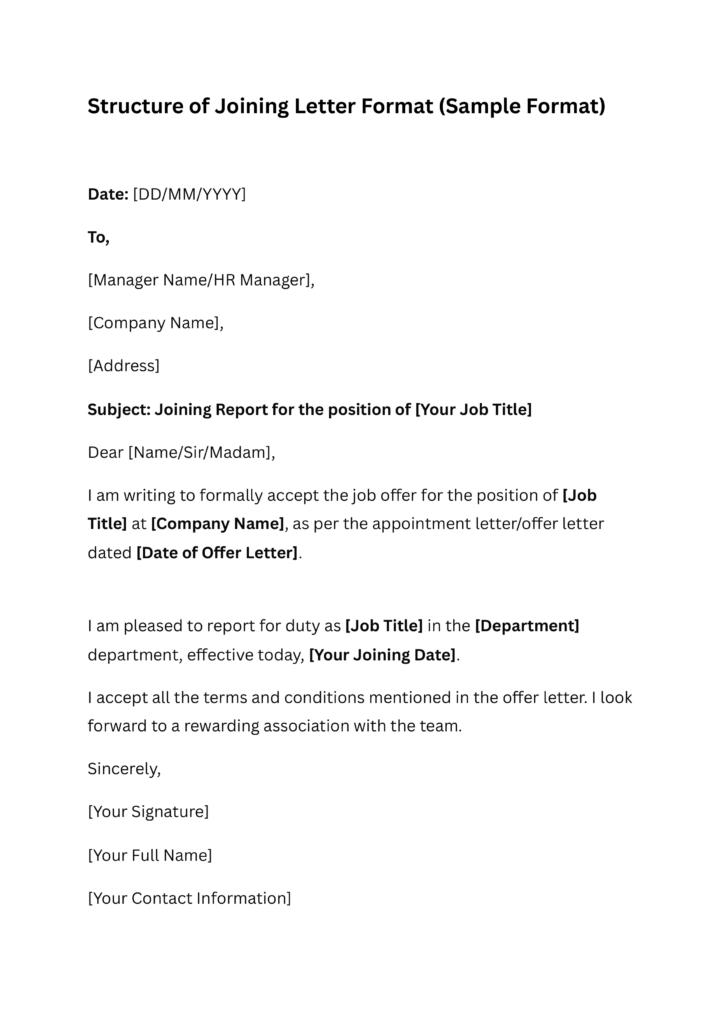
Structure of Joining Letter Format (Sample Format)
What are the Key Components of a joining letter format?
1. Employee Details
This portion will include the name, address, and contact details of the employee, which will confirm proper identification of the employee within the particular organization.
2. Date
This will mention the date on which the joining letter was written, which will ensure proper maintenance of dates within the organization.
3. Employer Details
This section will include the name, address, and contact details of the HR manager, which will ensure proper communication within the organization.
4. Subject Line
This portion will clearly mention the purpose of the letter, which will ensure proper identification of the letter by the HR team within the organization.
5. Joining Date
This section will provide the date from which the employee will join the organization, which is an important part of the joining letter.
6. Job Role
This will specify the role of the employee, which will confirm proper identification of the employee within the organization.
7. Body Content
This section will include the acceptance of the offer, the eagerness, and the commitment of the employee towards the responsibilities in a professional way.
8. Signature
This will ensure the authority of the joining letter, which will provide a formal touch to the joining letter format.
How to Write a Joining Letter Format (Step-by-Step)?
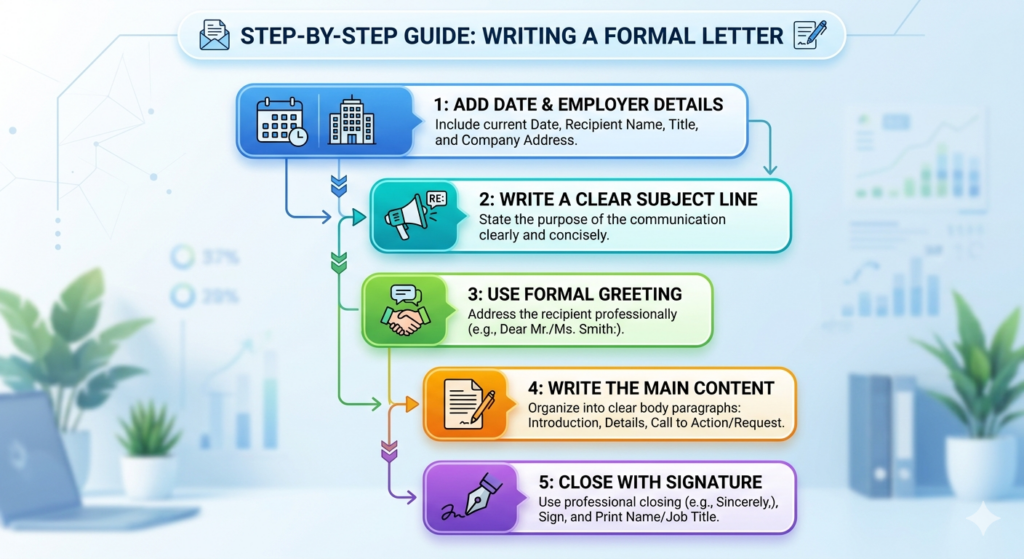
Step 1: Add Date and Employer Details
Firstly, the employee is required to provide the current date and employer details, including the HR manager, organization name, and official address.
Step 2: Write a Clear Subject Line
The candidate is required to write the subject line, such as “Joining Letter” and “Job Role,” to make it easy for HR teams to understand the purpose of the letter.
Step 3: Use a Formal Greeting
The candidate is required to use a formal greeting such as “Dear Sir/Madam” or the name of the HR manager.
Step 4: Write the Main Content
It is required to mention the acceptance of the job, joining date, and eagerness to work, while maintaining a formal, positive, and professional tone.
Step 5: Close with Signature
The writer is required to close the letter with a formal closing, followed by the full name and signature to ensure authenticity and maintain a professional tone.
What is the difference between a joining letter, Offer Letter & Appointment Letter?
| Basis | Joining Letter | Offer Letter | Appointment Letter |
| Definition | Employee’s confirmation of accepting the job and joining on the mentioned date. | Employer’s formal job offer with role, salary, and basic terms. | Official confirmation of employment with detailed terms and policies. |
| Issued By | Employee submits to HR or the employer. | Employer or HR issues with the selected candidate. | Employer issues after the employee joins. |
| Purpose | Confirms acceptance, joining date, and readiness to work. | Offers a job and highlights key employment details. | Confirms employment and defines complete terms and conditions. |
| Timing | After offer acceptance, before or on the joining day. | After selection, before the candidate joins. | After joining and onboarding completion. |
| Legal Value | Limited, mainly for record and communication. | Moderate; outlines agreed terms before employment. | High acts as an official employment agreement. |
| Key Content | Joining date, role, acceptance statement, signature. | Job role, salary, benefits, and basic terms. | Policies, responsibilities, salary structure, and compliance details. |
| HR Role | Starts onboarding and record creation in HRMS. | Initiates hiring and candidate confirmation process. | Finalizes employee records, payroll, and compliance. |
| Detail Level | Short and simple document. | Moderately detailed job offer document. | Detailed and complete employment document. |
What are the Tips to Create a Professional Joining Letter Format?
1. Use Clear Language
Always use simple and professional language to ensure clarity and eliminate confusion for the HR team while checking the format for the joining letter.
2. Keep It Concise
The content should be brief and to the point, without any unnecessary details, while including all important information to ensure proper documentation.
3. Maintain Formal Tone
The tone of the letter should be professional to reflect seriousness and commitment to the new role.
4. Double-Check Details
The details, such as the joining date, job title, and company name, should be double-checked to prevent any errors that may confuse.
5. Follow Proper Structure
The format for the joining letter should be followed to ensure consistency and make it easy for the HR team to process documents.
6. Use HR Software Tools
The use of modern technology, such as HR software or an HRMS, can help to ensure accuracy and accessibility for the joining letter.
Conclusion
Having a proper and well-structured joining letter format is essential to ensuring a smooth transformation from a candidate to an employee, while also maintaining clarity and professionalism in communication.
With the help of modern HRMS tools and software, organizations can effectively simplify the joining process, reduce errors, and improve the overall employee onboarding experience.
Simplify your onboarding and documentation with a free demo from Savvy HRMS, an all-in-one HR software solution for your organization!
FAQs
1. Is a joining letter mandatory in India?
Although a joining letter is not mandatory in India, it is highly recommended for smooth and efficient business operations.
2. Can a joining letter be sent through email?
Yes, a joining letter can be sent through email, and this is widely acceptable and commonly used in organizations, especially if an HRMS tool is used.
3. What are the components included in a joining letter format?
The components included are employee details, job offered, joining date, employer details, subject, and acceptance.
4. Who writes a joining letter?
The candidate writes a joining letter to express acceptance and confirmation to join the organization.
5. What is the difference between a joining letter and an appointment letter?
The main difference is that a joining letter is a confirmation letter, while an appointment letter is a confirmation letter sent by the organization to the employee.
6. How does HRMS help in managing a joining letter?
HRMS helps in managing a joining letter by storing documents digitally and ensuring easy access to these documents.