

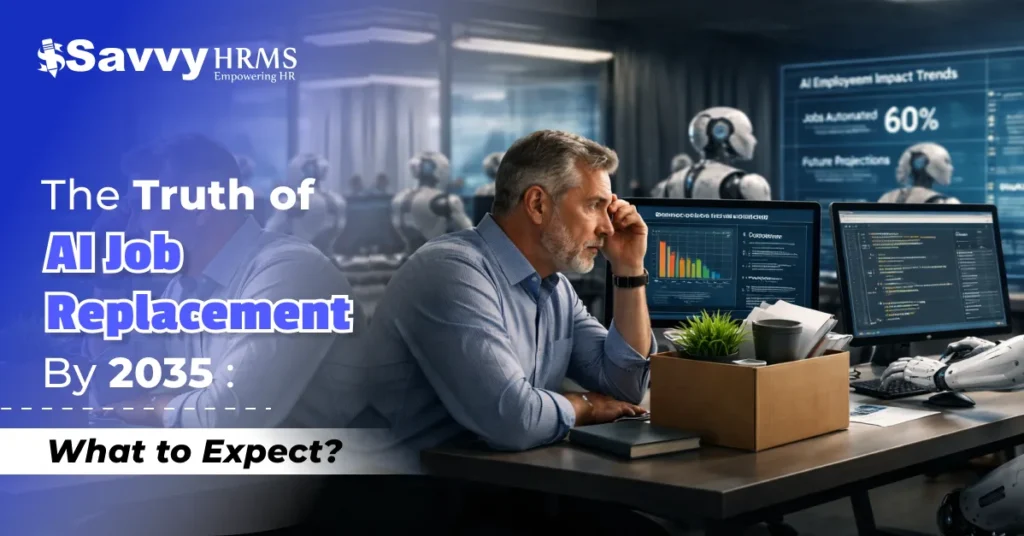
The Truth About AI Job Replacement by 2035: What to Expect?


-
AuthorRuchika Rajput
-
 Last Updated
May 12, 2026
Last Updated
May 12, 2026
-
 Reading Time
7 Mins
Reading Time
7 Mins
If an AI could do your job better, faster, and cheaper, would your employer still need you in 2035?
That question isn’t a science story anymore. AI is already reshaping workplaces at a speed nobody can predict. The shift is real, it’s happening right now, and most people are completely unprepared for what’s coming next.
But here’s the thing, AI replacing jobs isn’t the whole story. Some roles will disappear, sure. But others will develop, and entirely new careers will emerge.
The real question is: which side of that line will you be on?
This blog breaks it all down, including AI job replacement by 2035, no jargon, no panic, just the truth about AI, jobs, and your future.
Let’s get into it.
How Does AI Replace Jobs? Understanding the Key Factors
AI doesn’t just easily take over human jobs. It targets repetitive, rule-based, heavy data-based tasks, the kind of work where pattern identification and speed matter more than human judgment, creativity, or emotional intelligence.
The real disturbance happens when AI can perform entire job operations, not just a task, at a lower cost. When that threshold is crossed, businesses face serious economic pressure to automate, regardless of the human impact involved.
What AI Does Best vs. What Only Humans Can Do
| Where AI Wins | Where Humans Win |
| Processes millions of data points in seconds with zero issues | Reads emotions, builds trust, and navigates complex human relationships |
| Identifies patterns in complex datasets far beyond human capacity | Thinks ethically in grey-area situations requiring moral judgment |
| Automates repetitive administrative and related workflows efficiently | Creates truly original, context-driven art, strategy, and storytelling |
| Generates content, reports, and code at superhuman speed | Adapts fluidly to unexpected, chaotic, or completely novel situations |
| Works 24/7 without breaks, errors from tiredness, or salary demands | Provides physical care, touch, and human presence when it matters most |
| Translates, transcribes, and summarises documents instantly and accurately | Leads teams, inspires people, and drives meaningful cultural change |
Which Jobs Are Most Likely to Be Replaced by AI by 2035?
It doesn’t mean that every job is equally at risk. Roles built around routine, predictable tasks, especially those involving data processing or simple decision-making, face the highest automation warning in the next few years.
1. Data Entry Clerks & Administrative Assistants
AI already handles scheduling, email sorting, and data entry faster and more cheaply. These roles face near-total automation within the next few years.
2. Bank Tellers & Loan Processing Officers
Digital banking and AI credit scoring are making human-assisted financial transactions increasingly outdated for both retail and commercial sectors.
3. Manufacturing & Assembly Line Workers
Robotic systems with AI-powered vision and precision are quickly replacing manual assembly tasks in the automotive, electronics, and packaging industries globally.
4. Bookkeepers & Basic Accountants
AI tools like automated accounting software now handle invoicing, reconciliation, and tax filing, unexpectedly reducing demand for entry-level accounting roles.
5. Customer Support Representatives
Conversational AI and chatbots now resolve up to 80% of routine queries without human intervention, threatening millions of call centre jobs across the world.
6. Truck Drivers & Delivery Personnel
Independent vehicle technology is advancing fast. Long-pull trucking and last-mile delivery jobs face significant issues as self-driving logistics matures.
Quick Reference: AI Replacement Risk by 2035
| Job Role | Automation Risk | Key Reason | Timeline |
| Data Entry Clerk | Very High | Fully rule-based, repetitive tasks | Already underway |
| Bank Teller | Very High | Digital banking & AI transactions | 2025–2028 |
| Assembly Line Worker | Very High | Robotic precision & speed | 2025–2030 |
| Customer Support Rep | High | Conversational AI coverage | 2026–2030 |
| Bookkeeper | High | Automated accounting tools | 2026–2031 |
| Truck Driver | Medium–High | Autonomous vehicle rollout | 2029–2035 |
Which Jobs Will Transform but Not Disappear?
Most of the jobs will not disappear; they will develop. Roles that blend human judgment with AI tools will become more powerful, not outdated, by 2035.
1. Doctors & Medical Professionals
AI will handle diagnostics and imaging analysis, but doctors will focus on complex decisions, patient communication, and normal ethical care, roles AI simply can’t recreate.
2. Lawyers & Legal Professionals
AI will automate contract review and legal research, but human lawyers will still navigate courtrooms, client strategy, and complex legal arguments requiring judgment.
3. Graphic Designers & Creative Professionals
AI generates visuals fast, but skilled designers who direct AI tools and add strategic creative thinking will be in even higher demand than they are today.
4. Teachers & Educators
AI can personalize learning content, but teachers who mentor, inspire, and emotionally support students will remain important to meaningful human development.
5. Software Developers
AI writes code, yes, but developers who understand architecture, product thinking, and AI collaboration will be among the most valuable professionals through 2035.
6. Marketing & Brand Strategists
AI implements campaigns at scale, but marketers who understand human psychology, cultural complexities, and long-term brand building will lead the strategy side of growth.
Which Jobs Are Safe From AI Replacement?
Some professions are strongly human by nature. They require physical ability, emotional presence, moral judgment, or unpredictable real-world problem-solving, things AI still basically struggles with.
1. Skilled Tradespeople
Plumbers, electricians, and carpenters work in unpredictable physical environments that robots still cannot navigate reliably or cost-effectively.
2. Mental Health Professionals
Therapists, counsellors, and psychiatrists provide human empathy and trust-based healing that no AI can genuinely recreate in 2035.
3. Childcare & Early Education
Young children need human touch, physical interaction, and emotional bonding, deeply personal experiences that robots and AI simply cannot provide.
4. Performing Artists & Entertainers
Audiences crave authentic human expression in music, theatre, comedy, and live performance, a connection AI-generated content can’t genuinely create.
5. Construction Managers
Complicated site management, on-the-spot decision-making, and leadership of human teams require judgment and presence that AI tools cannot fully automate.
6. Caregivers & Social Workers
Elderly care, community support, and social service work depend on human dignity, compassion, and adaptability, qualities AI cannot genuinely possess or deliver.
How Can You Future-Proof Your Career Against AI?
Here’s the mindset shift you need right now: stop competing with AI and start learning to work with it. The professionals who thrive by 2035 won’t be those who resist AI; they will be the ones who control it.
The good news? You have time. But the window to adapt is closing faster than most people realize. Building the right skills now is the smartest investment you can make in your career this decade.
Important Skills to Develop Before 2035
1. AI Literacy & Prompt Engineering
Know how to use AI tools effectively, such as ChatGPT, Gemini, and Copilot. Being AI-fluent is the new basic computer literacy for every professional role.
2. Critical Thinking & Complex Problem-Solving
AI handles routine analysis. Humans who can address problems, challenge assumptions, and find non-obvious solutions will always be irreplaceable.
3. Emotional Intelligence (EQ)
The ability to identify, communicate with suggestion, and lead people through uncertainty is a skill AI cannot recreate, and it’s becoming more valuable, not less.
4. Data Interpretation & Digital Analytics
You don’t need to code, but understanding how to read data, draw insights, and make decisions from dashboards is now important across almost every industry.
5. Creative Thinking & Innovation
Original ideas, fresh perspectives, and breakthrough concepts are strongly human. Creativity paired with AI tools is one of the most powerful combinations in any field.
6. Adaptability & Lifelong Learning
The half-life of skills is shrinking. Those who stay curious, embrace change, and continually upskill across their entire career will always stay ahead of automation.
7. Leadership & Human Collaboration
Managing people, building culture, and navigating office politics require trust and relationship-building, uniquely human skills that grow more importantly as AI expands.
Conclusion
AI job replacement by 2035 is not a terrifying myth; it’s a real economic shift already unfolding. But it’s also not the end of human work. It’s a redefinition of what work means and what makes us valuable.
So here’s the real question worth sitting with: Are you building skills that AI complements, or skills that AI replaces?
The future belongs to those who adapt early, stay curious, and choose to develop. Whether you are a student, a mid-career professional, or a business owner, the best time to future-proof yourself against AI disruption is right now, not 2034.