Still spending days every month tracking attendance sheets, correcting salary errors, and worrying about compliance deadlines? Don’t worry, you are not alone. This blog unpacks how intelligent salary processing is quietly developing the way modern organizations handle payroll.
Think about what is truly at issue. A single payroll error can damage employee trust overnight. Outdated processes cost HR teams many hours annually. The pain is real, and so is the solution that thousands of forward-thinking businesses are already embracing.
Here is the good news: AI-powered payroll software is making all of this significantly simpler. Faster processing, zero manual errors, real-time compliance, and happier employees, intelligent salary processing delivers all of it, starting from day one.
What is Intelligent Salary Processing in Modern Payroll Systems?
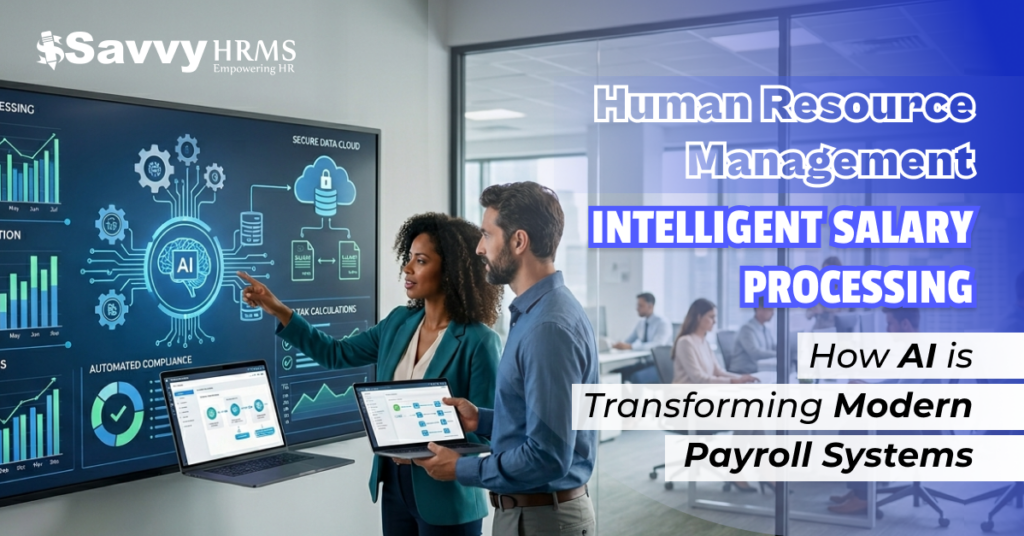
Intelligent salary processing refers to using artificial intelligence and automation to manage end-to-end payroll functions. It takes data from attendance management software, leave management software, and HR platforms to calculate correct salaries, completely without manual effort.
Unlike outdated payroll methods, intelligent salary processing learns from historical patterns, addresses errors instantly, and applies real-time tax and compliance rules. It converts payroll from a stressful administrative task into a smooth, data-driven business function.
How Does AI Fit into Salary Processing and Payroll Management?
So where exactly does AI step in, and how deeply does it actually change things? The answer might surprise you. AI integrates itself across various layers of payroll management, connecting employee data with financial systems for smarter, faster, and more reliable salary processing.
1. Automated Data Integration
AI takes real-time data directly from attendance management software and HR platforms, removing manual transfers and ensuring payroll inputs are always correct and up to date.
2. Intelligent Tax Computation
AI automatically calculates taxes, deductions, and statutory contributions based on the latest regulations, minimizing compliance errors and keeping your business audit-ready anytime.
3. Predictive Payroll Analytics
Machine learning models forecast payroll costs, identify budget overuse, and deliver actionable workforce cost insights to leadership well before each pay cycle closes.
4. Leave and Absence Management
AI integrates with leave management software to automatically point approved leaves, unpaid absences, and carry-forwards into final salary calculations, no manual entry required.
5. Real-Time Error Detection
AI algorithms continuously scan payroll data for inconsistencies, duplicate entries, and deviations, addressing potential errors before they ever reach an employee’s paycheck.
6. Natural Language Processing for HR Queries
Employees can simply ask a chatbot about their payslips, leave balances, or deductions, reducing HR helpdesk load and generally improving the everyday employee experience.
7. Continuous Compliance Monitoring
AI tracks developing labor laws and tax regulations, automatically updating payroll software rules so your business stays compliant without any manual policy maintenance in any case.
How Does AI Automate Salary Calculations and Payroll Tasks?
1. Dynamic Salary Component Calculation
AI calculates basic pay, allowances, bonuses, and overtime automatically using predefined rules, employee grades, and real-time attendance data from integrated workforce management systems.
2. Automated Payslip Generation
Once salary components are calculated, AI instantly generates detailed, correct payslips for every employee, eliminating manual document preparation and reducing administrative burden significantly.
3. Bank Transfer Processing
AI-powered payroll software automatically schedules and initiates direct bank transfers, ensuring every employee receives their salary on time without any finance team disturbances.
4. Statutory Deduction Management
Provident fund, ESI, professional tax, and TDS are calculated and applied automatically, keeping payroll fully compliant with statutory requirements across all employee types and grades.
5. Multi-Location Payroll Handling
AI simultaneously manages payroll for various locations, applying location-specific salary rules, tax laws, and labor regulations without any additional manual configuration from HR teams.
6. Year-End Processing Automation
Form 16 generation, annual tax reconciliation, and year-end compliance reports are handled automatically, saving HR teams weeks of exhausting manual effort during financial year closure.
What are the Key Features of Intelligent Salary Processing?
1. Smooth Attendance Integration
Intelligent systems connect directly with attendance management software, taking correct daily hours, overtime, and shift data for accurate salary computation every single pay cycle.
2. Leave Management Synchronization
Deep integration with leave management software ensures approved leaves, loss-of-pay deductions, and leave encashments are automatically reflected in every employee’s monthly salary processing.
3. Configurable Salary Structures
HR teams can design flexible, role-based salary structures with different components, easily customizing compensation packages for different employee grades, departments, and business units.
4. Real-Time Compliance Engine
A built-in compliance engine monitors tax laws and labor regulations continuously, automatically applying updated rules so your payroll software always produces legally compliant, error-free outputs.
5. AI-Powered Anomaly Detection
Machine learning models identify unusual salary patterns, duplicate entries, and suspicious deductions, alerting HR leaders before errors impact financial statements or trigger employee complaints.
6. Employee Self-Service Portal
Employees independently access payslips, tax forms, and leave balances through an employee self-service portal, reducing HR query volumes while giving teams complete, transparent salary information anytime.
7. Complete Audit Trails
Every salary transaction, approval, and modification is logged with full timestamps, providing complete audit trails that simplify compliance reporting and strengthen internal financial governance.
8. Advanced Reporting and Analytics
Intelligent payroll software generates detailed cost-center reports, headcount analysis, and compensation standard data, empowering HR leadership with the insights needed for strategic employee planning.
How Does AI Reduce Payroll Errors and Compliance Risks?
Ask any HR professional what keeps them up at night, and payroll errors will most of the time always top the list. A single miscalculation in tax laws or attendance data can activate costly penalties, dissatisfied employees, and time-consuming corrections that derail entire teams.
AI removes these vulnerabilities by confirming every payroll input against predefined rules before processing even begins. It cross-checks attendance, leave records, and compensation data in real time, ensuring accuracy and compliance long before salaries are distributed
Intelligent salary processing reduces payroll errors and compliance risks, as it can:
- Automatically addresses missing or inconsistent attendance data before pay runs start.
- Confirms all tax calculations against the latest available regulatory frameworks.
- Prevents duplicate payment processing through intelligent, real-time data reconciliation.
- Sends instant reminders when salary components fall outside expected or approved ranges.
- Maintains auto-updated compliance rules without requiring any manual policy changes.
- Generates statutory reports correctly, significantly reducing organizational audit risk
Why Should Businesses Adopt Intelligent Salary Processing Today?
Here is a fair question worth asking: if your current payroll process is getting the job done, why change anything at all? The honest answer is, in today’s world of distributed and hybrid teams, complex compliance landscapes, and sky-high employee expectations, “getting it done” is simply no longer good enough.
1. Significant Cost Reduction
Automating payroll functions reduces dependency on large administrative teams, cutting overhead costs while simultaneously improving accuracy and speed across all monthly pay cycles.
2. Faster Payroll Cycles
AI processes salary calculations in minutes rather than days, freeing HR teams to close payroll faster and redirect valuable time toward strategic workforce management and planning initiatives.
3. Improved Employee Trust
Accurate, on-time salary payments directly build employee confidence and satisfaction, contributing to stronger retention rates and a measurably more positive overall workplace culture.
4. Scalable for Business Growth
AI-powered payroll software scales effortlessly as headcount grows, managing hundreds or thousands of employees without any proportional increase in administrative effort or error probability.
5. Proactive Compliance Management
Businesses automatically stay ahead of regulatory changes, reducing the risk of expensive penalties that come from outdated tax calculations or non-compliant statutory deduction practices.
How Can Your Organization Get Started with AI-Powered Payroll Systems?
Step 1: Audit Your Current Payroll Process
Point out existing workflows, identify manual issues, and document recurring errors to address exactly where AI-powered payroll automation will deliver the greatest and most immediate impact.
Step 2: Define Integration Requirements
Identify every system needing connection, including attendance management software, leave management software, ERP, and accounting platforms, to ensure smooth, uninterrupted data flow organization-wide.
Step 3: Choose the Right Payroll Software
Evaluate vendors on AI capabilities, compliance depth, scalability, and integration breadth. Prioritize platforms offering full automation from data capture all the way through to salary distribution.
Step 4: Configure Salary Structures and Rules
Collaborate with HR and finance teams to configure employee-specific salary structures, tax components, and deduction rules within the new system before initiating any live payroll processing.
Step 5: Run Parallel Payroll Cycles
Process payroll simultaneously on both old and new systems during transition, comparing outputs carefully to validate accuracy and build organizational confidence before committing to full change.
Step 6: Train HR Teams and Employees
Deliver role-specific training for HR administrators and introduce employees to the self-service portal, ensuring smooth adoption and maximum utilization of every intelligent payroll feature available.
Conclusion
Payroll will always be one of the most important responsibilities any business carries, because behind every salary figure is a real person who depends on it. Intelligent salary processing ensures that responsibility is met with the speed, accuracy, and compliance it genuinely deserves.
If your organization is ready to move beyond spreadsheets and manual headaches, Savvy HRMS brings together AI-powered payroll software, attendance management software, and leave management software in one simplified, merged platform, designed to make intelligent salary processing simple, scalable, and stress-free for businesses at every stage of growth. Your smarter payroll journey starts today. Schedule a free Savvy HRMS demo and see intelligent salary processing in action.