

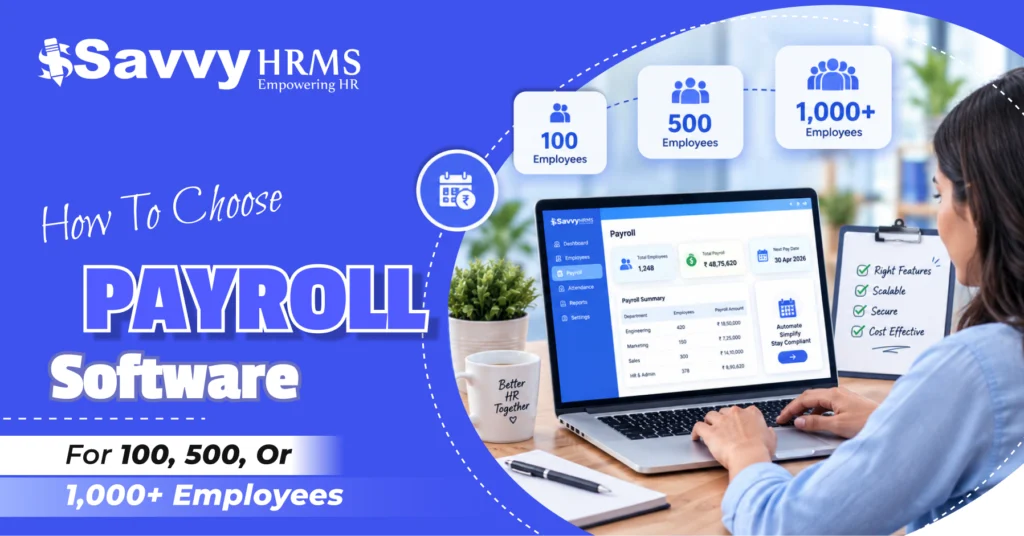
How to Choose Payroll Software for 100, 500, or 1,000+ Employees


-
AuthorSalilendra Kumar
-
 Last Updated
September 14, 2026
Last Updated
September 14, 2026
-
 Reading Time
15 Mins
Reading Time
15 Mins
Choosing payroll software becomes increasingly important as a business grows. But how do you know whether a payroll system that works for 100 employees will still be effective at 500 or 1,000+ employees?
The right payroll software should do more than calculate salaries. It should automate payroll processing, manage attendance and leave inputs, handle statutory compliance, reduce errors, provide accurate reports, protect employee data, and scale as your workforce grows.
Whether you have 100, 500, or 1,000+ employees, payroll requirements can differ significantly. Payroll software for 100, 500, or 1,000+ employees should therefore be selected based on workforce size, payroll complexity, compliance requirements, automation needs, integrations, security, and long-term scalability.
This guide explains how to choose payroll software for 100, 500, or 1,000+ employees, what features to evaluate, how much payroll software may cost, and which questions businesses should ask before investing in a payroll management system.
How to Choose Payroll Software for 100, 500, or 1,000+ Employees
The best payroll software is not necessarily the one with the most features. It is the one that matches your current payroll requirements while giving you enough flexibility to handle future workforce growth.
For example, a company with 100 employees may primarily need automated salary calculations, attendance integration, payslip generation, and statutory compliance. A company with 500 employees may require advanced workflows, employee self-service, multiple salary structures, integrations, and detailed payroll reports.
At 1,000+ employees, payroll becomes a high-volume and highly structured operation. Businesses may need multi-location payroll, role-based access, automated approvals, advanced reporting, integrations with attendance and HR systems, and stronger controls for payroll security.
Step 1: Identify Your Current and Future Employee Count
Start by identifying your current workforce size and expected growth over the next two to three years.
Do not select payroll software only according to your present employee count. If your organization has 100 employees today but expects to reach 500 employees soon, the system should be able to accommodate that growth without requiring a complete migration.
Step 2: Understand Your Payroll Process
Map your existing payroll process before evaluating software.
Consider:
- Salary components and structures
- Attendance and working days
- Leave deductions
- Overtime
- Bonuses and incentives
- Reimbursements
- Loans and salary advances
- Arrears
- Full and final settlement
- Payslip generation
- Statutory deductions
- Payroll reports
- Employee self-service
This helps you identify which processes should be automated.
Step 3: Check Indian Payroll Compliance
For Indian businesses, payroll software should support applicable statutory requirements such as Provident Fund (PF), Employee State Insurance (ESI), Tax Deducted at Source (TDS), Professional Tax (PT), Labour Welfare Fund (LWF), and other applicable payroll compliance requirements.
The exact compliance requirements can vary based on employee salary, location, establishment type, and applicable regulations.
Step 4: Evaluate Scalability
Ask whether the payroll system can handle a larger workforce without slowing down or creating unnecessary administrative work.
Scalability should cover not only employee numbers but also:
- Multiple locations
- Multiple departments
- Multiple salary structures
- Complex approval workflows
- Increased payroll transactions
- Additional HR modules
- Third-party integrations
- Higher reporting requirements
Step 5: Compare Automation and Integrations
Payroll should ideally connect with attendance, leave, employee management, expense, performance, and other HR processes.
The more payroll inputs can flow automatically into the system, the less manual data entry HR teams need to perform.
Step 6: Calculate the Total Cost of Ownership
Do not compare payroll software only by subscription price.
Consider implementation, migration, employee onboarding, integrations, support, customization, training, and future upgrades when calculating the overall cost.
Quick answer: To choose payroll software for 100, 500, or 1,000+ employees, evaluate employee capacity, payroll automation, Indian statutory compliance, integrations, security, reporting, implementation, support, pricing, and scalability.
Payroll Software Requirements by Employee Size: 100 vs. 500 vs. 1,000+
Payroll requirements change as employee numbers increase. A small workforce may be manageable with relatively simple payroll processes, while larger organizations need greater automation, controls, and scalability.
| Requirement | 100 Employees | 500 Employees | 1,000+ Employees |
| Automated salary calculation | Essential | Essential | Critical |
| Attendance integration | Useful | Essential | Essential |
| Leave integration | Useful | Essential | Essential |
| Statutory compliance | Essential | Critical | Critical |
| Employee self-service | Useful | Essential | Critical |
| Multiple salary structures | Useful | Essential | Critical |
| Multi-location payroll | Optional | Useful | Essential |
| Advanced payroll reports | Useful | Essential | Critical |
| Workflow automation | Basic | Advanced | Advanced |
| Role-based access | Essential | Essential | Critical |
| Payroll integrations | Useful | Essential | Critical |
| Bulk payroll processing | Useful | Essential | Critical |
| Scalability | Moderate | High | Very High |
| Advanced analytics | Optional | Useful | Essential |
1. Payroll Software for 100 Employees
For around 100 employees, businesses should focus on simplicity, automation, compliance, and ease of use.
The payroll system should automate salary calculations and deductions while reducing repetitive administrative work. Integration with attendance and leave management can also prevent HR teams from manually transferring payroll inputs.
Important features include:
- Automated payroll processing
- Attendance and leave integration
- PF, ESI, TDS, and applicable PT calculations
- Payslip generation
- Employee self-service
- Payroll reports
- Salary revision management
- Full and final settlement
- Basic role-based access
For a 100-employee company, usability is particularly important. HR teams should not require extensive technical knowledge to run monthly payroll.
2. Payroll Software for 500 Employees
At 500 employees, payroll becomes more complex because the workforce may include different departments, locations, salary structures, shifts, allowances, deductions, and approval processes.
Businesses should look for:
- Advanced payroll automation
- Multiple salary structures
- Attendance integration
- Leave and overtime integration
- Automated statutory calculations
- Employee self-service
- Reimbursement integration
- Salary revision workflows
- Advanced reporting
- Role-based access
- Multiple-location support
- API and third-party integrations
At this stage, reducing manual intervention becomes increasingly important. Even a small payroll error repeated across hundreds of employees can create significant administrative work.
3. Payroll Software for 1,000+ Employees
Payroll software for 1,000+ employees needs to be designed for high-volume payroll processing and organizational complexity.
Organizations should prioritize:
- High-volume payroll processing
- Strong payroll automation
- Multi-location support
- Multiple salary structures
- Complex payroll rules
- Advanced approval workflows
- Role-based access controls
- Detailed payroll analytics
- Employee self-service
- Automated compliance management
- Integration capabilities
- Audit trails
- Strong data security
- Scalable infrastructure
At this workforce size, payroll is no longer just a monthly calculation process. It becomes a critical business operation that requires reliability, security, automation, and clear accountability.
What Features Should You Look for in Payroll Software for Growing Businesses?
Growing businesses need payroll software that can develop with their workforce.
The following features should be considered essential when evaluating payroll management software.
1. Automated Payroll Processing
Payroll automation should calculate earnings, deductions, taxes, reimbursements, overtime, and other salary components according to configured rules.
Automation reduces repetitive manual calculations and helps HR teams process payroll more efficiently.
2. Attendance and Leave Integration
Payroll depends heavily on accurate attendance and leave information.
Integration between attendance, leave management, and payroll ensures that working days, absences, overtime, and leave deductions can flow into payroll automatically.
3. Statutory Compliance
Payroll software should support applicable Indian payroll compliance requirements, including PF, ESI, TDS, Professional Tax, and other relevant deductions and contributions.
Automated compliance calculations can reduce the risk of errors caused by manual calculations.
4. Employee Self-Service
Employee self-service allows employees to access information such as:
- Payslips
- Salary details
- Tax information
- Leave information
- Attendance records
- Personal information
This can reduce routine HR queries and improve employee access to payroll information.
5. Payroll Reports and Analytics
Payroll reports help HR and finance teams understand salary costs, deductions, employer contributions, department-wise expenses, and other payroll information.
As employee numbers grow, reporting becomes more important for budgeting and workforce planning.
6. Multiple Salary Structures
Organizations may have different salary structures for departments, job levels, locations, or employee categories.
Payroll software should allow businesses to configure different salary components without creating unnecessary manual work.
7. Full and Final Settlement
A complete payroll system should support employee exits and full and final settlement, including applicable salary calculations, deductions, leave encashment, reimbursements, and other configured components.
8. Role-Based Access
Payroll information is sensitive. HR, finance, managers, administrators, and employees may require different levels of access.
Role-based access ensures users can access only the information relevant to their responsibilities.
9. Integrations
A growing organization may use multiple business systems. Payroll software should integrate with HRMS, attendance systems, accounting platforms, expense management systems, banking systems, or other relevant applications.
10. Audit Trails
Audit trails help organizations understand who made a change, what was changed, and when the change occurred.
This is especially useful when payroll is managed by multiple HR and finance users.
How to Evaluate Payroll Software for Scalability and Performance?
Scalability means the payroll system can support business growth without requiring organizations to constantly replace or redesign their payroll process.
When evaluating payroll software, do not ask only, “How many employees can it support?” Ask how the system performs as employee count, transactions, locations, payroll rules, and integrations increase.
1. Evaluate Employee Capacity
Confirm the vendor’s supported employee capacity and whether the system can accommodate future growth.
A company with 100 employees should consider whether the same system can support 500 or 1,000 employees if the organization expands.
2. Evaluate Payroll Processing Performance
Ask how the software handles bulk salary processing.
Important questions include:
- Can payroll be processed for all employees in one cycle?
- How quickly can payroll calculations be completed?
- Can payroll be recalculated after changes?
- Can the system handle large amounts of payroll data?
- Can reports be generated without affecting system performance?
3. Evaluate Multi-Location Support
Growing organizations often expand across cities, states, or regions.
Payroll software should support different locations and applicable statutory requirements while allowing HR teams to manage payroll centrally.
4. Evaluate Workflow Scalability
As organizations grow, payroll approvals can become more complicated.
Look for configurable workflows for:
- Salary revisions
- Reimbursements
- Payroll approval
- Employee changes
- Overtime
- Full and final settlement
5. Evaluate Integration Scalability
The system should be capable of connecting with other HR and business applications as your technology ecosystem grows.
Payroll software is scalable when it can support increasing employees, payroll transactions, locations, salary structures, workflows, integrations, and reporting requirements without significantly increasing manual effort.
How Important Are PF, ESI, TDS, Professional Tax, and Other Compliance Features?
Payroll compliance is one of the most important factors when choosing payroll software in India.
Incorrect statutory calculations can lead to payroll corrections, employee dissatisfaction, additional administrative work, and potential compliance issues. Therefore, businesses should verify whether the software supports the statutory requirements applicable to their organization.
1. Provident Fund (PF)
Payroll software should support applicable PF calculations and contributions based on configured employee and employer requirements.
2. Employee State Insurance (ESI)
For eligible employees and establishments, payroll software should help calculate and manage applicable ESI contributions.
3. Tax Deducted at Source (TDS)
TDS calculation is an important part of payroll processing. The software should support applicable tax calculations and relevant payroll reporting.
4. Professional Tax
Professional Tax requirements vary by state. Businesses operating across multiple states should verify that their payroll software supports the applicable state-specific requirements.
5. Labour Welfare Fund
Where applicable, payroll systems should support Labour Welfare Fund deductions and contributions according to relevant state requirements.
6. Compliance Updates
Indian payroll rules can change. Businesses should therefore ask vendors how statutory updates are handled and how quickly applicable changes are incorporated into the software.
Key takeaway: Compliance should not be treated as an optional payroll feature. For Indian organizations, the ability to accurately manage applicable PF, ESI, TDS, Professional Tax, LWF, and other statutory requirements should be a core evaluation criterion.
How Much Does Payroll Software Cost for 100, 500, or 1,000+ Employees?
There is no single price for payroll software because vendors use different pricing models.
Payroll software pricing may depend on:
- Number of employees
- Number of users
- Number of modules
- Payroll frequency
- Locations
- Implementation requirements
- Integrations
- Customization
- Support requirements
- Reporting and analytics
- Additional HR modules
1. Payroll Software Cost for 100 Employees
A 100-employee business generally has fewer payroll transactions and simpler organizational structures. However, businesses should still consider whether the pricing model allows employee growth without becoming disproportionately expensive.
2. Payroll Software Cost for 500 Employees
At 500 employees, organizations may require additional automation, integrations, workflows, and reporting capabilities.
Pricing should therefore be evaluated against the time and administrative effort the software can save.
3. Payroll Software Cost for 1,000+ Employees
For 1,000+ employees, enterprise payroll pricing may depend on workforce size, locations, integrations, implementation requirements, security, customization, and support.
Rather than choosing the lowest-cost option, organizations should calculate total cost of ownership (TCO).
A useful TCO calculation can include:
Software subscription + implementation + migration + integrations + training + support + customization = Total Cost of Ownership
The most affordable payroll software is not always the cheapest subscription. A system that requires extensive manual work may cost more in HR and finance resources over time.
Cloud Payroll Software vs. On-Premise Payroll Software: Which Is Better for Growing Businesses?
| Feature | Cloud Payroll Software | On-Premise Payroll Software |
| Deployment | Hosted online | Installed on company servers |
| Accessibility | Remote access | Primarily internal access |
| Scalability | Easy to scale | Requires infrastructure upgrades |
| Cost | Lower upfront cost | Higher infrastructure cost |
| Maintenance | Vendor-managed | Organization-managed |
| Updates | Automatic/centralized | Usually manually managed |
| Compliance Updates | Typically vendor-supported | Often requires internal updates |
| Data Backup | Usually provider-managed | Organization-managed |
| Integrations | Easy cloud integrations | May require additional setup |
| Implementation | Faster deployment | Generally more time-consuming |
| IT Requirements | Lower | Higher |
| Best For | Growing businesses | Organizations needing greater infrastructure control |
Which Should Growing Businesses Choose?
For many businesses that expect rapid workforce growth, cloud payroll software can provide a more flexible and scalable approach.
However, the right choice depends on an organization’s security requirements, IT strategy, infrastructure, budget, regulatory environment, and internal capabilities.
When comparing cloud and on-premises payroll software, evaluate security, scalability, accessibility, backup procedures, integrations, support, and long-term costs rather than focusing only on deployment type.
What Security and Data Protection Features Should Payroll Software Have?
Payroll systems handle highly sensitive employee information, including salary details, bank information, tax information, deductions, and personal data.
Therefore, payroll security should be a major consideration during software selection.
1. Role-Based Access Control
Role-based access control ensures employees, HR teams, managers, and payroll administrators access only relevant information. It protects sensitive salary data, reduces unauthorized access, and provides better control over payroll information across growing organizations.
2. Data Encryption
Data encryption protects sensitive payroll information while it is transmitted and stored. Businesses should choose payroll software that uses appropriate encryption practices to safeguard employee salaries, bank details, tax information, and personal records.
3. Secure Authentication
Secure authentication helps prevent unauthorized users from accessing payroll systems and sensitive employee information. Businesses should look for strong login controls, multi-factor authentication, password policies, and other security measures that strengthen overall payroll protection.
4. Audit Logs
Audit logs record important activities and changes made within payroll software. They help organizations track user actions, identify unauthorized changes, investigate issues, maintain accountability, and improve transparency throughout the payroll management process effectively.
5. Backup and Recovery
Reliable backup and recovery mechanisms help protect payroll data from accidental deletion, system failures, or unexpected incidents. Businesses should understand backup frequency, recovery procedures, data restoration capabilities, and the provider’s disaster recovery strategy.
6. Data Privacy
Payroll software handles sensitive employee information, making data privacy an important consideration. Businesses should understand how employee data is collected, stored, processed, accessed, retained, and protected throughout the software’s lifecycle securely.
7. Vendor Security Practices
Before selecting payroll software, businesses should evaluate the vendor’s security policies, infrastructure, access controls, incident response procedures, security certifications, and data protection practices to understand how effectively sensitive payroll information is protected.
Payroll software should protect employee data through role-based access, authentication controls, encryption, audit logs, secure backups, controlled data access, and appropriate data protection practices.
How Easy Is It to Implement Payroll Software for 100, 500, or 1,000+ Employees?
Payroll implementation becomes more complex as employee numbers increase.
A successful implementation should include planning, data migration, configuration, testing, training, and payroll validation.
1. For 100 Employees
Implementation can often be relatively straightforward if employee records and salary structures are organized.
Businesses should prepare:
- Employee master data
- Salary structures
- Bank information
- Tax details
- Attendance records
- Leave balances
- Applicable statutory information
2. For 500 Employees
At 500 employees, organizations should pay more attention to data quality, department structures, salary variations, attendance integration, workflows, and user roles.
A phased implementation can reduce disruption.
3. For 1,000+ Employees
Large organizations should use a structured implementation plan.
Important steps include:
- Payroll process mapping
- Data cleansing
- Employee data migration
- Salary structure configuration
- Compliance configuration
- Attendance and leave integration
- Workflow configuration
- Role and access setup
- Testing
- Parallel payroll validation
- User training
- Go-live
- Post-implementation support
What Should You Ask the Vendor About Implementation?
Ask:
- Who manages implementation?
- Is data migration included?
- How long does implementation generally take?
- Is employee training provided?
- Is payroll testing included?
- Is post-go-live support available?
- Can the system integrate with existing HR tools?
- What happens if the organization grows significantly after implementation?
A payroll platform may have excellent features, but poor implementation can prevent organizations from realizing its full value.
What Questions Should You Ask Before Buying Payroll Software?
Before purchasing payroll software, HR and finance teams should evaluate the product from both current and future requirements.
Here are important questions to ask:
- How many employees can the software support?
- Does it support Indian payroll compliance?
- Can payroll integrate with attendance and leave?
- Can it handle multiple salary structures?
- Does it support multiple locations?
- Does it provide employee self-service?
- How secure is employee payroll data?
- Can the software integrate with other applications?
- How are statutory updates handled?
- What support is included?
- What is the total cost?
- Can the software grow with the business?
A payroll system should be able to support increasing employee numbers and complexity without forcing the organization to change platforms every few years.
Conclusion
Choosing payroll software for 100, 500, or 1,000+ employees requires more than comparing prices or feature lists. Businesses should evaluate payroll automation, compliance, integrations, employee self-service, security, reporting, implementation, and scalability based on their workforce size.
For growing organizations, the ideal payroll management software should simplify salary processing today while remaining capable of supporting future workforce expansion, multiple locations, complex payroll structures, and increasing compliance requirements.
The right payroll software can reduce manual work, improve payroll accuracy, strengthen compliance processes, and give HR and finance teams better control over employee payroll. Businesses should therefore select a solution based on long-term value, reliability, scalability, and ease of use.

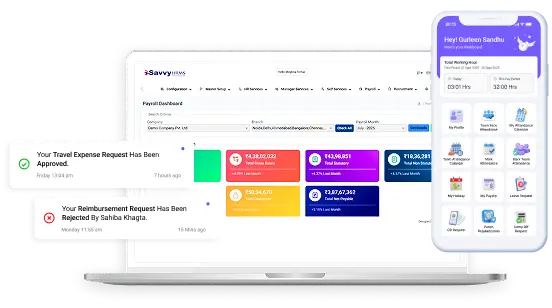









Secure your payroll today with reliable, scalable payroll software built for growing businesses.
Frequently Asked Questions (FAQs)
1. How do I choose payroll software for 100 employees?
Choose payroll software that offers automated salary processing, attendance and leave integration, statutory compliance, payslip generation, employee self-service, reporting, and scalability for future workforce growth.
2. What payroll software features are important for 500 employees?
For 500 employees, prioritize payroll automation, multiple salary structures, attendance integration, statutory compliance, employee self-service, advanced reporting, role-based access, workflow automation, and third-party integrations.
3. What should I look for in payroll software for 1,000+ employees?
Businesses with 1,000+ employees should prioritize high-volume payroll processing, scalability, multi-location support, advanced automation, compliance management, role-based access, integrations, audit trails, analytics, and strong data security.