



The best HRMS software for real estate companies should help manage employees, field teams, attendance, payroll, recruitment, compliance, performance, and multiple locations from one centralized platform. For real estate businesses, the right HRMS can reduce administrative work while giving HR teams better control over a distributed workforce.
Real estate companies often manage employees across corporate offices, project sites, sales teams, construction locations, and customer-facing operations. This makes attendance, leave, payroll, employee records, and workforce coordination more complex than in a conventional office environment.
A modern HRMS software for real estate companies in India brings these processes together. Instead of depending on spreadsheets, disconnected attendance systems, and manual payroll processes, HR teams can automate repetitive tasks and provide employees with self-service access to essential HR services.
In this blog, we compare 8 leading HRMS platforms based on functionality, real estate suitability, payroll and compliance capabilities, workforce management, scalability, integrations, and overall usability.
How Did We Rank These HRMS Software for Real Estate Companies?
We evaluated the HRMS platforms using criteria that matter particularly to real estate organizations. Since real estate businesses commonly have field employees, multiple project locations, different shifts, sales teams, and complex payroll requirements, workforce management and attendance capabilities receive significant weight.
| Ranking Criteria | Weightage |
| Core HR & Employee Management | 15% |
| Attendance, GPS & Field Workforce Management | 15% |
| Payroll & Statutory Compliance | 15% |
| Recruitment & Onboarding | 10% |
| Performance & Workforce Management | 10% |
| Leave, Shift & Time Management | 10% |
| Integrations & Scalability | 10% |
| Employee Self-Service & Mobile Accessibility | 5% |
| Reporting, Analytics & Ease of Use | 5% |
| Implementation & Support | 5% |
| Total | 100% |
This ranking is intended as a practical buying guide rather than a universal product score. The best HRMS depends on employee size, locations, existing systems, payroll requirements, and the complexity of field operations.
At a Glance
| Rank | HRMS Software | Best For | Overall Fit |
| 1 | Savvy HRMS | End-to-end HR, payroll, attendance, and field workforce management | ⭐⭐⭐⭐⭐ |
| 2 | Darwinbox | Large enterprises and complex workforce management | ⭐⭐⭐⭐½ |
| 3 | Keka HR | Growing companies seeking configurable HR and attendance | ⭐⭐⭐⭐½ |
| 4 | greytHR | Payroll, compliance and employee administration | ⭐⭐⭐⭐ |
| 5 | Zoho People | Businesses wanting HR with broader business integrations | ⭐⭐⭐⭐½ |
| 6 | Zimyo | Flexible HR, payroll and workforce management | ⭐⭐⭐⭐ |
| 7 | ZingHR | Integrated HR, payroll and workforce management | ⭐⭐⭐⭐ |
| 8 | PeopleStrong | Large organizations and enterprise HCM | ⭐⭐⭐⭐ |
8 Best HRMS Software for Real Estate Companies
1. Savvy HRMS
Overview
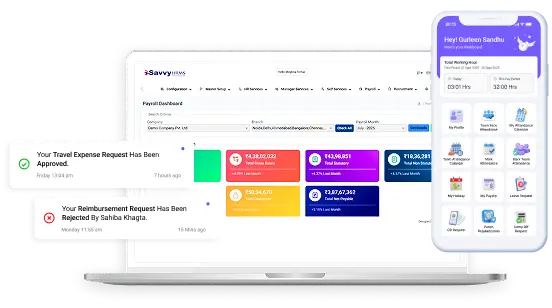
Savvy HRMS is an integrated HRMS platform designed to manage core HR, recruitment, attendance, leave, payroll, statutory compliance, performance, learning, travel and expenses, and employee-related processes from one system. Its broad module coverage makes it suitable for companies managing diverse and distributed workforces.
For real estate organizations, Savvy HRMS can be particularly useful where employees work across offices, project locations, sales teams, and field environments. Its mobile capabilities, attendance management, payroll, employee assets, task management, travel and expense, and compliance modules can help centralize workforce administration.
Key Features of Savvy HRMS
- Core HR: Centralizes employee information, workflows, documents, and essential workforce records.
- Attendance Management: Tracks employee attendance with configurable policies, shifts, and approval workflows.
- AI Face Recognition: Supports mobile attendance with face recognition, geofencing, and anti-spoofing capabilities.
- Payroll Management: Automates salary processing and connects payroll with attendance and employee information.
- Statutory Compliance: Helps HR teams manage statutory processes and compliance-related reporting.
- Recruitment Management: Supports candidate sourcing, hiring workflows, onboarding, and offer management.
- Performance Management: Helps organizations establish KPIs, feedback processes, reviews, and appraisal workflows.
- Travel & Expense: Manages business travel requests, expenses, approvals, and reimbursements.
- Employee Assets: Helps track organizational assets assigned to employees across locations.
Savvy HRMS currently presents 20+ modules, including Core HR, recruitment, attendance, leave, payroll, statutory compliance, performance, learning and development, travel and expense, helpdesk, task management, employee assets, surveys, visitor management, biometric attendance, and mobile functionality.
Who Should Choose Savvy HRMS?
Savvy HRMS is a strong choice for real estate companies that want one platform for HR, payroll, attendance, recruitment, performance, compliance, and employee administration. It can particularly suit organizations managing field employees, multiple locations, varied shifts, and growing workforce requirements.
Who Might Not Need Savvy HRMS?
Companies with very small teams and extremely simple HR requirements may not need a broad HRMS with multiple modules. Businesses that already have mature, deeply integrated enterprise systems may also prefer extending their existing technology ecosystem instead of adopting another HR platform.
Best For
All Real estate companies looking for an integrated HRMS for payroll, attendance, compliance, field employees, recruitment, employee management, and workforce operations across multiple locations.
2. Darwinbox
Overview
Darwinbox is an enterprise-focused HCM platform covering multiple areas of the employee lifecycle. It can suit larger real estate organizations that need centralized workforce management, talent processes, employee experience, and configurable HR workflows across departments and locations.
Key Features of Darwinbox
- Core HR: Centralizes employee information, organizational structures, and HR workflows.
- Talent Management: Supports recruitment, performance, learning, and employee development processes.
- Workforce Management: Helps organizations manage distributed and complex workforces.
- Employee Experience: Provides digital tools for employee engagement and self-service.
- Analytics: Supports workforce insights and HR decision-making.
- Enterprise Workflows: Enables organizations to configure HR processes around business requirements.
Who Should Choose Darwinbox?
Darwinbox can be suitable for large real estate groups, developers, infrastructure businesses, and organizations with complex HR structures. Companies operating across multiple cities or business units may benefit from an enterprise-oriented platform with extensive workflow and workforce management capabilities.
Who Might Not Need Darwinbox?
Small real estate firms with straightforward payroll, attendance, leave, and employee-management needs may find an enterprise HCM platform more extensive than necessary. Businesses looking for a simpler implementation and less complex HR technology environment may prefer a lighter HRMS.
Best For
Real estate companies requiring sophisticated HCM, workforce management, talent processes, analytics, and configurable HR workflows.
3. Keka HR
Overview
Keka HR provides HR, payroll, attendance, leave, and employee-management capabilities for growing organizations. Its attendance system supports mobile and GPS-based attendance, shift management, leave policies, and integration with payroll, making it relevant to distributed workforces.
Key Features of Keka HR
- GPS Attendance: Enables employees to record attendance from different locations.
- Shift Management: Supports flexible scheduling for employees working different shifts.
- Leave Management: Configures paid, unpaid, sick, statutory, and other leave types.
- Payroll Integration: Connects attendance and time information with payroll processing.
- Employee Self-Service: Gives employees access to essential HR processes and information.
- Performance Management: Helps organizations manage goals, feedback, and performance processes.
Who Should Choose Keka HR?
Keka HR can work well for growing real estate companies that need configurable attendance, shift, leave, payroll, and employee-management capabilities. It may be especially useful for organizations transforming from spreadsheets and manual HR processes to a centralized cloud HR platform.
Who Might Not Need Keka HR?
Organizations looking for highly specialized real estate workforce functionality may need to evaluate its configuration capabilities against their exact operational requirements. Very small businesses with only basic payroll and employee records may also prefer a simpler HR solution.
Best For
Growing real estate businesses seeking configurable HR, attendance, leave, payroll, and employee-management capabilities.
4. greytHR
Overview
greytHR is an established HR and payroll platform with capabilities spanning payroll, attendance, employee self-service, leave, workflows, and reporting. Its payroll functionality includes Indian statutory processes such as PF, ESI, professional tax, TDS, and related reporting.
Key Features of greytHR
- Payroll Management: Supports salary calculations and statutory payroll processes.
- PF & ESI: Provides payroll functionality for major Indian statutory requirements.
- Professional Tax: Supports state-specific professional tax rules.
- Employee Self-Service: Provides access to payslips, leave, attendance, and HR information.
- Attendance Management: Supports attendance tracking and regularization workflows.
- HR Workflows: Automates common employee and administrative processes.
Who Should Choose greytHR?
greytHR can suit real estate companies that prioritize dependable payroll, compliance, employee self-service, attendance, and HR administration. It may be particularly useful for businesses that want to standardize payroll processes while reducing repetitive HR intervention and employee payroll queries.
Who Might Not Need greytHR?
Businesses looking primarily for a highly specialized field-workforce solution may need to compare its capabilities with platforms offering stronger location-based workforce functionality. Very large enterprises seeking extensive enterprise HCM customization may also evaluate larger HCM platforms.
Best For
Real estate companies prioritizing payroll, Indian statutory compliance, employee self-service, attendance, and HR administration.
5. Zoho People
Overview
Zoho People is a cloud HR platform that can be attractive to companies already using the wider Zoho ecosystem. Its capabilities include employee management, attendance, leave, workflows, and integrations, while payroll can be connected through supported payroll solutions.
Key Features of Zoho People
- Employee Management: Maintains employee information and organizational records.
- Attendance & Leave: Manages attendance, leave policies, and employee requests.
- Workflow Automation: Automates recurring HR processes and approvals.
- Payroll Integration: Supports payroll connections, including Zoho Payroll in India.
- Employee Self-Service: Enables employees to complete common HR activities digitally.
- Business Integrations: Works well for organizations using connected business applications.
Who Should Choose Zoho People?
Zoho People is a strong option for real estate businesses already using Zoho applications or wanting HR software that fits within a wider business technology ecosystem. It can work well for organizations seeking connected workflows across HR and other business functions.
Who Might Not Need Zoho People?
Companies looking for a highly specialized HRMS focused heavily on field attendance, real estate-specific workforce workflows, or deep payroll operations may want to compare alternatives. Organizations not using other Zoho products may not fully benefit from its ecosystem advantage.
Best For
Real estate companies wanting HR management integrated with a broader business software ecosystem.
6. Zimyo
Overview
Zimyo provides HR, payroll, attendance, leave, employee engagement, learning, and workforce management capabilities. Its platform supports configurable salary rules, payroll processes, multiple compliance levels, shifts, rosters, GPS attendance, and biometric attendance.
Key Features of Zimyo
- Core HR: Manages employee information, documents, workflows, and policies.
- Payroll: Supports configurable salary rules, payroll processes, and compliance.
- GPS Attendance: Tracks attendance through location-enabled workflows.
- Roster Management: Helps manage employee shifts and work schedules.
- Employee Self-Service: Provides mobile and employee-facing HR functionality.
- Travel & Expense: Supports travel and expense administration for employees.
Who Should Choose Zimyo?
Zimyo can suit real estate organizations looking for configurable HR, payroll, attendance, roster, employee engagement, and expense-management capabilities. Companies with field employees and varied shifts can particularly evaluate its GPS, biometric, roster, and attendance functionality.
Who Might Not Need Zimyo?
Businesses requiring only basic employee records and payroll may not need its broader set of HR capabilities. Companies already standardized on another HR ecosystem should also evaluate integration requirements and implementation effort before switching platforms.
Best For
Real estate companies seeking configurable HR, payroll, attendance, rosters, GPS tracking, and employee engagement capabilities.
7. ZingHR
Overview
ZingHR is a cloud-based HRMS platform that supports core HR, payroll, attendance, recruitment, performance management, and employee engagement. It can be considered by real estate organizations looking to digitize workforce administration across offices, project locations, and distributed teams.
Key Features of ZingHR
- Core HR: Centralizes employee records, documents, organizational structures, and HR workflows.
- Payroll Management: Supports payroll processing and salary administration for employees.
- Attendance Management: Helps track employee attendance across different locations and work environments.
- Recruitment: Streamlines candidate management, hiring workflows, and employee onboarding.
- Performance Management: Supports goal setting, reviews, appraisals, and employee performance tracking.
- Employee Self-Service: Enables employees to access HR information and complete routine requests.
Who Should Choose ZingHR?
ZingHR can suit real estate companies seeking an integrated platform for HR, payroll, attendance, recruitment, and performance management. It may be particularly useful for organizations managing employees across multiple offices, project locations, and distributed teams while moving away from manual HR processes.
Who Might Not Need ZingHR?
Very small real estate businesses with only basic employee records and payroll requirements may not need a broader HRMS platform. Companies looking for highly specialized field-workforce functionality should also evaluate GPS attendance, mobile capabilities, integrations, and location-based workforce features before selecting the software.
Best For
Real estate companies seeking integrated HR, payroll, attendance, recruitment, performance management, and employee self-service capabilities.
8. PeopleStrong
Overview
PeopleStrong is an HCM platform aimed at organizations managing larger and more complex workforces. Its capabilities include core HR, payroll, leave, attendance, employee experience, and AI-enabled workforce processes, making it relevant for larger real estate organizations.
Key Features of PeopleStrong
- Core HR: Provides centralized employee and organizational management.
- Payroll: Automates payroll processes, payslips, and payroll-related workflows.
- Leave & Attendance: Supports configurable leave and attendance processes.
- Employee Experience: Provides digital tools for employee interaction and self-service.
- AI Capabilities: Uses AI-enabled tools for workforce-related processes.
- Workforce Insights: Supports reporting and workforce decision-making.
Who Should Choose PeopleStrong?
PeopleStrong can be suitable for large real estate groups with complex organizational structures, multiple business units, and significant workforce-management requirements. It may particularly appeal to enterprises looking for a broader HCM platform rather than only payroll or basic HR administration.
Who Might Not Need PeopleStrong?
Smaller real estate firms with straightforward HR requirements may not require an enterprise-oriented HCM platform. Organizations primarily seeking affordable payroll and attendance automation may prefer a more focused HRMS with simpler implementation.
Best For
Large real estate organizations seeking enterprise HCM, payroll, workforce management, employee experience, and analytics capabilities.
| HRMS Software | Best For | Biggest Advantage | Potential Integration | Ideal Employee Size |
| Savvy HRMS | End-to-end HR and field workforce management | Broad HRMS module coverage | Payroll, biometric, mobile and API integrations | 50 – 10,000+ |
| Darwinbox | Enterprise HCM | Advanced enterprise workflows | Enterprise systems and APIs | 1,000+ |
| Keka HR | Growing businesses | Flexible HR and attendance | Payroll and business tools | 100 – 2,000 |
| greytHR | Payroll and compliance | Strong Indian payroll capabilities | Payroll, banking and HR systems | 50 – 5,000+ |
| Zoho People | Connected business ecosystems | Zoho ecosystem integration | Zoho Payroll and Zoho applications | 50 – 2,000+ |
| Zimyo | Flexible workforce management | Configurable HR and attendance | Payroll, biometric and business systems | 50 – 2,000+ |
| ZingHR | Integrated HR and workforce management | Broad HR, payroll and talent capabilities | Payroll, attendance, and business systems | 100 – 5,000+ |
| PeopleStrong | Large enterprises | Enterprise HCM capabilities | Enterprise technology ecosystem | 1,000+ |
Employee-size ranges are indicative buying-guide ranges, not hard product limits. Actual suitability depends on workforce structure, locations, modules, integrations, and implementation requirements.
Why Do Real Estate Companies Need HRMS Software?
Real estate businesses have a workforce structure that can be considerably more complex than a traditional office-based company. Employees may include sales executives, project managers, engineers, site supervisors, administrative teams, contractors, and support staff.
An HRMS helps centralize these employees and standardize processes across locations. Instead of maintaining separate spreadsheets for attendance, leave, employee records, payroll, and performance, HR teams can manage these processes through a single system.
For real estate companies, HRMS software can help with:
- Managing employees across multiple offices and project sites.
- Tracking attendance for field and on-site employees.
- Automating payroll calculations.
- Managing leave and shift policies.
- Supporting recruitment and onboarding.
- Maintaining employee records digitally.
- Managing statutory payroll requirements.
- Tracking performance and KPIs.
- Providing employee self-service.
- Generating HR reports and workforce insights.
The biggest value comes from connecting these processes. For example, attendance data can influence payroll, employee information can support onboarding, and performance data can support appraisal decisions.
What Are the Key HR Challenges Faced by Real Estate Companies?
Real estate businesses commonly face workforce-management challenges because employees are distributed across offices, sites, projects, and customer-facing locations.
1. Distributed Workforce Management
HR teams may need to manage employees working at different project sites and locations. Tracking attendance and working hours manually becomes difficult as the workforce grows.
2. Field Attendance
Salespeople, site employees, supervisors, and other mobile workers may not work from a fixed office. Location-based attendance and mobile HR tools can make workforce tracking easier.
3. Payroll Complexity
Different salaries, allowances, attendance records, overtime, deductions, leave, and statutory requirements can increase payroll complexity.
4. High Recruitment Requirements
Real estate businesses may frequently recruit sales, construction, engineering, administrative, and support employees. A structured recruitment and onboarding process can reduce administrative effort.
5. Multiple Locations
Companies operating across multiple projects, cities, or states need centralized employee information and standardized HR policies.
6. Compliance Management
Indian businesses must manage applicable payroll and employment-related statutory requirements. Automating calculations and maintaining records can reduce manual compliance work.
7. Employee Engagement
A distributed workforce can make communication and employee engagement more difficult. Employee self-service and mobile HR applications can improve accessibility.
How to Choose the Best HRMS Software for a Real Estate Company?
Choosing the right HRMS should start with the company’s workforce structure rather than the number of features advertised by a vendor.
Consider these factors:
1. Workforce Distribution
Real estate companies often have employees working across corporate offices, construction sites, sales locations, and project sites. Choose an HRMS that can centrally manage employees regardless of their work location.
2. Attendance Requirements
Attendance management is especially important for distributed real estate teams. Look for features such as:
- Mobile attendance
- GPS and geofencing
- Biometric integration
- Shift and roster management
- Attendance regularization
- Location-based attendance tracking
3. Payroll and Compliance
The HRMS should simplify payroll while supporting applicable Indian statutory requirements. Evaluate whether it can handle salary calculations, deductions, payslips, payroll reports, and compliance workflows accurately.
4. Scalability
Choose software that can grow alongside your business. Consider whether the HRMS can accommodate:
- Increasing employee numbers
- New project locations
- Multiple offices
- Additional departments
- Changing HR policies
- Expanding payroll requirements
5. Mobile Accessibility
A mobile HRMS is valuable when employees and managers frequently work away from their desks. Employees should be able to access essential HR services from smartphones, including attendance, leave, payslips, and requests.
6. Integration
Check whether the HRMS can connect with the tools your organization already uses. Important integrations may include:
- Biometric attendance devices
- Payroll and accounting systems
- ERP platforms
- Recruitment systems
- Banking or payment systems
- APIs and other business applications
7. Employee Self-Service
Employee self-service reduces routine HR queries and gives employees greater control over everyday HR activities. Useful capabilities include:
- Viewing payslips
- Checking attendance
- Applying for leave
- Submitting requests
- Updating permitted information
- Tracking approvals
8. Reporting and Analytics
HR teams need actionable workforce data to make informed decisions. Look for dashboards and reports covering attendance, payroll, employee turnover, performance, workforce distribution, and other important HR metrics.
9. Implementation and Support
A feature-rich HRMS is only valuable when it is implemented properly. Before choosing a provider, evaluate implementation timelines, employee data migration, training, customer support, onboarding assistance, and ongoing technical support.
What Are the Key Features to Look for in Real Estate HRMS Software?
The best HRMS software for real estate companies should combine standard HR capabilities with tools that support distributed and mobile workforces.
1. Core HR
Core HR centralizes employee information, documents, organizational structures, job details, and HR records. This gives real estate companies a reliable employee database across offices, project sites, and departments.
2. Attendance and GPS Tracking
For field and site-based employees, location-based attendance can provide better visibility into workforce availability and working locations.
- Mobile attendance
- GPS tracking
- Geofencing
- Biometric integration
- Attendance regularization
3. Shift and Roster Management
Real estate projects may operate with different schedules, shifts, and working patterns. Flexible shift and roster management helps HR teams assign schedules and monitor employee attendance efficiently.
4. Payroll Management
Payroll automation connects employee information with attendance, leave, deductions, and salary calculations, helping HR teams reduce repetitive work and minimize payroll discrepancies.
5. Statutory Compliance
An HRMS should support applicable Indian payroll and statutory requirements while helping HR teams maintain accurate records and generate relevant compliance reports.
6. Recruitment and Onboarding
A centralized recruitment and onboarding process helps real estate companies manage hiring efficiently, particularly when they regularly recruit sales executives, site staff, engineers, project managers, and support employees.
- Candidate tracking
- Interview management
- Offer management
- Digital onboarding
- Document collection
7. Performance Management
Performance management helps organizations establish measurable goals and evaluate employee contributions through structured reviews, KPIs, feedback, and appraisal workflows.
8. Employee Self-Service
Employee self-service reduces dependency on HR teams for routine activities and gives employees faster access to important information and requests.
- Payslip access
- Leave applications
- Attendance viewing
- Expense requests
- HR service requests
9. Mobile HR
Mobile HR functionality allows field employees and managers to access essential HR services even when they are working away from corporate offices or project headquarters.
10. Analytics and Reporting
HR analytics and reporting provide management with workforce insights that can support better decisions around attendance, payroll, employee turnover, performance, and workforce planning.
- Attendance reports
- Payroll reports
- Employee analytics
- Performance dashboards
- Workforce trends
What Are the Benefits of Using HRMS Software in the Real Estate Industry?
Implementing HRMS software can provide operational and strategic benefits for real estate companies.
1. Reduced Manual HR Work
HRMS automation reduces repetitive administrative tasks such as employee data entry, attendance consolidation, leave processing, payroll preparation, and routine approvals, allowing HR teams to focus on strategic workforce activities.
2. Better Attendance Visibility
HR managers can monitor employee attendance across offices, project sites, and field locations through centralized attendance records, helping improve workforce visibility and identify attendance-related issues more quickly.
3. Faster Payroll Processing
Connecting employee, attendance, leave, and payroll information reduces manual reconciliation and repetitive calculations, helping HR teams process salaries more efficiently while reducing common payroll errors and discrepancies.
4. Improved Compliance Management
Digital workflows and automated payroll calculations can help HR teams manage recurring statutory processes more consistently, maintain relevant employee records, and generate reports required for payroll and compliance activities.
5. Better Employee Experience
Employees can independently access payslips, attendance records, leave balances, HR requests, and other services through self-service portals, reducing dependency on HR teams for routine queries and transactions.
6. Centralized Employee Data
A centralized employee database keeps important workforce information in one system, reducing dependence on scattered spreadsheets while helping HR teams access accurate employee records whenever required.
7. Improved Workforce Decisions
HR dashboards and analytics can help management identify attendance patterns, employee turnover, workforce gaps, performance trends, and other workforce insights needed for better planning and decision-making.
8. Easier Multi-Location Management
Centralized HR processes help real estate organizations maintain consistent policies and workflows while managing employees across different offices, project sites, cities, and other operational locations.
How HRMS Software Simplifies Payroll and Compliance for Real Estate Companies
Payroll becomes complicated when employee attendance, leave, overtime, allowances, deductions, and statutory requirements are managed manually.
An HRMS connects employee data with attendance and payroll workflows. This allows HR teams to reduce repetitive data entry and minimize discrepancies between attendance records and payroll calculations.
For example, the process can work as:
Employee Data → Attendance → Leave/LOP → Payroll Calculation → Statutory Deductions → Payslip → Reports
A platform such as greytHR, for example, provides payroll functionality covering PF, ESI, professional tax, TDS, Form 24Q, Form 16, and related payroll processes.
For real estate companies, this becomes particularly useful when employees work across multiple locations or follow different attendance and shift policies.
However, businesses should always verify that their selected HRMS supports the specific statutory requirements applicable to their workforce, states, employee categories, and payroll structure.
How HRMS Helps Manage Field and On-Site Employees
Field and site employees are one of the biggest reasons real estate companies should consider dedicated HRMS software.
Traditional office attendance methods may not work when employees are regularly moving between project sites, customer locations, or construction locations.
HRMS platforms can help by providing:
- Mobile attendance.
- GPS-based attendance.
- Geofencing.
- Biometric integration.
- Shift and roster management.
- Attendance regularization.
- Leave requests.
- Manager approvals.
- Mobile employee self-service.
- Real-time attendance visibility.
For example, Keka’s attendance platform supports GPS/mobile attendance and shift management, while Zimyo provides GPS and biometric attendance options.
Savvy HRMS also offers mobile attendance capabilities and an AI face-recognition attendance option with geofencing and anti-spoofing functionality.
This can help HR teams move from simply recording attendance to managing a more connected field workforce.
What are the HRMS Implementation Tips for Real Estate Businesses
Successful HRMS implementation requires more than purchasing software. Real estate organizations should prepare their workforce, policies, data, and processes before going live.
1. Map Existing HR Processes
Before implementation, document existing recruitment, attendance, payroll, leave, onboarding, performance, and exit processes. This helps identify manual tasks, workflow gaps, approval requirements, and opportunities for HRMS automation.
2. Identify Field Workforce Requirements
Understand how employees working at project sites, sales locations, offices, and customer locations currently manage attendance and HR requests. Choose workflows that accommodate different workforce locations and working conditions.
3. Clean Employee Data
Review employee records before migrating information into the HRMS. Remove duplicate, outdated, incomplete, or incorrect data to ensure accurate employee profiles, payroll processing, reporting, and workforce management after implementation.
4. Configure Policies Carefully
Configure attendance rules, leave policies, shifts, payroll components, approval workflows, departments, designations, and organizational structures according to actual business requirements. Accurate configuration prevents unnecessary corrections after implementation.
5. Integrate Attendance Devices
If your real estate company uses biometric devices, attendance machines, or other workforce systems, verify their compatibility and integration with the HRMS before going live to ensure uninterrupted attendance data.
6. Test Payroll
Run test or parallel payroll cycles before production processing. Check salary calculations, attendance inputs, leave deductions, statutory deductions, reimbursements, and payslips to identify discrepancies and resolve them beforehand.
7. Train HR and Managers
Provide practical training to HR administrators, managers, and other key users. Ensure they understand employee workflows, attendance approvals, payroll processes, reporting dashboards, permissions, and employee self-service functionalities.
8. Introduce Employees Gradually
Communicate the purpose and benefits of the new HRMS before rollout. Train employees on attendance, leave applications, payslips, requests, and other self-service features to encourage faster adoption.
9. Monitor the First Few Cycles
Closely monitor attendance, payroll, leave requests, approvals, and employee queries during the initial implementation period. Early monitoring helps identify technical issues, configuration errors, and user adoption challenges.
10. Review and Optimize
After implementation, regularly review HR metrics, employee feedback, system usage, and workflow performance. Use these insights to improve processes, automate additional tasks, and make the HRMS more effective.
Conclusion
The best HRMS software for real estate companies in India should do more than maintain employee records. It should help organizations manage distributed employees, automate attendance and payroll, simplify compliance, improve employee self-service, and create consistent HR processes across locations.
Savvy HRMS stands out as a strong option for businesses looking for broad HR functionality, including attendance, payroll, recruitment, performance, statutory compliance, travel and expense, employee assets, and mobile HR capabilities.
Ultimately, the right choice depends on workforce size, project locations, field employee requirements, payroll complexity, integrations, budget, and future growth plans. Companies should shortlist platforms based on their specific HR workflows and conduct a product demonstration before making a final decision.









Ready to simplify HR management across your real estate workforce?
Explore Savvy HRMS and see how a unified HRMS can streamline attendance, payroll, compliance, and employee management.
Frequently Asked Questions (FAQs)
1. Which software is best for a real estate business?
The best software depends on the company’s size and requirements. For HR and workforce management, Savvy HRMS is a strong option for managing payroll, attendance, recruitment, employee performance, compliance, and field employees.
2. What is the best HRMS software for real estate companies in India?
Savvy HRMS, Darwinbox, Keka HR, greytHR, Zoho People, Zimyo, ZingHR, and PeopleStrong are among the HRMS platforms real estate companies can consider based on workforce size, features, integrations, and HR requirements.
3. Why do real estate companies need HRMS software?
Real estate companies often manage employees across offices, project sites, and field locations. HRMS software helps centralize employee data, automate payroll, track attendance, manage leave, simplify compliance, and improve workforce management.
4. Can HRMS software manage field and on-site employees?
Yes. Many HRMS platforms support mobile attendance, GPS tracking, geofencing, biometric integration, shift management, and employee self-service, making them useful for managing employees working across project and field locations.
5. What features should real estate companies look for in HRMS software?
Real estate companies should look for core HR, attendance and GPS tracking, payroll, statutory compliance, recruitment, onboarding, shift management, performance management, employee self-service, mobile access, analytics, and integrations.