



What if employees could get answers to their HR questions, access important information, and complete everyday HR tasks without waiting for an HR executive? This is where AI-powered employee self-service is changing how businesses manage employee interactions and HR operations.
Traditional HR systems often require employees to search through policies, contact HR teams, or navigate multiple screens to find simple information. An AI agent can make these interactions more conversational, helping employees access HR services through a simpler and more intuitive experience.
For Indian businesses, this shift is particularly important as organizations become more distributed, employee expectations rise, and HR teams look for ways to reduce repetitive administrative work. Savvy HRMS AI Agent brings AI into everyday HR processes to make employee self-service smarter, faster, and easier.
What Is an AI Agent in HRMS and How Does It Work?
An AI agent in HRMS is an intelligent software capability that helps employees interact with HR systems using natural language. Instead of navigating through several menus or asking HR for every small query, employees can interact with an AI-powered system to find information and access relevant HR services.
Unlike a conventional search box, an AI agent is designed to understand the intent behind an employee’s request. For example, an employee might ask, “How many leaves do I have left?” or “Where can I find my salary statement?” The system can understand the request and guide the employee toward the relevant information or HR functionality.
The basic process can be understood in four steps:
Employee asks → AI understands → HRMS finds relevant information → Employee gets an answer or assistance
This makes HR technology more conversational.
An AI agent can also become more useful when it is connected with different HR processes. Instead of functioning as an isolated tool, it can become a convenient interface through which employees interact with their HRMS.
For example, employees may use AI to:
- Ask HR-related questions
- Understand company policies
- Check employee information
- Access attendance or leave-related information
- Find salary-related information
- Navigate HRMS features
- Get assistance with HR processes
- Interact with HR services through conversational commands
The bigger idea is simple: employees should not always have to learn how the HRMS works. The HRMS should make it easier for employees to get what they need.
That is where AI agents can make a significant difference.
How Is the Savvy HRMS AI Agent Different from a Traditional HR Chatbot?
A traditional HR chatbot is generally designed to answer predefined questions or provide information from a specific knowledge base. It can be useful for FAQs such as leave policies, working hours, company policies, or basic HR-related queries.
An AI agent, however, can be positioned as a broader layer of intelligence across HR processes.
The difference can be understood simply:
| Traditional HR Chatbot | Savvy HRMS AI Agent |
| Primarily focused on conversations | Designed around broader HR assistance |
| Answers common questions | Supports a wider range of HR interactions |
| Often works around predefined queries | Uses AI to understand conversational requests |
| Mainly information-oriented | Can connect employee interactions with HR processes |
| Limited to chatbot conversations | Extends into AI-powered HR workflows and capabilities |
The distinction is important because employees don’t always want an answer. Sometimes they want help completing something.
For example, asking “What is the leave policy?” is an information request.
But asking “How many casual leaves do I have?” relates to an employee’s own HR information.
Similarly, “How does payroll work?” is a general question, while accessing a salary statement is a practical employee-service requirement.
Savvy AI capabilities extend into multiple areas of HR, including its Savvy Bot, Voice Assistant, AI onboarding, intelligent workflows, salary processing, and clearance automation. This allows the AI experience to extend beyond the traditional question-and-answer chatbot model.
The result is a more comprehensive approach to AI-powered employee self-service.
Why Is Employee Self-Service Becoming Essential for Indian Businesses?
Employee expectations have changed significantly.
Employees today are accustomed to getting information instantly from digital platforms. Whether they are checking a bank balance, tracking an order, booking travel, or finding information online, they expect technology to be fast and easy to use.
HR technology is no different.
When an employee has a simple HR question, they may not want to send an email, wait for a response, or contact HR for something that could potentially be handled through self-service.
This is why employee self-service (ESS) has become an important part of modern HRMS platforms.
For Indian businesses, employee self-service can help address several common challenges:
1. Growing employee populations
As organizations grow, HR teams have to support more employees without necessarily increasing their administrative capacity at the same pace.
2. Repetitive HR queries
Questions about leave balances, attendance, policies, salary information, and HR processes can consume significant HR time when handled manually.
3. Distributed and hybrid teams
Employees may work from different offices, cities, or remotely. A centralized digital HR experience makes it easier to access HR services regardless of location.
4. Faster employee expectations
Employees increasingly expect quick access to information. Delayed responses can create unnecessary frustration.
5. HR needs to focus on strategic work
HR teams should spend more time on workforce planning, employee development, engagement, culture, and business strategy rather than repeatedly answering routine questions.
AI-powered employee self-service addresses these challenges by creating a more accessible layer between employees and HR technology.
How Does the Savvy HRMS AI Agent Transform Employee Self-Service?
The biggest change AI brings to employee self-service is simplicity.
Traditional HRMS platforms can be powerful, but employees sometimes need to know exactly where to click to find a particular feature. An AI-powered interface can make the interaction more natural.
Instead of thinking:
“Which HRMS menu contains this information?”
the employee can think:
“What do I need?”
For example:
“I want to check my leave balance.”
The employee’s focus remains on the task rather than the software interface.
Savvy HRMS AI supports this broader approach through its AI capabilities, including Savvy Bot and Voice Assistant, while other AI-powered functionalities extend into areas such as onboarding and HR workflows.
1. Making HR information easier to access
Employees can interact with HR information through a more conversational experience rather than manually searching through multiple pages.
2. Reducing dependency on HR
Routine employee questions can potentially be handled through self-service, reducing the number of repetitive requests reaching HR teams.
3. Creating a more connected HR experience
When AI capabilities are integrated with an HRMS, the employee experience can become more connected to existing HR processes rather than functioning as a separate chatbot window.
4. Making HR technology more approachable
Not every employee is comfortable navigating complex software. Conversational AI can make HR technology feel more familiar and intuitive.
Ultimately, the objective isn’t simply to add AI to HR software.
The objective is to make HR easier for people.
What Can Employees Do with the Savvy HRMS AI Agent?
The exact capabilities available to employees depend on how the AI functionality is configured and connected within the HRMS. However, Savvy HRMS positions its AI capabilities around helping employees interact with HR information and services more easily.
Here are some practical ways employees can benefit.
1. Get answers to HR-related questions
Employees can ask questions in a conversational manner rather than searching through multiple HR resources.
For example:
“What is the leave policy?”
Instead of manually locating the relevant policy document, an AI-powered HR experience can help employees find the information they need.
2. Access leave-related information
Leave is one of the most common employee-HR interactions.
Employees frequently need information about available leave, policies, eligibility, and related processes.
An AI-powered interface can make these interactions easier by giving employees a conversational way to access relevant HR information.
3. Check attendance-related information
Attendance is another area where employees regularly interact with HR.
Instead of navigating through multiple HRMS screens, employees can use an AI interface to get assistance with attendance-related information, depending on the available integration and permissions.
4. Find salary-related information
Salary and payroll are highly important employee concerns.
Employees may need to access salary statements, understand payroll-related information, or find where specific salary documents are available.
A connected AI-powered HRMS can make finding such information easier.
5. Understand HR policies
Company policies can sometimes be lengthy or difficult to navigate.
AI can provide a more accessible conversational layer for employees looking for policy-related information, while the underlying official policy remains the authoritative source.
6. Get help navigating HRMS
Employees don’t always know where a particular feature is located.
AI can act as an intelligent guide, helping employees understand how to access relevant HRMS services.
7. Interact through voice
Savvy HRMS also highlights a Voice Assistant capability, which can make employee interaction with HR technology more natural for situations where speaking is more convenient than typing.
This is particularly interesting because it moves HR self-service beyond traditional dashboards and menus.
How Does Savvy HRMS AI Reduce the Workload on HR Teams?
Ask an HR team what consumes their time, and you will often hear about repetitive administrative requests.
An employee asks a question.
HR responds.
Another employee asks the same question.
HR responds again.
Multiply that across hundreds or thousands of employees, and small queries can become a significant administrative workload.
AI-powered employee self-service can help reduce this repetitive burden.
1. Automating routine information access
When employees can find commonly required information themselves, HR teams don’t need to manually respond to every basic query.
2. Reducing repetitive communication
HR teams frequently receive questions around policies, attendance, leave, salary, onboarding, and processes. AI can provide an additional self-service channel for such interactions.
3. Supporting employees beyond office hours
An AI-powered system can provide assistance outside traditional HR working hours, giving employees a more flexible way to access information.
4. Helping HR focus on higher-value work
The real value isn’t simply saving a few minutes on individual questions.
The bigger benefit is allowing HR professionals to redirect time toward activities that require human judgment and interaction.
These can include:
- Employee engagement
- Talent development
- Workforce planning
- Performance management
- Employee relations
- Organizational development
- Strategic HR planning
This is where AI becomes a productivity tool rather than simply another HR technology feature.
How Can Savvy HRMS AI Improve the Employee Experience?
Employee experience is influenced by hundreds of small interactions.
- A complicated leave process.
- A difficult-to-find policy.
- A delayed response from HR.
- Confusion about where to access salary information.
Individually, these may seem minor. Collectively, they shape how employees perceive the organization.
Savvy HRMS AI can help create a more convenient HR experience by making HR interactions more accessible and conversational.
1. Faster access to information
Employees can quickly find HR information, such as leave, attendance, policies, and salary details, through AI-powered self-service instead of waiting for HR teams to respond to routine queries.
2. Less frustration
A conversational AI interface makes HR interactions simpler by reducing complicated navigation and helping employees find relevant information or services without searching through multiple menus.
3. More independence
AI-powered employee self-service allows employees to handle routine HR needs independently, giving them greater control over everyday tasks while reducing unnecessary dependency on HR teams.
4. Consistent access to information
A centralized AI-enabled HR experience gives employees a common channel for accessing relevant HR information, helping create more consistent and convenient interactions across the organization.
5. A more modern workplace experience
Employees already use AI-powered tools in their daily lives. Bringing similar convenience into HR creates a more modern, intuitive, and technology-driven workplace experience for employees.
The important point is that AI should support the employee experience, not replace the human experience.
HR teams will continue to play an important role in sensitive conversations, employee relations, career development, conflict resolution, and other areas where empathy and human judgment matter.
How Does Savvy HRMS Combine AI with Everyday HR Workflows?
AI becomes significantly more valuable when it is connected to actual HR processes.
A standalone chatbot can answer questions.
But an AI-enabled HRMS can potentially become part of a broader HR technology ecosystem.
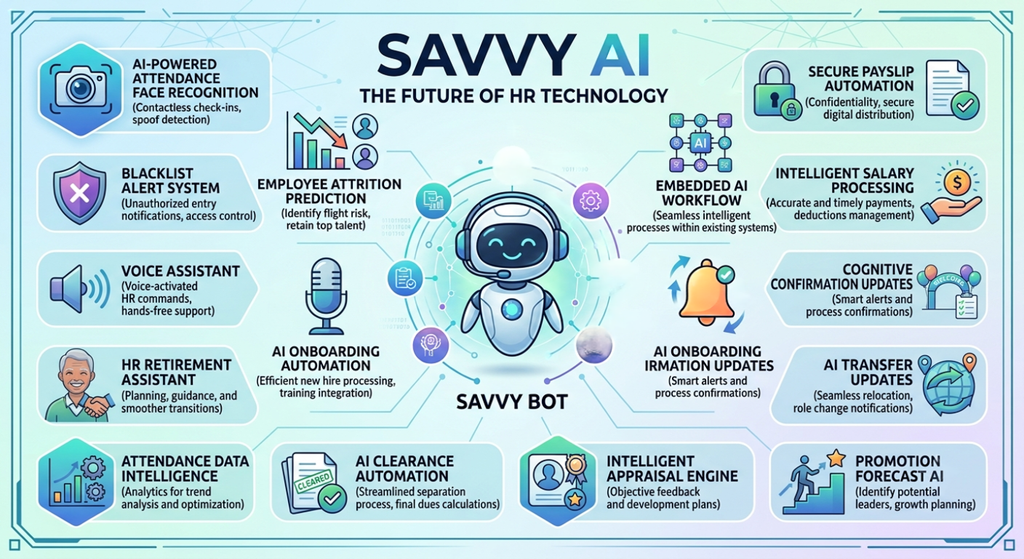
Savvy HRMS highlights several AI capabilities beyond its employee-facing Savvy Bot, including AI onboarding, intelligent workflows, salary processing, clearance automation, and Voice Assistant.
This broader approach is important because HR doesn’t consist of one process.
It involves an interconnected employee lifecycle.
Recruitment → Onboarding → Attendance → Leave → Payroll → Performance → Employee Services → Exit
AI can add intelligence at different points across this lifecycle.
1. AI-Powered Attendance Face Recognition
Explain how AI-based face recognition can help organizations simplify attendance capture and reduce manual attendance processes.
2. Employee Attrition Prediction
Discuss how AI can analyze workforce patterns and help HR teams identify potential attrition risks earlier.
3. Blacklist Alert System
Explain how intelligent alerts can help HR teams identify relevant employee or compliance-related risks based on configured organizational criteria.
4. Voice Assistant
Cover how employees can interact with HRMS using voice, making HR self-service more conversational and accessible.
5. HR Retirement Assistant
Explain how an AI-powered retirement assistant can support HR teams in managing retirement-related information, processes, and planning.
6. Attendance Data Intelligence
Discuss how AI can turn attendance data into useful workforce insights instead of simply recording punches and working hours.
7. AI Clearance Automation
Explain how AI can simplify employee clearance activities during the exit process and reduce manual coordination.
8. Secure Payslip Automation
Highlight how AI-powered automation can make payslip generation and employee access more efficient while maintaining appropriate security controls.
9. Intelligent Salary Processing
Explain how intelligent automation can help simplify payroll and salary-processing activities while reducing repetitive manual work.
10. Embedded AI Workflow
Discuss how AI can be embedded directly into HR workflows instead of functioning as a separate chatbot or application.
11. Cognitive Confirmation Updates
Explain how intelligent confirmation and update mechanisms can help HR teams keep track of important employee and workflow changes.
12. Savvy Bot
Position Savvy Bot as the employee-facing conversational AI layer that helps employees interact with HR information and services more naturally.
13. AI Onboarding Automation
Explain how AI can support new employees during onboarding by making information, processes, and required activities easier to manage.
14. AI Transfer Updates
Discuss how AI can help manage and communicate employee transfer-related updates and changes across HR processes.
15. Intelligent Appraisal Engine
Explain how AI can support performance appraisal processes by helping organizations make performance management more structured and data-driven.
16. Promotion Forecast AI
Discuss how AI can help HR teams identify potential promotion opportunities by analyzing relevant employee and performance data.
What Are the Key Benefits of an AI-Powered Employee Self-Service System?
An AI-powered employee self-service system can offer benefits to both employees and HR teams.
For employees
- Faster information access: Employees can get assistance without always depending on HR.
- Greater convenience: Conversational interaction can be easier than navigating multiple HRMS screens.
- 24/7 accessibility: Employees can potentially access AI-based assistance beyond regular HR working hours.
- Better self-service: Employees can take greater ownership of routine HR interactions.
- Simpler HR technology: AI can create a more natural interface for interacting with HR systems.
For HR teams
- Reduced repetitive queries: Routine questions can be handled through self-service.
- Improved productivity: HR professionals can spend less time on repetitive administrative tasks.
- Better scalability: AI-enabled self-service can support growing employee populations.
- More efficient workflows: AI can complement automation across different HR processes.
- Greater focus on strategic HR: HR teams can spend more time on people and business priorities.
For organizations
The broader organizational benefit is HR scalability.
As businesses grow, HR technology needs to support increasing complexity without creating an equally large administrative burden.
AI-powered employee self-service can become an important part of that strategy.
How Can Indian Businesses Use AI Agents to Build a Smarter HR Function?
AI adoption in HR should not begin with the question, “Where can we add AI?”
A better question is:
“Which employee and HR problems can AI solve better?”
For Indian businesses, there are several practical areas where AI agents can contribute.
1. Start with high-volume employee queries
Identify the questions HR receives most frequently.
- Leave.
- Attendance.
- Policies.
- Payroll.
- Employee information.
These are potential starting points for AI-powered self-service.
2. Connect AI with the HRMS
AI becomes more useful when it is connected with relevant HR data, workflows, and permissions rather than operating as a disconnected chatbot.
3. Keep employee data secure
HR systems contain highly sensitive information.
Organizations should ensure appropriate access controls, authentication, data protection, and permission management when implementing AI-based HR services.
4. Maintain human oversight
Not every HR issue should be automated.
Sensitive employee concerns, grievances, disciplinary matters, and complex people decisions require human involvement.
5. Measure the impact
Businesses should track practical metrics such as:
- Reduction in repetitive HR queries
- Employee adoption
- Self-service usage
- Response times
- HR productivity
- Employee satisfaction
- Workflow completion rates
6. Build AI into the broader HR strategy
AI should not exist as an isolated experiment.
It should support broader objectives such as employee experience, HR productivity, process automation, workforce scalability, and digital transformation.
For Indian organizations moving toward AI-powered HR, this approach can create a more sustainable path to adoption.
Conclusion
The future of employee self-service is moving beyond static HR portals and traditional chatbots. Employees increasingly expect HR technology to be as intuitive and responsive as the digital tools they use every day. AI agents can help bridge that gap by making HR interactions more conversational, accessible, and efficient.
Savvy HRMS AI Agent represents this broader shift toward AI-powered employee experiences. With capabilities such as Savvy Bot, Voice Assistant, AI onboarding, intelligent workflows, and other AI-enabled HR functions, Savvy HRMS brings intelligence closer to everyday HR operations and employee needs. The goal isn’t to replace HR teams; it is to help them spend less time on repetitive tasks and more time creating meaningful employee experiences.










Ready to make employee self-service smarter with AI?
Explore Savvy HRMS and discover how AI-powered HR can simplify everyday employee and HR interactions.
Frequently Asked Questions (FAQs)
1. What is an AI agent in HR?
An AI agent in HR is an intelligent system that understands employee requests, provides relevant information, and can support HR processes. It helps automate routine interactions while making employee self-service faster and easier.
2. How does AI improve employee self-service?
AI improves employee self-service by helping employees quickly access information about leave, attendance, payroll, policies, and other HR services. It reduces dependency on HR teams for repetitive queries and provides a more convenient experience.
3. Can AI help HR teams predict employee attrition?
Yes. AI can analyze workforce data, employee trends, and relevant patterns to identify potential attrition risks. HR teams can use these insights to take proactive steps toward improving retention and employee engagement.
4. How can AI help with employee attendance management?
AI can support attendance management through capabilities such as face recognition, attendance pattern analysis, anomaly detection, and intelligent reporting. This can help organizations reduce manual processes and gain better visibility into workforce attendance.
5. What is Savvy HRMS AI Agent?
Savvy HRMS AI Agent is an AI-powered layer within Savvy HRMS designed to make HR interactions more intelligent and convenient. Its capabilities include Savvy Bot, Voice Assistant, AI onboarding, intelligent workflows, and other AI-powered HR functions.
6. How can Savvy HRMS AI help HR teams?
Savvy HRMS AI can support HR teams across multiple areas, including employee self-service, onboarding, attendance intelligence, salary processing, clearance automation, appraisals, and other HR workflows, helping reduce repetitive work and create a smarter HR experience.