

How to Set Up HR Software in India: A Complete Guide


-
AuthorRuchika Rajput
-
 Last Updated
January 27, 2026
Last Updated
January 27, 2026
-
 Reading Time
8 Mins
Reading Time
8 Mins
Do your organization have difficulty in managing HR tasks, payroll errors, attendance problems, and meeting compliance with HR based on manual effort?
As the number of employees increases, many Indian companies find the old way of handling the human resources of their employees with spreadsheets or paper records inefficient and impractical to use. The complexity of human resources processes (such as payroll processing and compliance with statutory regulations) requires HR professionals to very accurately, quickly, and clearly accomplish their tasks.
HR Software will therefore assist organizations in the automation of their HR functions and reduce errors or missed compliance with Indian Employment Laws.
This guide will explain the function of HR Software, the importance to all types of businesses, the step-by-step process for implementing HR Software, the important features to look for within HR Software, the challenges of implementing HR Software, and why Savvy HRMS should be selected by Indian Business Organizations for their HR software implementation.
What Is HR Software?
HR software (Human Resource Management Software) is an online system that assists companies in storing employee-related information, calculating payroll and benefits information, tracking employee attendance and leave, and ensuring compliance with applicable laws and regulations.
This type of software provides a way to automate many of the traditional paper-based HR processes, allowing businesses to simplify HR processes, improve the speed and accuracy of HR processes, and reduce the complexity of managing HR processes by the human resources team and by business owners.
Additionally, the HR software that is used in India has been developed to accommodate the local payroll regulations, statutory deductions such as PF, ESI, and professional tax, as well as the features offered in attendance management software and leave management software.
Why Every Organization Needs HR Software?
Employee management software is important for all modern organizations in India, with no exception!
Below are some reasons why every organization needs HR Software:
1. Centralized System of Records for Employees
All employee records, including documents, compensation, and career history, are stored in a centralized, secure digital format.
2. Timely Payroll Processing Accuracy
Monthly Payroll automation (automatic Salary Calculation, deduction, reimbursement, and employee payslips) ensures that Employees get paid on time and accurately.
3. Compliance with Indian Labour Regulations
HR Software in India addresses Compliance with the Employee Provident Fund (PF) Act, Employee State Insurance (ESI) Act, Professional Tax (PT) Act, Tax Deducted at Source (TDS) Act, Gratuity Act, and other Labour Regulations.
4. Simple Attendance Tracking
Attendance management software allows employers to track when employees are present (or absent), whether employees are overtime, late, etc., through biometrics or mobile devices, as well as generating reports providing detailed attendance data for each Employee.
5. Simplify Leave Management
Leave Management Software automates leave request processes, approvals, balances, policies, etc. It allows managers to allocate time off among various employees and departments.
6. Reduced Time and Administrative Costs
The automation of HR activities eliminates most of the manual HR work and significantly reduces the time and costs associated with traditional HR methods.
7. Enhancing Employee Experience
By giving its employees access to self-service employee portals where employees can check their payslips, make leave requests, or update their information without assistance from HR, the HRMS eliminates the need for employees to contact HR to complete these tasks.
What Are the Steps to Set Up HR Software in India?
Implementing HR software needs a structured approach to ensure smooth adoption and more benefits.
Step 1: Determine The Needs Of Your Company Regarding Human Resources
It is important to evaluate your organization’s existing human resource gaps, operational problems, and potential future employee requirements prior to selecting any HRMS, which must include:
- Identify your organization’s current challenges and inefficiencies with human resources.
- Make a list of the modules needed for your organization e.g. payroll, attendance or leave, and recruitment.
- Review your organization’s size and any anticipated growth in the future.
- Define compliance requirements for the area where your organization operates.
- Involve the human resources, finance and executive teams in the selection process.
Step 2: Draft Budget And Scope Of HRMS Implementation
Setting a clear budget and implementation plan helps avoid cost limits and ensures smooth HR software implementation:
- Create a budget for your organization’s HRMS.
- Choose whether to purchase the HRMS through the cloud or through an on-premises solution.
- Plan your implementation timeline.
- Include the cost for employee training and support.
- Determine your return on investment expectations.
Step 3: Select The Right HR Software Provider
Choosing the right HR software provider is important for compliance, scalability, and long-term HR success in India:
- Verify if the provider and software are compliant with the necessary compliance regulations and expertise required in India.
- Investigate the scale of employee and technology growth for your organization.
- Review testimonials and case studies from other clients.
- Confirm that the provider has the proper technology and standards for providing secure employee data as well as agency privacy.
- Evaluate the quality of customer support provided by the provider.
Step 4: Develop And Configure HR Policies And Processes
Proper configuration of HR policies ensures correct payroll processing, attendance tracking, and policy compliance:
- Develop the attendance policies and shifts for your employees.
- Develop your leave management processes.
- Develop payroll structures and salary components to be included in your HRMS.
- Map out the HR processes associated with approval workflows.
Step 5: Relocate employee data securely
Accurate and secure data relocations is essential to ensure smooth HRMS implementation without operational errors:
- Collect an accurate employee master file.
- Upload documents and historical payroll data.
- Validate before relocation.
- Provide role-based access to all employee data.
- Ensure confidentiality of employee data.
Steps 6: Integration of payroll & statutory compliance
Integrating payroll & statutory compliance guarantees that salary is processed on time and compliance with Indian laws regarding employees:
- Configuration of PF, ESI, PT, and TDS rules.
- Calculation of salary.
- Generating statutory reports and challans automatically.
- Full tests of payroll-related calculations before execution.
- Align payroll cycles.
Step 7: Train all HR teams and employees
Training is essential in maximizing adoption rates and getting employees using the new HR software fully effective from day one:
- Provide training to HR Administrators.
- Provide employees with training on self-service features.
- Supply user guide, FAQs, demo, and live support.
- Encourage usage through assistance.
Step 8: Test Go-Live and continue to monitor
The testing of the application and constant monitoring of the application can help to identify issues early on and allow the application to perform smoothly once it is fully implemented:
- Use the parallel payroll test mode.
- Troubleshoot issues prior to your production use.
- Execute HRMS departmentally (if necessary).
- Monitor system performance.
- Use feedback to make the operations better.
Key Features of HR Software in India
1. Payroll Management System
Automates the calculation and payment of salaries, deductions, other payments, payslips and statutory compliance correctly during every payroll cycle.
2. Attendance Management Software
Tracks attendance (such as biometric, mobile and web) along with scheduling of shifts, calculating overtime and managing attendance in real-time.
3. Leave Management Software
Manages leave policies, approvals, balances, carries forward to the next year and holiday calendars for multiple sites.
4. Statutory Compliance Management
Ensures compliance with statutory requirements for PF, ESI, PT, TDS, gratuity and other labour law reporting requirements in India.
5. Employee Self Service Portal
Provides employees with access to their payslips, employee leave application process, manages their employment status and views their attendance records independently.
6. HR Analytics and Reporting
Provides actionable HR insights from HR dashboards, management information reports (MIS), compliance reports and employee analysis.
7. Recruitment and Onboarding
Manages hiring process workflows, issuance of offer letters, collection of documents from candidates for employment and onboarding processes.
8. Data Security and Role-Based Access
Provides confidentiality of employee data while providing secure access control management, and ensures compliance with data protection standards.
What Are the Challenges While Implementing HR Software?
| Challenge | Solution |
| Resistance to change from employees | Provide proper training, communication, and demonstrate benefits clearly |
| Data relocation errors | Clean and validate data before relocation |
| Payroll configuration complexity | Choose HRMS with Indian payroll expertise |
| Compliance misalignment | Use HR software designed for Indian laws |
| Low user adoption | Offer self-service training and ongoing support |
| Integration issues | Select scalable, API-enabled HR software |
| Budget constraints | Go for cloud-based HRMS with flexible pricing |
Why Savvy HRMS Is the Best Choice?
Savvy HRMS is an HRMS designed specifically for Indian organisations, taking into consideration statutory compliance, the complexity of payroll, and the diversity of India’s workforce. The intent behind Savvy HRMS is to simplify human resource operations while ensuring compliance and accuracy when performing HR activities.
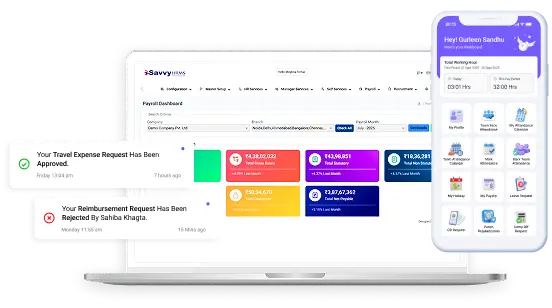
IT provides an all-inclusive solution for managing human resources through back office payroll software, attendance management software, leave management software and employee self-service software, along with an easy-to-use interface that enables teams to quickly embrace its use.
Savvy HRMS provides strong customer support, frequent updates of compliance, and its capabilities grow with you, so startup, small-to-medium and large businesses can manage their human resources effectively.
Conclusion
Implementing HR software in India is an important factor in determining productivity, improving compliance, and improving employee satisfaction. When properly implemented, an HRMS allows for effective human resources management and helps organizations become strategic partners rather than simply administrative functions.
When implemented with the right vendor partner, such as Savvy HRMS, organizations are able to automate payroll and attendance processes while delivering a complete and integrated employee experience. The right choice in HR software today will support your continued growth and operational excellence in the future.