The effective management of Human Resources (HR) is one of the largest challenges facing organizations today: From hiring to compliance, each decision impacts employee satisfaction, growth, and cost-effectiveness, making the decision between in-house HR and HR outsourcing very important.
Many organizations have limited resources, increasing operational costs, and an ever-increasing complexity of labour laws, creating a significant challenge to running an efficient and compliant HR operation. With the wrong HR model, organizations may create inefficiencies, risks to their compliance, and poor employee experiences by using the wrong HR operating model, which will ultimately impact their overall organizational performance and scalability.
The following blog post will provide you with the information necessary to understand the differences between in-house HR and HR outsourcing, explore the benefits of each model, compare the two models, and help you decide on the model that fits your business needs.
What is In-House HR?
An in-house HR team is established and functionally integrated with an organization, which addresses all HR aspects of the organization, such as recruitment, payroll, compliance, employee engagement, and performance management, and aligns with company culture and long-term organizational objectives.
Benefits of Having an In-House HR Team
- More control over company HR processes and policies.
- Strong alignment with the cultures and values of the organization.
- Communication and decision-making are faster.
- Better employee relationships and employee engagement.
- More confidentiality and security of HR data.
- Tailored HR strategies for the business.
What is HR Outsourcing?
HR Outsourcing is the automation of tasks like payroll processing, recruiting, compliance issues, and managing employees to outside service agencies, thus enabling companies to concentrate on their core activities while taking advantage of expert know-how and effective solutions.
Benefits of HR Outsourcing
- Cost savings in operation and administration.
- Availability of human resource professionals and the latest technologies.
- Better adherence to labor regulations and laws.
- Flexibility in scaling according to requirements.
- Time-saving and efficiency.
- Core business concentration.
Difference between In-House HR vs HR Outsourcing
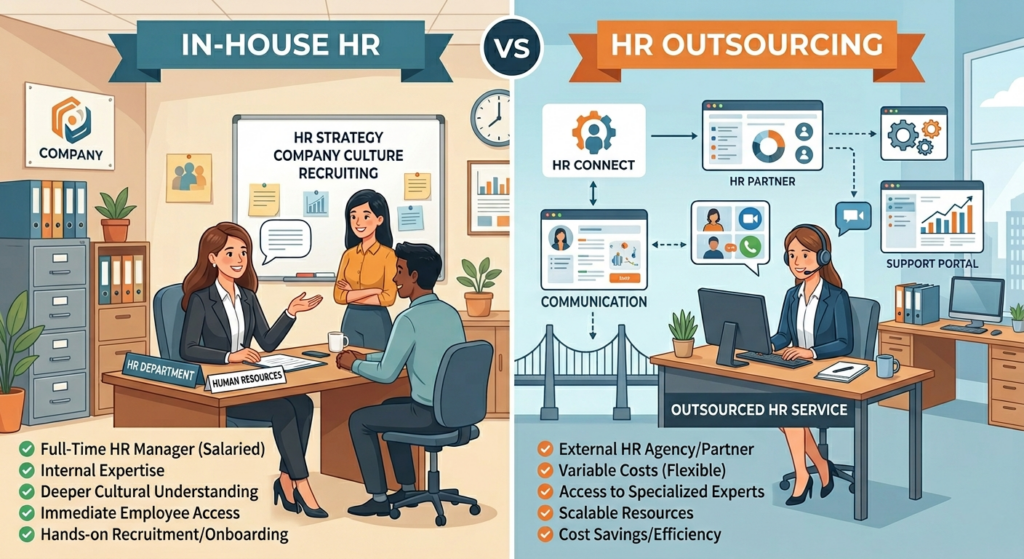
| Parameter | In-House HR | HR Outsourcing |
| Definition | HR functions are managed internally by a dedicated team employed within the organization. | HR responsibilities are assigned to an external service provider specializing in HR functions. |
| Cost Structure | High fixed costs, including salaries, benefits, office space, and HR software investments. | Flexible and often lower costs with pay-as-you-go or subscription-based pricing models. |
| Control Over Processes | Complete control over policies, procedures, and decision-making. | Limited direct control; depends on service-level agreements and vendor capabilities. |
| Scalability | Scaling requires hiring, training, and onboarding new HR staff, which takes time. | Easily scalable, as services can be increased or decreased based on organizational needs. |
| Compliance Management | Requires continuous monitoring of labor laws and regulatory updates internally. | Managed by experts who stay updated with legal changes, reducing compliance risks. |
| Technology & Tools | Requires investment in HRMS software, payroll systems, and automation tools. | Advanced HR technologies and tools are usually included as part of the service. |
| Flexibility | Less flexible in adapting to sudden business changes or workforce fluctuations. | Highly flexible and adaptable to changing business requirements. |
| Time Efficiency | Time-consuming as internal teams handle both strategic and administrative tasks. | Saves time by offloading routine and administrative HR tasks. |
| Focus on Core Business | Management may get distracted by HR-related operational challenges. | Allows leadership to focus more on core business growth and strategy. |
| Data Security | Higher control over sensitive employee data within the organization. | Requires trust in third-party providers and strong data protection agreements. |
| Customization | Highly customizable HR policies aligned with company culture and goals. | Limited customization depending on the provider’s service scope. |
| Recruitment Process | Managed internally, which may limit reach and speed depending on resources. | Faster hiring with access to broader talent networks and recruitment expertise. |
| Risk Management | Higher risk of errors if internal expertise is limited. | Reduced risk due to professional handling and standardized processes. |
| Implementation Time | Takes time to build and establish an effective HR team and processes. | Quick to implement with ready-to-use systems and frameworks. |
| Employee Engagement | Stronger engagement due to direct interaction and relationship building. | Engagement initiatives may not be as impactful if not customized. |
| Long-Term Strategy | Ideal for long-term workforce planning and leadership development. | More focused on execution rather than deep strategic alignment. |
| Best Suited For | Medium to large enterprises with stable operations and long-term HR needs. | Startups, SMEs, or businesses looking for cost efficiency and flexibility. |
How to Choose Between In-House and Outsourced HR?
1. Analyze the Size and Growth Stage of Your Business
Startups and small industries usually find outsourced HR more beneficial due to resource limitations, whereas big industries often opt for in-house HR solutions for greater control and customization.
2. Estimate the Available Budget
If your organization lacks sufficient funds, HR outsourcing may come to the rescue. In contrast, in-house HR requires some fixed expenses related to salaries and infrastructure.
3. Review Compliance Issues
A highly regulated industry suggests opting for HR outsourcing because outsourcing providers know all about dealing with complex laws.
4. Check Required Skill Set
Outsourcing HR functions enables obtaining specialized services that might be difficult to provide through an in-house HR department.
5. Examine Control and Customization Issues
In case maintaining control over all HR processes is of primary importance and you want to improve company culture, opt for an in-house solution.
6. Identify Scalability Factors
Rapid growth necessitates HR outsourcing because it will help avoid constant recruiting and educating HR personnel.
7. Assess Time and Resource Management Aspects
HR outsourcing is a great solution for overloaded employees who are engaged in routine tasks and lack time for strategy development.
When Does it Make Sense to Keep HR In House?
1. Importance of Company Culture
Companies that outline culture creation and employee engagement will see advantages in using internal HR, since the internal team understands its values and behavior.
2. High Level of Control Required
Companies that require total control over HR processes and decision-making might be interested in an internal HR department.
3. Complex Company Structure
Organizations with a more complicated organizational structure will find an in-house HR department more useful.
4. Sensitive Information Processing
Organizations handling sensitive information about their employees will find in-house HR more convenient for maintaining confidentiality.
5. Number of Employees
Organizations with number of employees will find in-house HR helpful in managing human resources processes.
6. Strategic Human Resources Planning
Organizations concentrating on strategic HR planning, leadership development, and talent management will prefer internal HR.
Conclusion
In order to decide whether to use in-house HR or outsourced HR services, you need to consider what suits your goals, budget, and other requirements. There are benefits to each, and choosing wisely will make a huge difference for your efficiency, compliance, and satisfaction with the process.
One such modern solution is provided by Savvy HRMS, as their HR solutions work to meet the demands of both types of HR service structures, making things easier for workforce management.