Human Resource Management depends heavily on data for the formation of a basis for strategic decision-making. HR analytics is a way for organisations to depend on actual evidence rather than intuitive knowledge when making important decisions about their workforce.
HR analytics can be utilised to include identifying trends and patterns among employees, as well as selecting candidates for new positions and improving employee performance. By transforming raw data from HR systems into valuable insights, HR analytics gives organisations the ability to plan their workforce more effectively through improved visibility of workforce data.
With organisations continuously looking to improve efficiency and grow, it is no surprise that HR analytics is becoming one of the most important business tools for organisations. In addition to increasing the quality of the decisions made, organisations will have access to HR analytics as a way to be more competitive in an increasingly data-driven organisational environment.
Looking for smart HR Software to help manage your workforce? Check out the Best HR Software available in India! Check out Now!
What is HR Analytics?
HR analytics is the act (or practice) of collecting and analyzing data of employees with the goal of improving human resource management decision-making. It helps employers analyze and understand trends in their workforce, which in turn helps them develop a data-driven approach to strategic workforce planning.
Through the use of metrics (such as employee performance, turnover rates, hiring, and employee engagement), HR analytics provides insights to HR Management so that challenges (and their causes) can be identified, outcomes can be predicted, and overall workforce management can be improved.
With HR analytics, organizations can shift from “reactive” decision-making toward more proactive decision-making. It improves the recruitment process; it improves the employee experience; and it enables the HR function to align its strategies with the business strategy. Eventually, HR analytics leads to increased productivity and the long-term success of an organization.
How HR Has Developed Over Years?
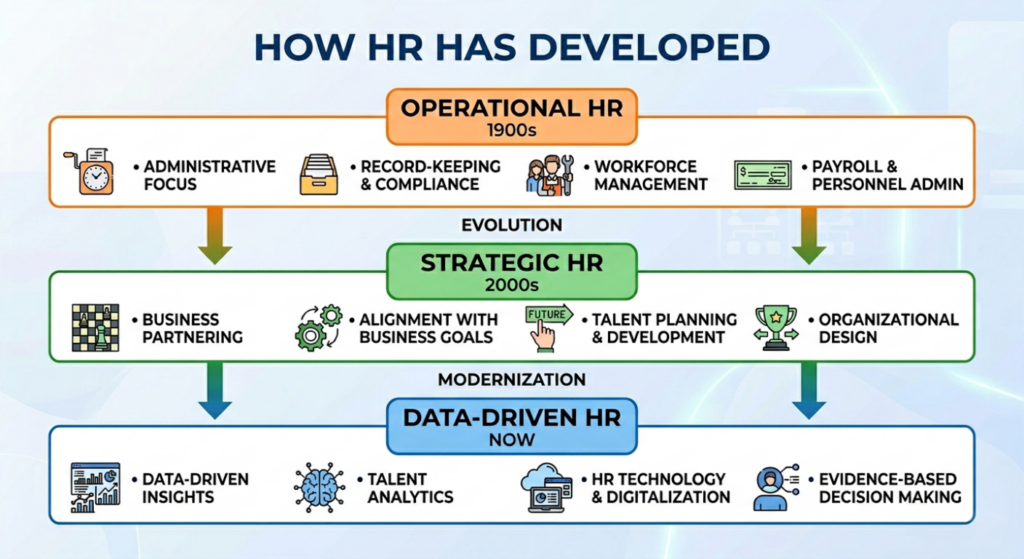
| Operational HR 1900s | Strategic HR 2000s | Data-Driven HR Now |
| Administrative Focus: Maintains routine HR functions such as documentation, policies, and employee records. | Business Partnering: HR collaborates closely with leadership to support organizational growth and strategy. | Data-driven Insights: Converts workforce data into actionable insights for better decision-making. |
| Record Keeping & Compliance: Maintains employee records while ensuring adherence to labor laws and regulations. | Alignment with Business Goals: Ensures HR strategies directly support and improve business objectives. | Talent analytics: Analyzes employee data to improve hiring, retention, and overall performance. |
| Workforce Management: Improves staffing, scheduling, and productivity across the organization. | Talent Planning & Development: Focuses on nurturing employee skills and preparing future leaders. | HR technology & digitalization: Leverages digital tools and automation to simplify HR processes. |
| Payroll & Personnel Admin: Efficiently manages employee compensation, benefits, and administrative HR tasks. | Organizational Design: Structures teams and roles to maximize efficiency and business performance. | Evidence-based Decision Making: Uses accurate data and analytics to guide HR strategies and actions. |
What are the different types of HR Analytics?
1. Descriptive Analytics
Descriptive analytics examines HR historical performance data to see what took place. Reports, dashboards, and metrics are used to provide patterns, trends, and insights into the organization’s employee performance.
2. Diagnostic Analytics
Diagnostic analytics analyzes data to determine the basic reasons HR outcomes occurred. For example, it can help to determine what resulted in high turnover, low employee engagement, and low employee performance.
3. Predictive Analytics
Predictive analytics utilizes historic data and analytical modeling to provide an estimate of future HR outcomes. For example, organizations can use predictive analytics to help estimate employee turnover, hiring needs, and future performance trends to assist in workforce planning and decision-making activities.
4. Prescriptive Analytics
Prescriptive analytics makes recommendations based on data insights and predictions. It requires actions to be taken to improve HR outcomes (such as improving the employee hiring process, improving employee engagement, and decreasing employee turnover through targeted intervention).
What are the applications of HR analytics?
Data analysis in HR is commonly used to help companies make better workforce decisions through the analysis of employee data. HR analytics enable companies to make more informed hiring, performance management, retention, and other workforce efficiency decisions by providing insights from data and supporting workforce strategy.
1. Attracting Talent
HR analytics help organizations simplify their hiring process in three ways: by identifying sourcing channels that submit the highest quality applicants; by shortening the amount of time required to fill open positions; and by predicting which candidates will be successful on-the-job. By providing these services, HR analytics enable companies to hire the best talent more effectively.
2. Managing Employee Performance
HR Analytics helps organizations measure and manage employee performance through data analysis. This allows managers to measure high-performing employees, as well as identify where employee performance is lacking, and develop strategies to improve performance.
3. Retaining Employees
HR analytics assists organizations in identifying why employees leave their jobs so that they can take a proactive approach towards improving employee engagement and developing retention strategies that result in lower employee turnover.
4. Workforce Planning
HR analytics support workforce planning by allowing organizations to perform future workforce needs forecasting on various dimensions based on current employees. Thus, HR analytics will help organizations guarantee a sufficient number of employees with sufficient skills are available for work at any given time.
5. Learning and Development
HR analytics enable organizations to assess employee skill gaps and develop targeted employee development programs based on developing employee skill sets that fit their career paths, both short-term and long-term.
6. Employee Engagement
Employee engagement is evaluated through feedback, including surveys and statistical summaries of those surveys. These tools help both employees and employers understand how engaged an employee is and how to create initiatives that will increase the employee’s satisfaction, motivation, and overall experience at work.
7. Compensation and Benefits Optimization
By using HR analytics, an HR professional is able to analyze and improve compensation systems and benefits programs to ensure they remain competitive, equitable, consistent with employee expectations, supportive of the organization’s objectives, and efficient with the organization’s budget.
What is the Importance of HR Analytics?
1. Better Decision-Making
Use of HR analytics will provide a more reliable method of making decisions that will result in reducing the number of potential errors in determining the best hiring decision, assessing employee performance, and managing overall operations.
2. Improved Talent Acquisition
HR analytics will track resource allocation and resource output to identify which recruiting resources produce the right type of candidate to fill a position most effectively and efficiently.
3. Improved Employee Retention
Using HR analytics to identify trends in attrition rates and the reasons for those trends can help organizations to understand what might be causing their employees to become dissatisfied and leave their jobs, allowing them to take corrective action to prevent attrition and improve employee retention levels.
4. Increased Employee Productivity
HR analytics will identify where company employees are performing below potential and will assist organizations in making the necessary adjustments to improve overall organizational productivity by maximizing employee productivity.
5. Strategic Workforce Planning
Through HR analytics, organizations will be able to project their likely future workforce needs and plan for them to ensure they have the right people with the required skills to meet their long-term strategic goals.
6. Cost Optimization
HR analytics will help organizations reduce their HR costs by improving hiring effectiveness, reducing turnover costs, and increasing the efficiency of resources used by the organization.
HR Analytics Case Studies: Real-World Applications
1. Nilkamal Limited
Problem:
Nilkamal (a large manufacturing organization) had difficulty in effectively managing its largely distributed and diverse workforce. Their manual work means of handling attendance, payroll, and compliance results in inefficiency, data inaccuracies, and delays in operations.
How did Savvy HRMS help them?
With Savvy HRMS, they automated and simplified their HR processes. By automating the processes for attendance, payroll, and compliance, they were able to centralize all data and provide real-time reporting. This created greater data accuracy, provided a reduction in manual labour costs associated with HR, and allowed for much more efficient management of the organization’s workforce over various locations.
For more info, visit: Nilkamal Limited
2. FICCI
Problem:
FICCI had problems due to the difficulty in managing their multiple leave, attendance, and travel processes by hand. A lack of an integrated system, an excessive amount of work for the HR department, and an absence of real-time visibility into data all result in decreased levels of efficiency.
How did Savvy HRMS provide a solution?
Savvy HRMS solution automated the company’s attendance, leave, and travel management systems and provided smooth integration with current ERP systems, resulting in centralized data, real-time reporting, reduction of manual workloads through automation, and improved decision-making through comprehensive management information system (MIS) reports.
For more info, visit: FICCI
3. Toyota Boshoku Corporation
Problem:
Toyota Boshoku Corporation faced issues and challenges in managing large-scale HR operations with an increasing workload and limited automation. Manual processes, confusing data, and a lack of simplified systems result in inefficiencies and difficulty in handling HR tasks efficiently.
How did Savvy HRMS help them?
Savvy HRMS automate their HR processes by automating its important HR functions and centralizing employee data. It improved operational efficiency, reduced manual workload, and enabled smooth employee management with better accuracy and control.
For more info, visit: Toyota Boshoku Corporation
4. COS Power India New Energy
Problem:
Cospower India, being a company in the energy industry, faced some problems related to their workforce operations management. Due to manual HR processes, the absence of centralized information, and the lack of ability to monitor employees’ activities, efficiency was badly affected.
How did Savvy HRMS help them?
Savvy HRMS offered them an HR software solution, which resulted in an improvement in the organization’s HR functions through automation and data visibility.
For more info, visit: COS Power India New Energy
What are the key HR metrics to track?
| HR Metric | Description | How to Calculate |
| Employee Turnover Rate | Measures the percentage of employees leaving the organization over a period. | (Number of employees who left ÷ Average total employees) × 100 |
| Time to Hire | Tracks the average time taken to fill a job position. | Total days to hire all candidates ÷ Number of hires |
| Cost per Hire | Calculates the total cost involved in hiring a new employee. | Total recruitment cost ÷ Number of hires |
| Employee Engagement Score | Evaluates employee satisfaction through surveys and feedback. | (Total engagement score ÷ Total responses) |
| Absenteeism Rate | Measures the frequency of employee absences. | (Total absent days ÷ Total working days) × 100 |
| Training Effectiveness | Evaluates how well training improves performance and skills. | (Post-training performance – Pre-training performance) ÷ Pre-training performance |
| Employee Productivity | Tracks output and efficiency levels of employees. | Total output ÷ Total number of employees |
| Retention Rate | Measures the percentage of employees retained over time. | (Employees retained ÷ Total employees) × 100 |
| Offer Acceptance Rate | Indicates the percentage of accepted job offers. | (Offers accepted ÷ Offers made) × 100 |
| Performance Rating | Evaluates employee performance based on appraisal scores. | Total performance scores ÷ Number of employees |
How can you get started with data analytics in HR?
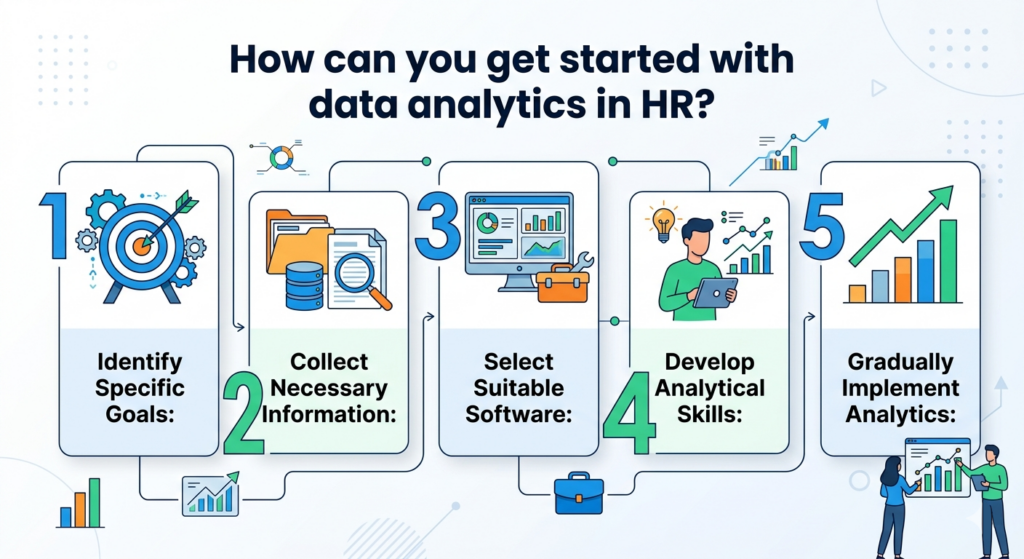
1. Identify Specific Goals
Firstly, it is important to identify what goals the organization has set for itself in HR management, such as improving recruitment, minimizing turnover, increasing productivity, etc., to ensure the alignment of HR analytics activities with business objectives.
2. Collect Necessary Information
Correctly collect information about employees through HRMS, payroll, attendance systems, as well as surveys, to create reliable premises for further analytics activities.
3. Select Suitable Software
Buy appropriate software tools for data analysis in HR management to be able to process all necessary information and create reports.
4. Develop Analytical Skills
Develop employees’ analytical skills in explaining data and understanding the basics of statistics to work with analytics tools properly.
5. Gradually Implement Analytics
Implement the first metrics, test, and analyze results to gain experience; continue working on more advanced HR analytics programs as you gain experience.
How can HR transition from descriptive to predictive and prescriptive analytics?
The transition from descriptive to predictive and prescriptive analytics in HR happens gradually and is dependent on the proper balance of elements such as data, technology, and mindset. The first step involves establishing a solid database and then using the information to engage in strategic analytics.
1. Establish a Solid Data Foundation
Ensure HR data is precise, consistent, and properly organized using HRIS, payroll management, and attendance systems to facilitate analysis and forecasting.
2. Employ Innovative Analytics Software
Purchase cutting-edge HR software with predictive features capable of analyzing trends, predicting outcomes, and providing meaningful insights for strategic planning.
3. Enhance Analytical Expertise
Educate HR personnel on data analysis, statistics, and analytical tools, enabling them to progress from simple reporting to predictive and insightful decision-making.
4. Apply Predictive Models
Employ past data to predict trends, including turnover, hiring, and performance, helping HR departments point out potential challenges proactively.
5. Transition to Prescriptive Actions
Utilize findings to suggest practical recommendations such as improved retention initiatives, effective recruiting processes, and enhanced employee engagement efforts.
6. Cultivate a Data-Driven Mindset
Promote evidence-based decision-making through continuous evaluation and improvement of HR strategies, ensuring their effectiveness and efficiency.
Conclusion
HR analytics is transforming workforce management practices through the ability to make informed decisions, increase efficiency, and improve employee experiences. With this practice, companies can remain relevant and ensure that HR activities align with organizational growth.
Using platforms such as Savvy HRMS, it becomes easier for companies to implement human resources analytics. This makes it easy for businesses to improve workforce management and make better, strategic decisions regarding their HR practices.
Ready to grow your HR career?
Start by upgrading your skills, exploring emerging roles, and positioning yourself for high-impact opportunities today.
Book a Demo TodayFAQ
1. What are HR analytics?
HR analytics involves the collection and analysis of employee information in order to enhance human resource decisions on recruitment, performance, engagement, and management.
2. What are the 4 different types of HR analytics?
Descriptive, diagnostic, predictive, and prescriptive analytics are the four types of HR analytics that can be used to determine what happened in the past, diagnose why an event occurred, predict future happenings, and suggest solutions.
3. What are the 7 pillars of HR analytics?
These pillars are data quality, data integration, HR analytics tools, capable human capital, data governance, HR analytics reports, and data-driven business decisions.
4. Which HR role is highly paid?
Examples of some of the high-paying HR positions include HR Analytics Manager, HR Business Partner, Head of Talent Acquisition, and CHRO (Chief Human Resources Officer).