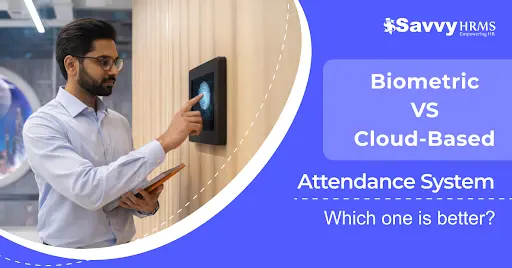
The tracking of employee attendance is an important part of managing employees. Manual methods of tracking employee attendance are not only slow to expand as organizations grow, but may also lead to errors or delays when expanding across several locations and multiple teams.
Today’s rapid growth in technology has enabled HR processes to lead organizations to adopt automated tools for their attendance management processes. These tools include biometric systems and cloud-based systems. Companies have implemented both of these types of tools to help automate their attendance management processes, enhance accuracy, and maintain compliance with government regulations.
In this blog, we will explain the key differences between biometric attendance systems and cloud-based attendance systems, and discuss which type of attendance management tool will suit your organization’s needs going forward.
What Is a Biometric Attendance System?
A Biometric attendance system is a process that captures an employee’s presence within the company. In addition to establishing an employee’s physical identity at the time they accept a job offer, biometric systems enable employers to maintain accurate records of when they arrive and depart. Additionally, these systems help eliminate “buddy punching” (when one employee clocks in or out for another) and the associated time theft.
What Is a Cloud-Based Attendance System?
A cloud-based attendance system is an internet-based service that allows your business to keep track of employee attendance. The cloud-based attendance solution will provide your Business with real-time access to employee records and a completely automated way of managing employee attendance.
Key Advantages of a Biometric Attendance System
1. Precision in Tracking Attendance
Biometric Identifiers provide extreme precision in tracking attendance by removing the potential for manual errors and eliminating the occurrence of buddy punching or proxy attendance.
2. Strong Verification of Employee Identity
Physical Biometric features uniquely identify employees, ensuring they are the only ones who can clock in for their attendance.
3. Control Over Attendance Data
Biometric Systems are located at the business site, providing businesses with complete control over how the attendance information is stored and accessed.
4. Significant Reduction of Time Theft
Time can no longer be operated through unauthorized entries by means of Fingerprint or Facial Recognition technology.
5. Simple Daily Usage
With minimal training and with the use of the installed hardware, employees find Biometric Systems to be simple to use.
6. Enhanced Support for Compliance
Accurate Attendance Records provide businesses with the necessary information required to meet labor laws and audit compliance requirements.
Key Advantages of a Cloud-Based Attendance System
1. Anytime, Anywhere Access
A cloud-based solution gives you access to mark employees’ attendance from anywhere, including working from home or while out on-site, using a mobile or web-based application.
2. Real-Time Data Visibility
With cloud technology, businesses can get their HR teams accurate information about employee attendance quickly. This enables them to make faster decisions and take action in a timely manner based on employees’ punctuality.
3. Integrated Systems
Cloud technology makes it easy to integrate with an attendance management system, leave management systems, payroll software, and other HRMS modules.
4. Scalable & Flexible
Cloud technology grows with the businesses as they grow their teams, expand their locations, and hire more remote employees.
5. Reduced Costs
Cloud technology eliminates the need for additional hardware to keep track of employee attendance, as well as to have to service and maintain that hardware, and to keep track of all employee attendance records manually or on paper.
6. Data Protection
Cloud providers take extra security precautions to protect customers’ data by providing secure cloud storage through encryption, backup options, and compliance-ready infrastructure.
Comparison Table: Biometric vs Cloud-Based Attendance System
| Aspect | Biometric Attendance System | Cloud-Based Attendance System |
| Setup | Requires physical hardware | No hardware, cloud-based |
| Accessibility | Office-location dependent | Accessible from anywhere |
| Remote Work | Not supported | Fully supported |
| Field Staff | Limited tracking | GPS-enabled tracking |
| Scalability | Hardware-dependent | Instantly scalable |
| Cost | High upfront cost | Subscription-based, cost-effective |
| Maintenance | Manual device maintenance | Vendor-managed updates |
| Real-Time Data | Limited | Real-time visibility |
| Integration | Limited | Integrates with HRMS, payroll |
| Leave Management | Separate system needed | Built-in leave management |
| Payroll Processing | Semi-manual | Fully automated |
| Data Storage | Local servers | Secure cloud storage |
| Security | Depends on internal IT | Enterprise-grade security |
| Reporting | Basic reports | Advanced analytics |
| Employee Self-Service | Not available | Available |
| Multi-Location Use | Complex | Seamless |
| Updates | Manual | Automatic |
| Reliability | Device failure risk | High availability |
| Future Readiness | Limited | Highly future-ready |
| Best For | Traditional offices | Modern, growing organizations |
Key Differences:
1. Location Dependency
Biometric systems require physical presence at the office. Cloud-based attendance systems allow employees to track attendance from any location.
2. Workforce Flexibility
Biometric attendance systems are designed for traditional office-based teams, while cloud-based attendance systems provide complete support for remote, hybrid, and field workforces.
3. Infrastructure Requirement
Biometric attendance systems require hardware installation and maintenance. In contrast, cloud-based attendance systems require no hardware.
4. Integration Capabilities
Biometric attendance systems are limited in their ability to integrate with hr software, leave management systems, and payroll software; cloud-based attendance systems allow full integration with these solutions.
5. Scalability and Growth
Adding devices is necessary for biometric attendance systems to support growth, while cloud-based attendance systems scale instantly for growing organizations.
6. Future Readiness
Biometric attendance systems meet basic employer needs, but cloud-based attendance systems align with modern hrms solutions and digital transformation initiatives.
Which System Is Better for Your Organization?
When deciding between a biometric and cloud-based attendance system, consider how each option aligns with your company’s workforce structure and future growth goals. For example, if your organization has a physical office location and isn’t likely to see remote employees in the future, then a traditional biometric solution may suffice for basic attendance tracking.
As more organizations want flexible solutions that provide real-time data, along with the ability to have smooth integration with HR software, organizations with hybrid employees working across multiple locations or rapidly growing generally benefit from implementing a cloud-based attendance solution. These systems provide greater efficiencies, scalability, and automation of HR processes.
Why Cloud-Based Attendance System Is the Future of Organizations?
The future of employee management lies in flexibility, automation, and data-driven decision-making. Cloud-based attendance systems enable organizations to manage attendance beyond physical boundaries while integrating effortlessly with payroll software and HRMS.
1. Supporting Hybrid Working Models
With a cloud-based attendance system, organizations can track attendance of their employees (whether it’s remote, on-site, or field) with no geographical restrictions on a physical infrastructure.
2. Increasing HR Productivity
The use of automation allows for less manual attendance tracking, thus allowing HR teams save more time by reducing errors and enabling them to concentrate on strategic HR initiatives, such as talent development or employee engagement.
3. Providing Real-Time Insight
Real-time dashboard analytics offer organizations accurate visibility of their attendance patterns and absenteeism, as well as productivity, to enable faster data-driven workforce planning and decision-making.
4. Allowing for smooth Payroll Processing
Attendance data syncs with payroll software automatically, allowing for accurate salary calculation, timely payouts, and removing the need for HR to make manual errors or have delays in payroll.
5. Ensuring Compliance and Readiness
Automated attendance records allow organizations to maintain compliance with labor laws, maintain a transparent audit trail, and be able to produce reports during an inspection or audit with relative ease.
6. Providing Employees with Self-Service Options
Employee self-service portals give employees the ability to mark their attendance, apply for leave, and see their records independently, thereby improving transparency and reducing the dependency on HR.
7. Digital Transformation of HR Functions
By using cloud-based attendance systems, organizations are able to eliminate hardware costs, significantly lower hardware maintenance costs, and provide organizations with enterprise-grade HR functionality at a significantly lower cost of ownership than previously experienced.
How to Choose a Cloud-Based Attendance System?
1. Highly Friendly Interface For Users
A cloud attendance solution should provide a simple interface that is easy for employees and HR teams to use, minimising the amount of training time required to use the system and increasing overall uptake of the application.
2. Social Media Integration Features
To provide smooth data integration, it is important to implement an attendance solution that is easily integrated with HR software, leave management systems, payroll systems, and other enterprise resources.
3. Customisation Options and Scalability
You need to choose an attendance solution that’s scalable, adaptable to the organisational size and multiple sites, and flexible enough for adapting to business needs as well as changes in attendance practices and policies.
4. Security and Compliance
The system must have data encryption, access controls based on user permissions, and be fully compliant with local labour laws and data protection legislation in order to protect sensitive employee information.
5. Real-time Analytic Reports
HR leaders need to receive complete, real-time data to allow HR leaders to receive insights into employee attendance patterns and trends, and provide immediate feedback on attendance issues to assist in making better employee management decisions.
6. Facial Recognition Technology
Mobile attendance systems with GPS and facial recognition enable accurate attendance tracking for remote and hybrid employees, as well as field workers, and eliminate the need to manipulate attendance records.
7. Vendor Reliability and Support
It is important to select a vendor that offers responsive technical assistance, continuous updates, and a defined product roadmap to maintain reliability and ensure business continuity in the long term.
Why Savvy HRMS Is the Best Choice?
Savvy HRMS is a complete, cloud-based attendance management system that provides organizations with the ability to easily manage employee attendance while smoothly connecting with the organization’s leave and payroll software.
Real-Time Attendance Monitoring through Savvy HRMS allows managers to view the time an employee punches in and punches out through a mobile device, as well as track the location of an employee’s punch using GPS.
Savvy HRMS creates a perfect solution to the need for companies to monitor employee attendance and compliance across different geographical locations.
Conclusion
The conflict between biometric attendance systems and cloud-based attendance systems shows a transition in how organizations are managing their employees. While Biometric systems are a traditional system used for managing employee attendance in a traditional office setting, Cloud-Based Solutions allow management of attendance records with common levels of flexibility, scalability, and automation.
For businesses that wish to future-proof the HR department, adopting a Cloud-Based Attendance Management System that is integrated with Payroll Software and Human Resource Management Systems represents a smarter option. Solutions such as Savvy HRMS allow businesses to simplify attendance management and improve worker productivity while creating a digitally adaptive workforce.