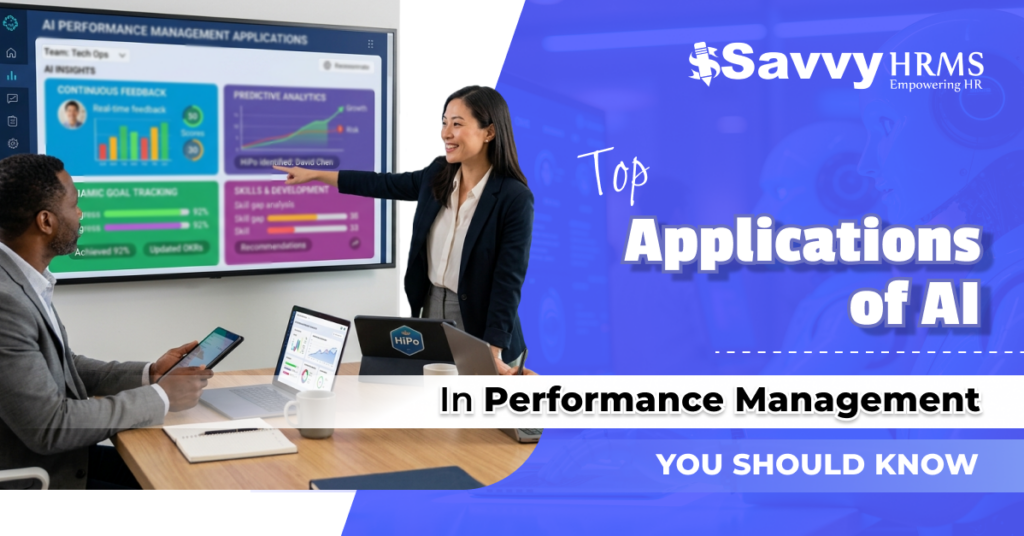
Imagine an era where your performance management tool could actually think, learn, and develop on its own. Isn’t that a vision from the future? But with the use of AI in performance management, the future has arrived sooner than you thought.
Performance management has always been considered somewhat traditional, but it has to develop to adapt to the rapid pace of today’s business environment.
So, how can an organization do that?
- Real-time insights rather than yearly reviews
- Data-based decision making rather than assumptions
- Tailored development for each employee
In our blog, we will uncover how AI in performance management can help organizations assess performance and overcome critical difficulties in their way, all to achieve better results through smarter performance management.
What Does AI in Performance Management Mean for Organizations?

AI in performance management suggests using cutting-edge technologies such as machine learning, predictive analytics, and automation to measure, assess, and improve employee performance on an ongoing basis more efficiently and accurately.
In this case, rather than waiting for regular assessments, it becomes possible to keep track of employee achievements and performance indicators in real time. Thus, managers are able to make more informed decisions based on relevant information that reflects reality.
This implies that rather than being limited to performance reviews, companies will be capable of using performance management as a tool to obtain intelligence on their staff’s achievements and progress.
How Can Organizations Shift from Annual Reviews to AI-Driven Performance Intelligence?
The transition from traditional yearly reviews to AI in Performance Management involves both cultural and technological change. The organization needs to move from yearly reviews to using AI to evaluate performance trends and employee progress on a continuous basis.
Additionally, the organization will need to adopt AI-based performance intelligence into its existing human resources technology solutions to gain valuable data insights and predictions through analytics.
Steps involved in making the transition:
- Moving away from yearly reviews to continuous feedback processes.
- Using AI-based performance management systems.
- Utilizing real-time analytics in performance evaluations.
- Training managers to understand AI-based insights.
- Aligning performance indicators with organizational objectives.
What Are the Key Use Cases of AI in Performance Management?
Various applications of AI in performance management can be found to benefit organizations by increasing efficiency and improving decisions while boosting employee satisfaction. These application areas display the importance of the use of AI technology in making performance management smart and effective.
1. Real-Time Performance Monitoring
With the use of artificial intelligence (AI), the activities, tasks, and achievements of employees can be monitored in real time with great accuracy.
Outcome: Provides immediate feedback, enhances responsibility, improves employee efficiency, and enables managers to make timely decisions with the help of real-time performance insights.
2. Predictive Performance Analysis
Predicting future performance becomes possible with the help of analyzing the employee performance data over a period of time in the past.
Outcome: Helps identify the best-performing and poorly-performing employees in advance, allowing better planning and decision-making that will positively impact organizational performance.
3. Customized Feedback and Coaching
With the use of AI, custom-tailored feedback and coaching based on employee performance data become available for managers to provide efficiently.
Outcome: Increases employee motivation and involvement, helps develop their skills promptly, and provides recommendations that promote continuous growth.
4. Elimination of Subjective Judgment
Through the analysis of performance data based on specific objective criteria, AI reduces the potential for any human biases and makes evaluations more consistent.
Outcome: Ensures the process is transparent, trustworthy, impartial, and free of any discrimination.
5. Goal Setting & Alignment
Through AI, companies can set specific, realistic, and measurable goals aligned with their corporate objectives and monitor their progress.
Outcome: It makes the process clearer and more transparent, promotes accountability, aligns employee and organizational objectives, and results in better performance management outcomes.
6. Employee Engagement Analysis
AI analyzes the state of employee engagement through surveys, feedback, and interactions within an organization to identify issues at an earlier stage.
Outcome: Helps to spot problems before they become significant and engage employees proactively, leading to improved overall employee experience and productivity.
7. Automated Performance Review Process
AI automates performance review processes by collecting data from various sources, analyzing it, and assembling it.
Outcome: Eliminates slow work, speeds up, and facilitates the entire process for HR and managers involved, improving the accuracy of performance reviews.
8. Skill Gap Identification
AI constantly monitors employee performance data and job requirements to identify any gaps in competencies and skills.
Outcome: Allows organizations to develop appropriate training programs and prepare people for further growth and advancement opportunities.
9. Productivity Analytics
AI analyses the productivity of people across different teams and departments within an organization to identify possible issues and inefficiencies.
Outcome: Provides meaningful insights into ways to increase productivity and enhance business performance through improved processes.
How Do AI and Performance Management Deliver Tangible Business Results?
Performance management using AI results in measurable success for organizations through greater efficiency, increased employee motivation, and data-driven decision-making. It helps turn performance management into a strategic activity that positively impacts organizational growth and success.
1. More Informed Decision-Making
AI delivers accurate information, thus allowing leaders to make decisions that will result in success based on data regarding the performance of their employees.
2. Higher Productivity Levels Among Employees
The ability to track employees’ progress motivates them and makes them perform better, which transforms into increased productivity.
3. Greater Employee Motivation
Individualized feedback and learning opportunities make employees happier and motivate them to become more engaged.
4. Less Potential for Bias and More Fairness
AI ensures fair treatment of all employees regardless of their gender, race, and other demographic characteristics.
5. Effective Talent Retention Strategies
With the help of AI, managers can identify any issues and prevent talented employees from leaving the company.
Traditional vs. AI-Based Performance Management
| Aspect | Traditional Performance Management | AI-Based Performance Management |
| Review Frequency | Annual or periodic reviews | Continuous, real-time feedback |
| Data Usage | Limited and manual | Data-driven and automated |
| Bias | High human bias | Reduced bias through AI |
| Feedback | Delayed and infrequent | Instant and ongoing |
| Decision-Making | Subjective | Objective and data-backed |
| Employee Engagement | Often low | Higher due to personalization |
| Efficiency | Time-consuming | Faster and automated |
| Insights | Limited insights | Predictive and actionable insights |
What Should Organizations Consider When Implementing AI-Driven Performance Management?
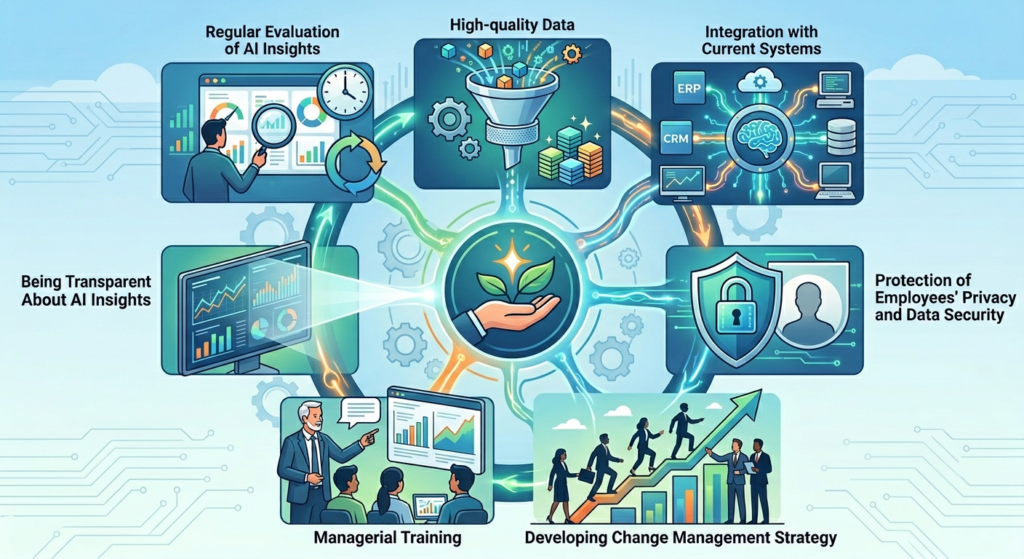
1. High-quality Data
The accuracy of the data is important for the proper operation of an AI system. The quality of such data determines whether the organization will get valuable insights that will allow making the right decisions.
2. Integration with Current Systems
When implementing AI into performance management processes, organizations must make sure that AI tools fit perfectly with existing HR systems.
3. Protection of Employees’ Privacy and Data Security
Ensuring security when implementing AI into performance management is necessary not only because of legal aspects but also due to the importance of building trust between people and technology.
4. Developing Change Management Strategy
It is important to develop a change management strategy so that people can quickly adopt AI-based solutions for performance management.
5. Managerial Training
Managers must undergo training to learn how to properly interpret AI insights so that they can make the right decisions regarding performance improvement.
6. Being Transparent About AI Insights
Transparency about how AI is used within performance management processes helps in creating trust among all people involved.
7. Regular Evaluation of AI Insights
It is important to evaluate how effective the use of AI-based solutions is on a regular basis.
What Is the Future of AI in Performance Management?
For the future of artificial intelligence, the main focus of performance management will be AI-driven customization systems that can give unique recommendations, feedback, and development opportunities to each employee according to their performance history.
The role of AI in predicting will increase, thus helping organizations to expect workforce changes and challenges and deal with them beforehand, ensuring efficient performance management practices.
With growing AI implementation, performance management will be closely related to the business strategy in general and help form an agile, data-driven workplace culture.
Conclusion
Performance management using AI technologies is changing the way companies measure, motivate, and develop their employees. Through implementing advanced data analysis technologies in place of outdated techniques, companies will be able to enhance efficiency and attain success in performance management.
Tools such as Savvy HRMS allow for easy integration of AI-powered performance management technologies into company operations. With features like automation and real-time analytics, Savvy HRMS ensures effective performance management for all employees.
Upgrade Your Performance Management with AI
Looking for a better way to improve your company’s performance management process using AI technology?
Get Started with Savvy HRMS Today