HR teams have always taken care of tracking where their employees are working, and it has often been a time-consuming task. Traditional tracking methods, such as manual registers, spreadsheets, and card systems, often produced errors and made them vulnerable to manipulation and incorrect payroll.
With changes in the composition of the workforce, such as hybrid working setups, and with the addition of more strict compliance requirements, the HR industry requires innovative and reliable ways to track attendance. As a result, employers have determined that there must be three criteria present in modern HR operations: accuracy, transparency, and real-time access to information.
An artificial intelligence-based attendance system is an example of this new trend in attendance management. An AI-based attendance system utilizes artificial intelligence technology to automate attendance tracking processes with minimal human participation and easily connects to existing payroll systems, HR systems, and HRMS platforms.
What is an AI-Based Attendance Management System?
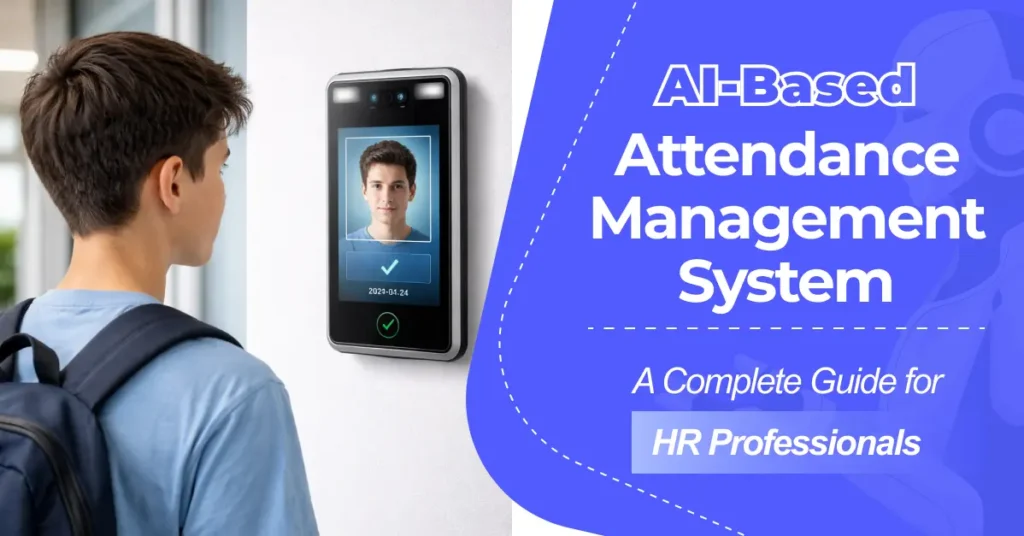
AI attendance management solutions automate recording employees’ attendance using AI technologies such as facial recognition, biometrics, geo-fencing, and geo-tagging. This technology eliminates manual input while also making sure your time is tracked accurately.
AI attendance systems can not only recognize patterns but also detect abnormal events such as buddy punching. These systems include integration into HRMS or payroll software as well as leave management systems to enhance the entire HR operation.
How Does an AI-Based Attendance Management System Work?
An AI-based attendance management system automates the whole process of tracking employee hours, making it correct, efficient and error-free. Here’s how it works in practice:
1. Employee Identity Recognition
Employees can be uniquely identified by AI-powered face recognition or biometric verification to ensure attendance is taken in a secure manner without physically touching the system or needing to intervene manually.
2. Real-Time Attendance Capture
Employees’ attendance will be captured upon check-in and check-out in real-time from any work device (whether it’s from the office, on mobile, or remote).
3. Geo-Fencing and Location Tracking
Employee locations will be tracked via GPS & geo-fencing by the AI, and therefore will only be marked as present from approved work locations.
4. Automated Shift and Policy Mapping
The AI systems will automatically apply shift schedules, late protocols, overtime policies, etc., to the system based on existing HR configurations.
5. Data Processing and Validation
AI will validate attendance data by identifying potential error sources (variations, duplicates, etc.) to minimise payroll processing errors.
6. HRMS and Payroll Integration
Once validated, attendance data will feed directly to the HR software, payroll software and leave management system for uncomplicated salary computation.
Key Features of an AI-Based Attendance Management System
1. Facial Recognition Technology for Attendance
Facial recognition technology that is driven by AI captures attendance in a reliable and precise way. This process of attendance verification eliminates any need for manual entry and eliminates any opportunities for proxy punching. The use of facial recognition technology requires no physical contact and allows for safer and faster attendance verification.
2. Mobile AI for Attendance Verification
With the use of mobile applications, employees are able to easily mark their attendance. The Attendance verification technology is powered by AI and guarantees authenticity; therefore, it is suitable for hybrid or remote workers, as well as for workers in the field. This confirmation of attendance provides employees with greater flexibility and productivity.
3. Intelligent Shift Management
The system creates complex schedules automatically for all types of shifts, including rotating, night, and flexible shifts. Attendance regulations are enforced automatically using AI, thus eliminating the need for manual HR intervention when calculating overtime and ensuring compliance with regulations.
4. Dashboard Reporting
HR will obtain real-time attendance data through an intuitive dashboard. AI-based analytical data will help identify trends, absenteeism patterns, and the productivity of the entire workforce so that HR can make informed decisions regarding the future management of the workforce.
5. HRMS Integration
AI Attendance software is integrated with HRMS, payroll, and leave management systems; data flows smoothly between these platforms, resulting in accurate salary calculations and simplified human resources processes.
6. Complying with Audit Readiness
The system creates tamper-proof attendance records that comply with labor laws. AI-generated biometrics provide an auditable and transparent solution for HR Audit, regulatory compliance, and HR accountability.
7. AI-based Anomaly Detection
AI looks for unusual patterns of attendance, such as frequent delay or absenteeism, and predicts these differences for HR so they can take proactive measures to reduce time theft and improve work efficiency.
Why Should Businesses Switch to an AI-Based Attendance Management System?
Transforming to an AI-based attendance management system offers various benefits for organizations, helping HR teams save time, improve accuracy, and boost workforce efficiency:
1. Removes Manual Error
AI automation decreases dependency on “manual” entries, reducing the number of calculation errors affecting payroll and compliance.
2. Eliminates Time Theft and Proxy Attendance
AI-powered attendance verification ensures that only verified employees are able to signify their presence at work, improving overall productivity for the company.
3. Reduces HR Time and Cost
HR professionals can spend less time resolving inaccuracies in attendance records and more time working on strategic initiatives.
4. Enhances Payroll Accuracy
Accurate attendance data leads directly to the improvement of payroll software calculations, thus reducing salary disputes.
5. Obey Modern Work Styles
AI-automated systems make it easy to adapt to remote, hybrid, and flexible working environments.
Impact of AI on Employee Attendance Tracking
AI has completely converted how organizations track and manage employee attendance in the following ways:
1. Enhanced Accuracy and Clarity
AI provides accurate, consistent, and completely transparent attendance tracking, allowing HR teams to build trust with employees and reduce the likelihood of human error associated with manual timekeeping.
2. Real-Time Visibility
HR managers have the ability to view workforce attendance, availability, and shift patterns in real time, allowing for improved decision-making and operational effectiveness at all locations.
3. Build Employee Trust
AI provides automated systems that reduce attendance conflicts by ensuring impartial, objective tracking of attendance, which will help reinforce employees’ confidence in the payroll and HR systems.
4. Predictive Attendance Insights
Using historical attendance data, AI can help make predictions about future absenteeism patterns, enabling HR departments to anticipate shortages in resources and prepare accordingly.
5. Integration with Leave Management
Attendance records are automatically linked to leave management systems, reducing manual effort to update employee leave balances and ensuring that payroll and HRMS accurately calculate leave payments.
6. Improved Compliance
AI-generated audit trails that are tamper-proof help ensure that an organisation meets labour standards and that HR audits are performed easily and with minimal risk of penalties.
How to Choose the Best AI-Based Attendance Management System?
Selecting the right solution is important for maximizing the benefits of AI in attendance management systems.
Step 1: Understanding Your Business Needs
- Look at the complete size of your workforce and how many people are grouped by the department.
- Recognize employees who work remotely, hybrid, and field-based.
- Identify the types of shifts, attendance regulations, rules, and documentation.
- Ensure that you are following all legal obligations for compliance and other employee rights under the Labour Law.
- Link attendance procedures to existing HR processes already in use.
Step 2: Evaluate AI Capabilities
- Measure the accuracy of facial recognition and biometrics.
- Establish the ability to use machine learning for identifying differences and patterns.
- Define the capability of geo-fencing technology to remotely track employees through GPS.
- Verify that there is adaptability for changes when there is a shift in the established policies.
- Look for constant AI learning and improvement of the AI system.
Step 3: Verify HRMS & Payroll Integration
- Verify that there can be a smooth integration with your existing HRMS system.
- Determine if your payroll software can accurately handle salary processing with time entered from your new systems.
- Does your leave management system automatically FTP files to payroll at scheduled times?
- Do you have one employee attendance database to track all employees?
- Does your HR dashboard receive real-time data from the system being used to track employee attendance?
Step 4: Ensure a Great User Experience
- The end-user experience, considering how employees and HR may access the interface.
- Mobile and remote access for hybrid employees.
- Ease of use for HR and employees; the check-in or check-out process should be very quick, and needs little or no training to use.
- Employee interfaces should be in multiple languages, depending on the employees’ nationality.
Step 5: Security and Data Privacy
- Data Protection and Encryption.
- Utilizing a secure and highly-available cloud infrastructure, with backups that allow for rolling retention of backups offsite.
- Role-based access for human resources and management.
- All companies will need to comply with both local and international laws regarding data privacy.
- Conduct regular security audits and vulnerability assessments.
Step 6: Reporting and Analysis
- Attendance reports that can be customized for either the department or individual employee.
- Real-time dashboards that show the business’s workforce trend.
- Reports that can be exported to comply with annual audits or to facilitate the regulatory compliance process.
- Predictive analytics for analyzing absenteeism and productivity trends.
- Actionable insights for management to make business decisions.
Step 7: Vendor Support and Scalability
- Access to customer support 24/7 to address issues with the system.
- Regular updates to software and adding new features.
- Provide scalable solutions that will support a growing organization.
- Experience with AI in attendance management systems and services.
- Provide a transparent pricing structure, without any hidden fees.
Future of AI-Based Attendance Management Systems
The viewpoint for attendance management systems based on artificial intelligence (AI) is huge. As companies are increasingly adopting digital transformation, we will see AI systems become more user-friendly, more predictive, and more focused on the needs of employees.
Newer systems will integrate much more tightly with existing Human Resource (HR) software and HRMS (Human Resource Management System) platforms to provide workforce analytics, productivity metrics, and automated compliance management. Attendance-related metrics will become a strategic metric for making sound business decisions.
As AI technology matures, expect to see more sophisticated attendance management systems that can respond in real-time to the employee’s behaviors, work patterns, and needs of the organization, creating a much more agile and data-driven Human Resource function.
Conclusion
An AI-based attendance management system is no longer a luxury but a necessity for modern organizations. It simplifies attendance tracking, improves accuracy, enhances payroll results, and supports flexible work environments.
By adopting AI in attendance management systems integrated with HRMS, payroll software, and leave management systems, organizations can build transparent, efficient, and future-ready HR operations.
Savvy HRMS offers a powerful AI-based attendance management system designed to meet the developing needs of Indian businesses with geo-fencing, geo-tagging, and face recognition attendance features.
Book a free demo today and see how Savvy HRMS can transform your attendance, payroll, and HR management smoothly.