Full Form of KSA: Meaning, Definition, Examples & Importance in HR


-
AuthorVikas Negi
-
 Last Updated
October 19, 2026
-
 Reading Time
22 Mins
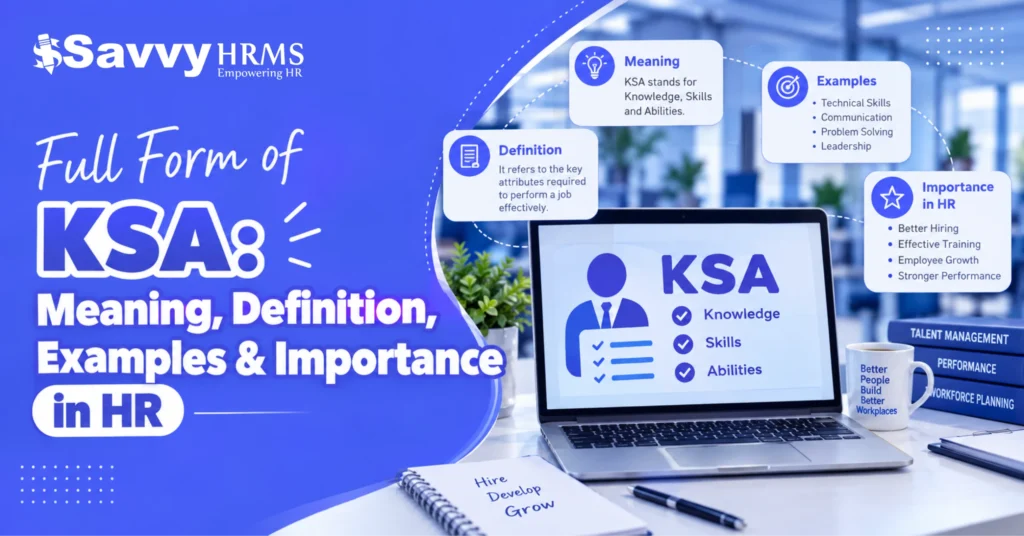
In human resource management, understanding what employees know, what they can do, and how effectively they perform their responsibilities is important for building a productive workforce. This is where KSA becomes important. The full form of KSA is Knowledge, Skills, and Abilities, three essential elements that help organizations understand the requirements of a job and evaluate an employee’s suitability for a role.
KSA provides a structured way to identify the qualifications, practical capabilities, and individual abilities employees need to perform their work successfully. HR teams can use this framework during recruitment, candidate selection, employee training, performance evaluation, and career development. For example, a payroll executive may need knowledge of payroll rules, skills in spreadsheet management, and the ability to identify salary discrepancies accurately.
Understanding KSA helps organizations make more consistent hiring decisions, identify employee skill gaps, and create targeted development plans. In this guide, we will explain the meaning of KSA in HR, its three components, practical workplace examples, implementation challenges, and ways to use KSA to improve workforce management.
TL;DR
- Full form of KSA: Knowledge, Skills, and Abilities.
- Meaning in HR: A framework for identifying the capabilities required to perform a job effectively.
- Three components: Knowledge refers to what an employee knows, skills describe what they can do, and abilities reflect what they are capable of accomplishing.
- Importance of KSA: It supports recruitment, candidate assessment, employee training, and performance management.
- Workplace example: A payroll executive needs payroll knowledge, payroll processing skills, and the ability to identify salary discrepancies.
- KSA vs. KPI: KSA defines job-related capabilities, while KPIs measure performance against specific objectives.
- Implementation challenges: Unclear job requirements, assessment bias, inconsistent evaluation, and changing skill requirements.
- Role of HR software: Platforms like Savvy HRMS help organize employee records, track performance, and manage training-related processes to support workforce development.
What Is the Full Form of KSA in HR?
The full form of KSA in HR is Knowledge, Skills, and Abilities. It is a framework used to identify the attributes a person needs to perform a particular job effectively.
According to the US Office of Personnel Management (OPM), knowledge, skills, and abilities are job-related attributes that can generally be demonstrated through education, experience, or training. Organizations can use these attributes to define job requirements and develop relevant candidate assessment methods.
The three elements have different meanings:
- Knowledge: What a person knows about a subject, process, system, or field.
- Skills: What a person can perform through learned practice and experience.
- Abilities: What a person can do by applying their capabilities to a task or situation.
For example, consider a company hiring an HR executive. The candidate may need knowledge of recruitment processes, skills in interviewing candidates, and the ability to manage multiple vacancies while meeting hiring deadlines.
KSA helps HR professionals move beyond qualifications alone and focus on what a candidate needs to know and demonstrate in the actual workplace.
Read also: Best Contract Labour Management Software in India
What Does KSA Mean in Human Resource Management?
In human resource management, KSA means identifying and evaluating the knowledge, skills, and abilities required for a job role. It helps HR teams connect job responsibilities with measurable employee requirements.
Instead of depending only on educational qualifications or years of experience, organizations can define what successful job performance looks like and assess candidates against those expectations.
For example, two candidates may have the same degree and similar work experience, but their practical capabilities may differ. One may be proficient in HR software and payroll processing, while the other may have stronger communication and employee relations skills.
A KSA framework helps recruiters identify which differences matter for the specific position.
KSA can support several HR activities:
- Job descriptions: Identifying the important requirements of each position.
- Recruitment and selection: Evaluating candidates against job-related criteria.
- Performance management: Identifying whether employees can meet role expectations.
- Learning and development: Finding gaps that require training or coaching.
- Career planning: Identifying capabilities employees need for future roles.
- Succession planning: Preparing employees for greater responsibilities.
The important point is that KSA should be linked to actual job responsibilities rather than a generic list of desirable qualities.
What Are the Three Components of KSA: Knowledge, Skills, and Abilities?
The KSA framework has three interconnected components. Although they work together, each measures a different aspect of job readiness.
1. Knowledge
Knowledge refers to the information, concepts, rules, and principles an employee understands and applies while performing a job.
Examples include:
- Understanding payroll calculations and salary components.
- Knowing recruitment procedures and interview practices.
- Understanding applicable labour laws and workplace policies.
- Knowing how attendance and leave management systems operate.
- Understanding data privacy and employee record management.
For example, an HR payroll executive needs knowledge of salary structures, deductions, payroll cycles, and applicable statutory requirements.
Knowledge can be assessed through written tests, technical questions, certifications, and practical case studies.
2. Skills
Skills are learned capabilities that enable employees to perform specific tasks effectively. They are often demonstrated through practical work.
Examples include:
- Using spreadsheets to analyse employee data.
- Conducting structured interviews.
- Preparing payroll reports.
- Operating HRMS platforms.
- Communicating workplace policies clearly.
- Resolving employee queries professionally.
For example, knowing what payroll reconciliation means is knowledge, while actually reconciling payroll records and identifying discrepancies is a skill.
Skills can be evaluated through work samples, practical assignments, demonstrations, and structured interviews.
3. Abilities
Abilities refer to a person’s capacity to perform tasks, apply reasoning, or respond effectively to workplace situations.
Examples include:
- Analysing information to identify patterns.
- Solving unfamiliar problems.
- Managing competing priorities.
- Understanding complex information.
- Making sound decisions within assigned responsibilities.
- Adapting to changing business requirements.
For example, an HR executive may know the recruitment process and have experience using an applicant tracking system. However, the ability to prioritize urgent vacancies while maintaining hiring quality is a separate requirement.
Abilities should be evaluated through job-relevant evidence rather than assumptions about a person’s personality or background.
In simple terms: Knowledge is what an employee knows, skills are what the employee can demonstrate, and abilities describe what the employee is capable of accomplishing.
Why Is KSA Important in HR?
KSA is important because it helps organizations define job requirements, assess candidates more consistently, and identify the capabilities employees need to perform effectively.
When job requirements are clearly defined, HR teams can make decisions based on relevant evidence rather than depending only on intuition or general impressions.
The major benefits of KSA in HR include the following.
1. Improves Recruitment Accuracy
A clear KSA framework helps recruiters identify essential qualifications and capabilities before advertising a vacancy. It also makes it easier to develop relevant interview questions and practical assessments.
2. Supports Fairer Candidate Evaluation
When candidates are evaluated against consistent, job-related criteria, recruiters can compare their responses and demonstrations more systematically. This does not automatically eliminate bias, but it can reduce inconsistent decision-making when applied correctly.
3. Identifies Employee Skill Gaps
KSA helps HR teams compare the capabilities required for a role with the capabilities an employee currently demonstrates. This comparison can reveal where additional training, mentoring, or practical experience may be needed.
4. Improves Training Effectiveness
Instead of offering the same training to every employee, organizations can develop learning plans based on specific capability gaps.
For example, employees who understand payroll concepts but struggle with payroll software may benefit more from practical system training than from another introductory payroll course.
5. Supports Performance Management
KSA connects employee expectations with actual job responsibilities. Managers can use the framework to discuss performance gaps, recognize strengths, and agree on improvement objectives.
6. Strengthens Workforce Planning
Organizations can identify which capabilities are available internally and which may need to be developed or recruited. This is particularly useful when implementing new technologies or expanding into new business areas.
For HR teams, the practical value of KSA lies in creating a clear connection between job requirements, employee capabilities, and business outcomes.
What Are Some Examples of KSA in the Workplace?
KSA requirements differ depending on the position, industry, seniority, and complexity of the work. The following examples show how organizations can apply the framework to common job roles.
| Job role | Knowledge | Skills | Abilities |
| HR executive | Recruitment and HR policies | Interview coordination and documentation | Managing multiple HR activities |
| Payroll executive | Salary structures and payroll rules | Payroll processing and reconciliation | Identifying discrepancies |
| Recruiter | Hiring processes and job requirements | Candidate screening and interviewing | Prioritizing vacancies |
| Accountant | Accounting principles and tax rules | Financial reporting and reconciliation | Analysing financial variances |
| Sales executive | Products and customer needs | Negotiation and presentation | Handling objections |
| Team manager | Business processes and team objectives | Delegation and communication | Decision-making under pressure |
| IT support specialist | Systems and troubleshooting concepts | Technical diagnosis and support | Resolving unfamiliar issues |
Consider a practical example involving a payroll executive.
The employee must understand salary components and applicable deductions. They must also know how to use payroll software, reconcile attendance records, and check salary calculations. In addition, they need the ability to investigate unexpected differences and resolve issues within payroll deadlines.
These requirements can be converted into clear assessment criteria.
For example, an organization may evaluate payroll accuracy, system proficiency, knowledge of applicable rules, and problem-solving ability separately. The criteria and their relative importance should reflect the actual responsibilities of the position.
This makes KSA useful for both recruitment and the ongoing development of existing employees.
How Is KSA Used in Recruitment and Employee Selection?
KSA helps HR teams establish a connection between the work a position requires and the evidence used to evaluate applicants.
The US Office of Personnel Management explains that job analysis identifies job duties and the competencies or KSAs required for effective performance. This information can then inform recruitment, assessment, and employee development processes.
A general KSA-based recruitment process involves these steps:
Step 1: Analyse the Job
Identify the role’s key responsibilities, expected outcomes, and working conditions. Consult managers and existing employees to understand the tasks and requirements necessary for successful job performance.
Step 2: Identify Required KSAs
Determine the important knowledge, skills, and abilities required for each responsibility. Focus on job-specific capabilities that directly influence performance, productivity, and the achievement of organizational goals.
Step 3: Define Assessment Criteria
Establish clear criteria to measure candidates’ capabilities and proficiency levels. Define acceptable performance standards and identify the evidence needed to evaluate each knowledge, skill, and ability consistently.
Step 4: Evaluate Applicants
Use suitable assessment methods, including technical questions, structured interviews, practical assignments, and job-related tests. Select methods that accurately measure the specific KSAs required for the position.
Step 5: Compare Evidence
Evaluate each candidate against the same job-related criteria to ensure consistency and fairness. Compare assessment results, practical demonstrations, and relevant experience before making informed recruitment decisions.
Step 6: Document Decisions
Record assessment results, supporting evidence, and the reasons behind selection decisions. Document identified capability gaps and potential development needs to support transparent hiring and future employee development.
For example, when hiring a recruiter, HR may assess knowledge of sourcing methods, practical interviewing skills, and the ability to manage several vacancies.
A structured interview might ask the candidate to explain how they would handle a difficult-to-fill position. A practical exercise could require them to shortlist candidates against a supplied job description.
The objective is not to find someone who meets every imaginable requirement. It is to identify the KSAs that are genuinely necessary for successful performance in that role.
How to Define KSAs for a Job Role?
Defining KSA requires a systematic understanding of the job. HR teams should start with actual work responsibilities instead of copying generic requirements from other job descriptions.
Follow these steps to develop a practical KSA framework.
Step 1: Identify Key Job Responsibilities
List the main activities the employee must perform. Focus on important tasks, expected outcomes, and decisions associated with the role.
For a payroll executive, these may include processing payroll inputs, validating attendance data, checking deductions, and preparing payroll reports.
Step 2: Map Responsibilities to KSAs
Determine what knowledge, skills, and abilities are needed for each responsibility.
For example, validating attendance inputs may require knowledge of attendance policies, skills in using the attendance system, and the ability to identify inconsistencies.
Step 3: Separate Essential and Preferred Requirements
Not every desirable attribute should become a mandatory requirement.
Classify each KSA as essential or preferred, based on its importance to the job. Avoid adding unnecessary qualifications that could exclude otherwise suitable applicants.
Step 4: Define Observable Evidence
Describe how the KSA can be demonstrated.
Instead of writing “strong analytical skills,” specify that the employee should be able to investigate payroll discrepancies, identify their causes, and document corrective action.
Step 5: Set Proficiency Levels
Use a simple scale to describe the required level of capability.
An organization might use four levels:
- Level 1 – Basic: Understands fundamental concepts and completes simple tasks with guidance.
- Level 2 – Working: Performs routine tasks independently.
- Level 3 – Advanced: Handles complex situations and resolves most problems independently.
- Level 4 – Expert: Develops processes, guides others, and handles highly complex cases.
These levels are an illustrative model, not a universal industry standard. Adapt them to the position and the organization’s operating requirements.
Step 6: Validate the Framework
Ask the hiring manager, experienced employees, and relevant subject-matter experts to review the requirements. Confirm that each KSA is necessary and that the assessment method measures it appropriately.
Step 7: Review Periodically
Update KSA requirements when job responsibilities, technology, business processes, or compliance obligations change.
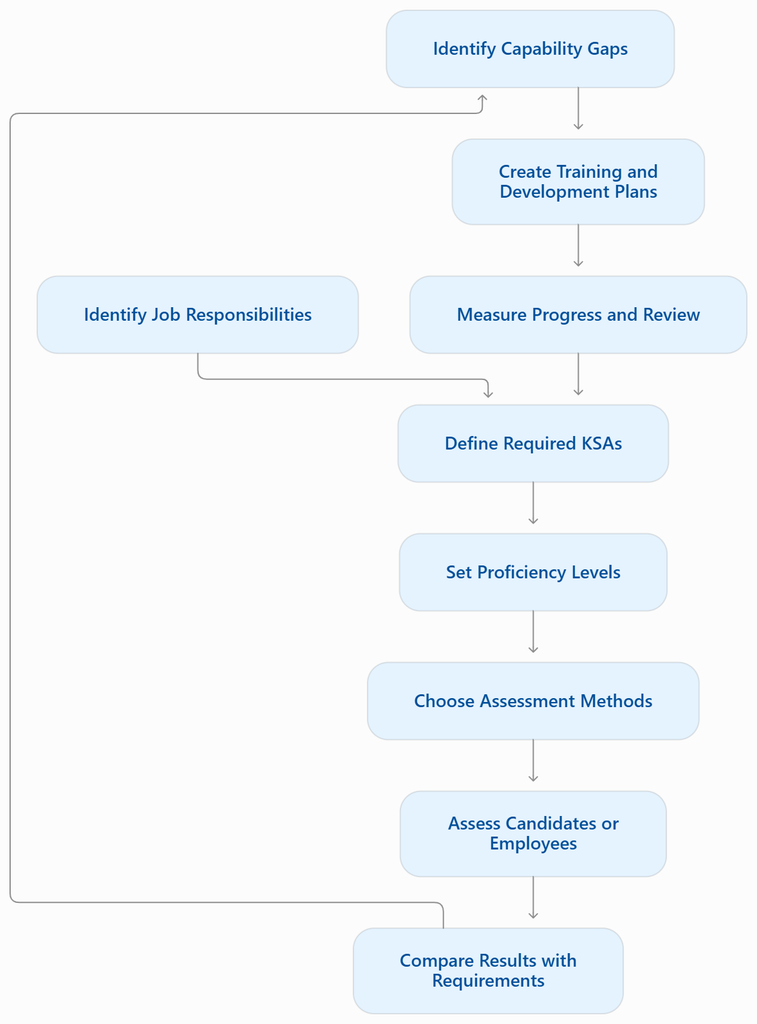
A well-designed KSA framework should be specific, measurable where practical, job-related, and easy for recruiters and managers to apply consistently.
How Can HR Teams Assess Knowledge, Skills, and Abilities?
HR teams should choose assessment methods based on the KSA being evaluated. A written test may be useful for technical knowledge, while a practical task may provide stronger evidence of an employee’s ability to perform a specific activity.
| Assessment method | Best suited for | Example |
| Technical test | Knowledge | Questions on payroll concepts |
| Work sample | Skills | Processing a sample payroll file |
| Structured interview | Knowledge, skills, and abilities | Asking every candidate the same job-related questions |
| Situational exercise | Abilities and applied judgment | Resolving a hypothetical attendance discrepancy |
| Performance review | Demonstrated workplace capabilities | Reviewing documented performance against expectations |
| Training assessment | Knowledge and skills | Testing whether an employee can use a new HRMS feature |
A structured approach can use a rating scale from 1 to 5, where 1 represents limited evidence, and 5 represents strong evidence against predefined criteria.
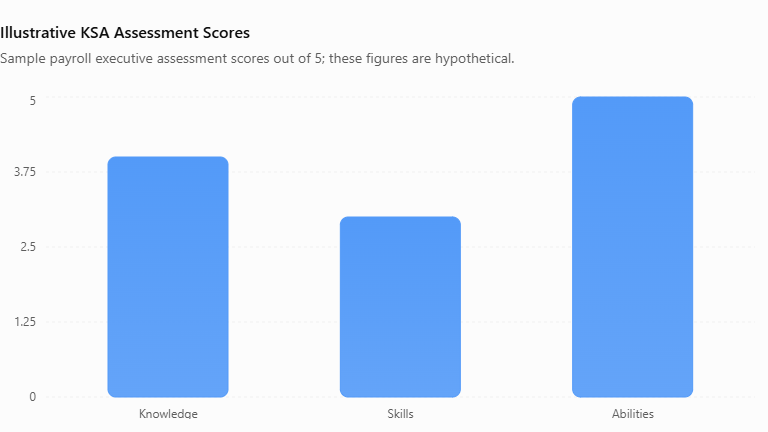
For example, an illustrative payroll assessment could allocate different weights to technical knowledge, practical system skills, and problem-solving ability.
The weighted score can be calculated as:
Weighted KSA score = Sum of (criterion score × criterion weight)
Suppose a candidate receives these scores:
| Criterion | Weight | Score out of 5 |
| Payroll knowledge | 30% | 4 |
| System proficiency | 40% | 3 |
| Problem-solving ability | 30% | 5 |
The weighted result is:
(4 × 0.30) + (3 × 0.40) + (5 × 0.30) = 3.9 out of 5, or 78% of the maximum score.
This is an illustrative calculation, not a hiring benchmark. Organizations should establish their own role-specific criteria, use reliable assessments, and consider any essential requirements separately rather than allowing a high overall score to compensate for a critical deficiency.
The purpose of assessment is to support informed decisions, not to reduce an individual’s potential to a single number.
What Is the Difference Between KSA, KRA, and KPI?
KSA, KRA, and KPI are related HR terms, but they serve different purposes.
- KSA: Knowledge, Skills, and Abilities. Describes the capabilities required to perform a job.
- KRA: Key Result Area. Describes a major area of responsibility in which an employee is expected to deliver results.
- KPI: Key Performance Indicator. A measurable indicator used to track progress or performance against an objective.
| Aspect | KSA | KRA | KPI |
| Main purpose | Identify required capabilities | Define responsibility areas | Measure performance |
| Focus | What an employee knows and can do | What the employee is responsible for | How results are measured |
| Example for a recruiter | Interviewing and sourcing skills | Talent acquisition | Time to fill vacancies |
| General use | Hiring and development | Goal setting | Performance tracking |
For example, a recruiter may need sourcing knowledge and interviewing skills (KSA). Their KRA may be talent acquisition, while a KPI could measure the percentage of vacancies filled within an agreed timeframe.
The three concepts work together. KSA helps identify the capabilities needed to perform the work, KRA defines the result area, and KPI measures progress.
However, KPIs should be selected carefully. A recruiter who fills vacancies quickly should not automatically be considered successful if the quality of hires or candidate experience suffers.
What Are the Different Challenges in Implementing KSA?
Organizations may use descriptions such as “good communication” or “strong analytical ability” without explaining what these phrases mean in the context of the job.
Although KSA can improve HR decision-making, implementation requires clear definitions, relevant assessment methods, and regular reviews.
1. Vague or Generic Job Requirements
Impact: Recruiters and managers may interpret the same requirement differently.
Solution: Define observable behaviors and connect them to actual responsibilities.
2. Difficulty Measuring Abilities
Knowledge can sometimes be tested directly, and practical skills can often be demonstrated. Abilities may be more difficult to evaluate because they can depend on the situation and the task.
Impact: Assessment may depend too heavily on subjective impressions.
Solution: Use job-related scenarios, structured questions, and consistent rating criteria.
3. Managerial Bias
Interviewers may unintentionally favour candidates who communicate similarly to them, share familiar backgrounds, or make strong first impressions.
Impact: Hiring decisions may become less consistent and may overlook qualified applicants.
Solution: Use structured interviews, multiple evidence sources, and documented evaluation criteria.
4. Changing Job Requirements
New technology, revised processes, and changing business priorities can make older KSA frameworks less relevant.
Impact: Employees may be assessed against outdated expectations.
Solution: Review job requirements periodically and update them when responsibilities change.
5. Limited Time and Resources
Developing job analyses, assessment tools, rating scales, and employee development plans takes time.
Impact: HR teams may create a framework but struggle to use it consistently across departments.
Solution: Start with critical roles, standardize reusable templates, and use HR technology to reduce repetitive administrative work.
6. Inconsistent Assessment Methods
One manager may use a technical test while another depends entirely on an informal conversation for the same role.
Impact: Candidate results may be difficult to compare fairly.
Solution: Establish common assessment guidelines while allowing relevant role-specific exercises.
7. Confusing Qualifications With Capability
A degree or certification can provide evidence of learning, but it does not always demonstrate practical proficiency in a particular task.
Impact: Employers may overlook candidates who have relevant experience or transferable skills.
Solution: Evaluate qualifications alongside practical demonstrations, relevant experience, and other valid job-related evidence.
8. Poor Documentation and Follow-Through
KSA assessments may be completed during recruitment but never connected to employee development or performance reviews.
Impact: Organizations miss opportunities to use assessment results to improve workforce capabilities.
Solution: Record relevant findings, assign development actions, and review progress over time.
Addressing these challenges requires a consistent process that balances standardization with the specific requirements of each job.
How Can Organizations Overcome KSA Implementation Challenges?
Organizations can make KSA more effective by treating it as an ongoing HR process rather than a one-time recruitment exercise.
The following practices can help:
- Start with job analysis. Identify actual tasks, responsibilities, and required capabilities before creating KSA criteria.
- Involve relevant stakeholders. Ask hiring managers and experienced employees to validate the requirements.
- Standardize assessment methods. Use consistent scoring criteria and structured interviews for comparable positions.
- Train hiring managers. Explain how to evaluate evidence and avoid depending on assumptions.
- Use practical assessments. Where appropriate, give candidates realistic work samples or job-related scenarios.
- Maintain clear records. Document assessment criteria, results, and reasons for decisions in line with applicable privacy and record-retention requirements.
- Connect KSA with employee development. Convert identified gaps into specific training, mentoring, or coaching activities.
- Review effectiveness. Compare hiring and development outcomes with the original objectives and revise the framework when needed.
Organizations can also use HRMS platforms to centralize employee records, maintain job information, organize training records, and support performance management.
Technology can make these processes easier to coordinate, but it cannot replace sound job analysis or responsible assessment decisions.
How Does KSA Support Employee Training and Performance Development?
KSA helps organizations identify the difference between the capabilities a job requires and those an employee currently demonstrates. This difference is commonly described as a skill or competency gap, although it may involve knowledge or abilities as well.
For example, an employee may understand attendance policies but struggle to use the organization’s attendance management system. In this case, the development requirement is primarily practical system training rather than additional policy instruction.
A simple development process can follow five steps:
1. Define the required KSA. Identify the knowledge, skills, and abilities needed for the role.
2. Assess current capabilities. Use appropriate evidence from work samples, assessments, or performance discussions.
3. Identify the gap. Compare current performance with the required proficiency level.
4. Create a development plan. Select training, mentoring, coaching, or practical assignments suited to the gap.
5. Measure progress. Reassess the employee and check whether performance has improved.
For example, an HR executive who needs to improve employee data reporting may complete spreadsheet training, practice with sample datasets, and then demonstrate the ability to prepare an accurate report independently.
Organizations can track relevant indicators such as training completion, assessment scores, error rates, and proficiency improvements. These measures should be selected according to the role and interpreted alongside other performance evidence.
KSA can also support career development. An employee preparing for a managerial position may need to develop delegation, decision-making, conflict resolution, and workforce planning capabilities in addition to existing technical knowledge.
By linking development activities to identified gaps, organizations can make learning more relevant and use training resources more effectively.
What Is the Difference Between KSA and Competency-Based Assessment?
KSA and competency-based assessment are closely related, but they are not identical.
KSA describes the knowledge, skills, and abilities required for a job. Competency-based assessment evaluates whether an individual demonstrates the broader capabilities needed to perform a role successfully.
Competencies may combine knowledge, skills, abilities, observable behaviours, and other relevant characteristics. In practice, the terms can overlap, and organizations may use them differently depending on their HR framework.
| Aspect | KSA framework | Competency-based assessment |
| Primary focus | Knowledge, skills, and abilities | Broader capabilities and demonstrated behaviours |
| Main question | What does the job require the employee to know and do? | How effectively does the person demonstrate the capabilities required? |
| Assessment examples | Technical tests and practical exercises | Behavioural interviews, simulations, and work samples |
| Application | Job requirements and employee assessment | Selection, performance, and development |
| Relationship | Can form the foundation of a competency model | May combine multiple KSAs with behavioural expectations |
For example, an HR manager may require knowledge of employee relations, skills in resolving workplace concerns, and the ability to analyse complex situations. A broader employee relations competency could combine these elements with observable behaviours such as listening carefully, applying policies consistently, and documenting decisions appropriately.
Neither approach is automatically better in every situation. The choice depends on the complexity of the role, the organization’s objectives, and the evidence needed to evaluate performance.
A well-designed framework makes requirements clear and connects assessments to the work employees actually perform.
What Are the Best Practices for Implementing KSA in HR?
To use KSA effectively, HR teams should focus on job relevance, consistent assessment, practical application, and continuous improvement.
1. Keep Requirements Job-Specific
Avoid applying the same generic KSA list to every role. A payroll executive, software developer, recruiter, and sales manager require different capabilities.
2. Prioritize Essential Capabilities
Identify which KSAs are critical for satisfactory job performance. Distinguish these from capabilities that can reasonably be developed after hiring.
3. Use Multiple Sources of Evidence
Combine interviews, practical demonstrations, work samples, and performance records where appropriate. No single assessment method is suitable for every KSA.
4. Establish Clear Rating Criteria
Define what different proficiency levels look like. Provide examples so assessors understand how to apply the scale consistently.
5. Review for Fairness and Accessibility
Ensure assessments are relevant to the job, accessible where reasonable, and designed to minimize unnecessary barriers. Follow applicable employment, accessibility, and anti-discrimination requirements.
6. Connect KSA With the Employee Lifecycle
Use the framework consistently across recruitment, onboarding, training, performance management, and career development rather than treating each activity separately.
7. Use HR Technology to Organize Information
An HRMS can help maintain employee information, manage training records, support performance reviews, and centralize relevant HR workflows. Choose features according to the organization’s actual needs.
8. Measure Outcomes and Update the Framework
Track indicators such as assessment completion, proficiency improvement, training effectiveness, and relevant performance outcomes. Review the results periodically to identify areas for improvement.
A useful starting point is to pilot the KSA framework with one department or a small group of roles. Collect feedback from HR, managers, and employees before expanding it across the organization.
This approach helps organizations identify practical issues early and refine the framework before wider implementation.
Conclusion:
The full form of KSA is Knowledge, Skills, and Abilities, a framework that helps HR teams define job requirements, assess candidates, and identify employee development needs. By linking capabilities with measurable responsibilities, organizations can strengthen hiring, training, and performance management. Consistent assessment and regular reviews help keep KSAs relevant.
HR software like Savvy HRMS helps organizations simplify recruitment, track employee performance, manage training records, and monitor workforce capabilities, making it easier to align employee skills with business goals.
Make Smarter HR Decisions with Savvy HRMS. Organize employee data, monitor performance, and align workforce capabilities with your business goals using Savvy HRMS.
Frequently Asked Questions (FAQ’s)
1. What does KSA stand for?
KSA stands for Knowledge, Skills, and Abilities. It is a framework used to identify the capabilities a person needs to perform a job effectively.
2. What does KSA stand for in HR?
In HR, KSA stands for Knowledge, Skills, and Abilities. HR teams use this framework to define job requirements, evaluate candidates, identify employee skill gaps, and plan training and development activities.
3. Why is KSA important in human resource management?
KSA helps HR professionals make informed recruitment decisions, assess employee capabilities, identify training needs, and improve performance management by aligning individual capabilities with job requirements.
4. What is an example of KSA in the workplace?
For a payroll executive, knowledge includes understanding salary structures and payroll rules, skills include processing payroll using HR software, and abilities include identifying discrepancies and resolving payroll-related issues.
5. What is the difference between KSA and KPI?
KSA refers to Knowledge, Skills, and Abilities required to perform a job, whereas KPI stands for Key Performance Indicator, a measurable value used to track progress toward specific performance objectives. KSA describes capabilities, while KPIs measure results.