Contractor vs Direct Employee Records: What HR Operations Must Keep Separate



-
AuthorVikas Negi
-
 Last Updated
October 19, 2026
-
 Reading Time
22 Mins
Contractor and direct employee records must be managed separately to maintain accurate payroll, attendance, employee documentation, and labour law compliance. Understanding the difference between contractor vs direct employee records is essential because both groups may work in the same organization, but their employment arrangements, contractual responsibilities, payment processes, and supporting documents can differ significantly.
For HR operations teams, the key is to maintain a clear record of who employs each worker, who processes their payments, which statutory obligations apply, and who is responsible for handling the required documents. Mixing contractor records with direct employee records can create payroll errors, missing documentation, compliance gaps, and difficulties during audits.
A structured recordkeeping system helps businesses maintain accurate workforce data, verify contractor compliance, and retrieve documents when needed. Whether an organization manages 50 employees or a large number of employees across multiple locations, separating records by worker category creates a more reliable foundation for HR operations, payroll management, and workforce reporting.
TL;DR
- Direct employees and contract workers have different documentation requirements.
- Maintain accurate employee details, contractor agreements, attendance, wages, and statutory records.
- Verify applicable EPF, ESI, labour law, and tax compliance requirements.
- Define recordkeeping responsibilities for contractors and principal employers.
- Use HRMS software like Savvy HRMS to simplify documentation, improve workforce visibility, and reduce manual errors.
What Is the Difference Between Contractor and Direct Employee Records?
The main difference between contractor and direct employee records is the employment relationship they document. Direct employee records generally relate to individuals employed directly by an organization, while contractor records may relate to workers supplied or employed by an external contractor under a service or labour contract.
For HR operations, this difference determines how records are created, maintained, verified, and used for payroll and compliance. However, the contractual label alone does not settle a worker’s legal status. The actual working arrangement and applicable law must also be considered.
Direct employee records
Direct employee records document an individual’s employment relationship with the organization. These records help HR manage the employee lifecycle, from recruitment and onboarding to salary processing, performance reviews, and separation.
General records include:
- Offer letters, appointment letters, and employment agreements.
- Employee master data, identification details, and emergency contacts.
- Salary structures, payroll calculations, payslips, and tax declarations.
- Attendance, working hours, overtime, and leave balances.
- Performance reviews, training records, and disciplinary documentation, where applicable.
- Applicable provident fund, ESI, tax, and other statutory records.
- Resignation, termination, full-and-final settlement, and exit documents.
Contractor records
Contractor records document the business relationship with the contractor and the workers deployed through that contractor. They help HR and procurement teams verify deployment, service periods, payment details, and relevant statutory compliance.
General records include:
- Contractor agreements, work orders, and purchase orders.
- Contractor registration, licence, and other applicable authorization documents.
- Worker deployment lists and site-wise attendance records.
- Wage registers, wage slips, and payment evidence maintained by the responsible party.
- Applicable EPF, ESI, and other statutory contribution records.
- Contractor invoices, bills, deductions, and payment approvals.
- Worker identity and onboarding documents required for deployment, safety, and compliance.
- Contract expiry, worker replacement, and exit records.
For Example: A manufacturing company directly employs 120 people and engages 45 housekeeping and security workers through contractors. The 120 employees should have their own employee master records and payroll history. The 45 contract workers should be identifiable through the relevant contractor, deployment location, service period, and compliance records.
Both groups may need to be counted in relevant workforce or statutory reports, but they should not automatically be processed through the same employment and payroll workflow.
Related blog: Best Contract Labour Management Software in India
Which Records Should HR Maintain for Direct Employees?
HR teams should maintain a complete, accurate, and secure record for every direct employee. These records should cover the employee’s entire lifecycle and be updated whenever an important employment detail changes.
A useful approach is to divide direct employee records into six categories.
1. Employee master data
The employee master is the central source of employee information. It should contain a unique employee ID, name, department, designation, reporting manager, joining date, work location, employment status, and other information required for HR operations.
Bank details, tax information, and identity documents should be restricted to authorized users.
2. Recruitment and onboarding records
These include the appointment letter, employment terms, qualifications or verification documents where relevant, joining forms, policy acknowledgements, and required declarations.
India’s four Labour Codes came into effect on 21 November 2025. The Ministry of Labour and Employment has highlighted appointment letters and formal employment documentation among the framework’s provisions. HR teams should check the applicable Code, rules, and any relevant transitional requirements when designing their onboarding process.
3. Payroll and compensation records
HR and payroll teams should maintain:
- Approved salary structures and revisions.
- Monthly earnings, allowances, deductions, and net pay.
- Payslips and payroll registers.
- Reimbursements, bonuses, incentives, and overtime payments, where applicable.
- Tax deduction calculations, deposits, and employee tax documents.
- Full-and-final settlement calculations.
Payroll records should reconcile with approved compensation, attendance inputs, and accounting entries.
4. Attendance and leave records
These records help HR calculate payable days, overtime, leave balances, and salary adjustments. They should include attendance punches or approved timesheets, regularization requests, leave applications, holiday calendars, and manager approvals.
5. Statutory and benefits records
Maintain the records relevant to the employee and establishment, such as provident fund membership and contributions, ESI details where applicable, tax withholding, and other mandatory benefits or deductions.
Not every employee will have identical statutory applicability. Eligibility should be assessed using the relevant law and rules rather than assumed from job title alone.
6. Performance and separation records
Performance appraisals, training completion, promotion approvals, transfers, disciplinary documentation, resignation acceptance, exit clearances, and final settlements should be retained according to the organization’s retention policy and applicable law.
HR operations tip: Assign a unique employee ID to every direct employee and link all employment-related records to that ID. This reduces duplicate profiles and makes it easier to retrieve records during payroll reconciliation or an audit.
What Records Must HR Maintain for Contract Workers?
Contract worker records require coordination between HR, the contractor, procurement, finance, site administration, and compliance teams. The objective is to establish which contractor deployed each worker, when and where the worker was deployed, and whether the relevant contractual and statutory requirements were met.
The precise documentation depends on the type of contract, the establishment, the work being performed, the applicable law, and the rules in force.
1. Contractor and contract documentation
Maintain the signed agreement, work order, scope of services, contract period, rate structure, authorized signatories, applicable registrations or licences, and renewal or amendment documents.
These records establish the basis on which the contractor provides services and the organization approves payment.
2. Worker deployment and attendance records
For each deployed worker, maintain or obtain the necessary information to verify:
- Worker name and unique reference or identification number.
- Contractor or subcontractor, where relevant.
- Worksite, department, and assignment.
- Deployment and exit dates.
- Attendance, shifts, working hours, and overtime where applicable.
- Supervisor or authorized contact.
- Site induction, safety training, and required access authorisation.
A worker who moves from one site to another should have a traceable deployment history. This is particularly important for businesses operating multiple factories, warehouses, offices, or project locations.
3. Wage and payment records
The responsible party should maintain the applicable wage registers, wage slips, payment evidence, overtime details, deductions, and other records required under the relevant framework.
The principal employer should establish a verification process for contractor wage payments where required. An invoice stating that wages were paid is not always sufficient evidence that each worker received the correct amount.
4. Statutory compliance documents
Depending on the applicable requirements, HR or the compliance team may need to verify:
- EPF contribution and employee-wise remittance details.
- ESI registration and contribution evidence, where applicable.
- Wage compliance and overtime records.
- Relevant contractor registration or licence details.
- Required registers, returns, and other labour compliance documentation.
- Records relating to inter-state migrant workers, where applicable.
EPFO has provided a Principal Employer functionality that enables eligible principal employers to monitor contractor compliance and view information relating to contract workers reported through the contractor’s electronic challan-cum-return process. This illustrates why organizations should not depend only on the contractor’s invoice when verifying statutory compliance.
5. Contractor worker exit records
When a worker’s deployment ends, update the deployment end date, site access, outstanding payments or documentation, and any applicable exit or clearance records. The contractor’s service agreement may continue even when an individual worker is replaced, so these are two separate events that HR must track.
Practical recommendation: Maintain a contractor master, a contract register, and a worker deployment register. Link them using unique contractor, contract, and worker identifiers instead of depending on names or spreadsheets with inconsistent labels.
Contractor vs. Direct Employee Records: Key Differences at a Glance
The following comparison explains how HR operations can distinguish the two record categories while maintaining the information needed for workforce management and compliance.
| Record category | Direct employees | Contract workers |
| Primary relationship | Employment relationship with the organization | Engagement through a contractor or service arrangement, subject to the actual legal relationship |
| Main record owner | Employer’s HR team | Contractor and principal employer, according to their respective duties |
| Core agreement | Appointment letter or employment agreement | Contractor agreement, work order, and relevant worker documents |
| Master record | Employee master | Contractor master and worker deployment register |
| Payroll workflow | Employee payroll | Contractor wage processing and invoice verification, as applicable |
| Attendance | Employee attendance and leave records | Worker deployment attendance, shifts, and relevant wage inputs |
| Payment evidence | Payslips, payroll register, and bank payment records | Applicable wage slips, wage payment evidence, invoices, and approvals |
| Statutory records | Applicable employee-specific contributions and deductions | Applicable worker-specific compliance evidence and contractor records |
| Performance records | Employee appraisal, development, and employment history | Service-related performance or deployment records, where relevant |
| Exit documentation | Resignation, termination, and final settlement | Deployment closure, replacement, contractor exit, or contract completion |
| Reporting | Employee headcount, payroll, attrition, and leave reports | Contractor headcount, deployment, invoice, and compliance reports |
Note: This is an operational comparison, not a universal allocation of legal responsibility. Statutory duties can overlap, and a contractor arrangement does not automatically remove the principal employer’s obligations.
How should HR structure its records?
A simple structure can help HR teams keep records distinct without creating unnecessary duplication.
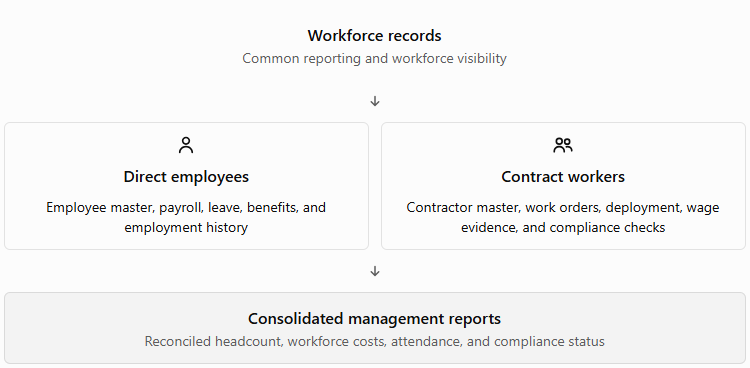
The important principle is to maintain separate source records while allowing authorized users to create consolidated reports. This supports workforce planning without confusing contractor payments with direct employee salaries.
How Should HR Separate Payroll, Attendance, and Leave Records?
Payroll, attendance, and leave records are closely connected. An error in any one of them can affect payments, cost allocation, and compliance reporting.
HR operations should establish separate workflows for direct employees and contract workers, with common validation controls where appropriate.
Separate the payroll processes
For direct employees, the payroll workflow generally uses approved salary structures, attendance, leave, overtime, reimbursements, deductions, and tax calculations to determine net salary.
For contract workers, the workflow may involve worker-wise wage calculations by the contractor, attendance verification, contract rates, approved invoices, and compliance checks. Payment of the contractor’s invoice is not the same as payment of an employee’s salary.
The two workflows may share financial reporting and approval controls, but their underlying records should remain identifiable.
Keep attendance and leave classifications accurate
For direct employees, attendance and leave systems should connect to employee IDs and approved leave policies.
For contract workers, records should identify the contractor, worksite, implementation period, shift, and applicable attendance or wage rules. Leave entitlements should be determined under the relevant employment arrangement and applicable law rather than automatically copied from a direct employee policy.
For example, if a contract worker records 24 working days in a month, HR should verify the applicable wage terms, attendance evidence, holidays, overtime, and deductions before approving the relevant wage or invoice data. The number of working days alone does not establish the amount legally payable.
Use a monthly reconciliation checklist
| Validation check | What HR should verify |
| Worker identity | Is every record linked to the correct worker and employment category? |
| Attendance | Do attendance totals match approved timesheets and deployment dates? |
| Payroll or wages | Do amounts reconcile with approved salary terms or applicable contract rates? |
| Statutory deductions | Are applicable contributions and tax deductions calculated and recorded correctly? |
| Invoice approval | Do contractor invoices match verified deployment and contractual terms? |
| Payment evidence | Is there evidence of payment to the relevant employee or worker where required? |
| Compliance | Have required returns, contributions, and supporting documents been checked? |
Illustrative data analysis: Monthly reconciliation
Consider an assumed organization with 200 direct employees and 80 contract workers. During one monthly review, HR identifies the following exceptions.
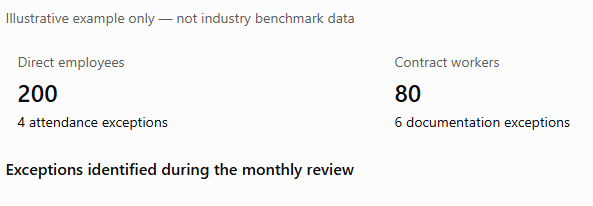
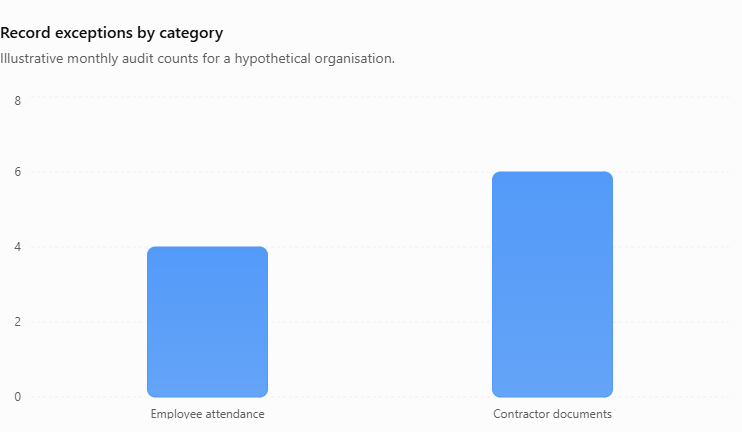
In this example, HR should investigate all 10 exceptions, record the corrective action, assign an owner, and confirm closure before the relevant reporting period is finalized. These numbers demonstrate a possible reporting method; they do not represent measured error rates for Indian businesses.
Useful monthly metrics include:
- Record completeness rate: Complete required records divided by total required records, multiplied by 100.
- Payroll exception rate: Records requiring payroll correction divided by records reviewed, multiplied by 100.
- Contractor compliance rate: Applicable contractor compliance checks passed divided by checks completed, multiplied by 100.
- Average exception closure time: Total time taken to resolve exceptions divided by the number of exceptions closed.
These metrics help HR identify recurring issues, compare sites, and prioritise corrective action. They should be calculated consistently and supported by documented definitions.
What Are the Labour Law Compliance Requirements for Contractor and Employee Records in India?
Labour law compliance is one of the most important reasons to separate contractor and direct employee records. Employers need to identify the correct worker category, maintain applicable documents, verify statutory payments, and produce reliable evidence when required.
As of October 2026, India’s four Labour Codes- the Code on Wages, 2019; Industrial Relations Code, 2020; Code on Social Security, 2020; and Occupational Safety, Health and Working Conditions Code, 2020– have been in force since 21 November 2025. The Ministry of Labour and Employment also reported that the Central Rules were notified on 8 May 2026. Organizations should review the current framework alongside applicable state rules, notifications, and transitional provisions.
1. Maintain Records According to Applicable Legal Requirements
HR teams should maintain records based on the legal requirements applicable to their organization and workforce. This includes wage and attendance registers, overtime details, payment records, and relevant employment documents.
- Wages and working hours: Keep accurate records of attendance, wages, overtime, deductions, and payments to ensure workers receive their applicable dues.
- Social security: Maintain relevant EPF and ESI records, verify applicable contributions, and check payment evidence for eligible workers, including contract workers.
- Employment documentation: Keep appointment letters and employment records for direct employees, along with contractor agreements and worker deployment records for contract labour.
- Workplace safety: Maintain relevant safety training, induction, and incident records for workers deployed at your establishment.
- Inter-state migrant workers: Where applicable, maintain the required records for workers recruited or deployed across state boundaries.
2. Understand the Principal Employer’s Compliance Responsibilities
Hiring a contractor does not automatically transfer every compliance responsibility to the contractor. Depending on the applicable law, the principal employer may also have verification, monitoring, or other statutory obligations.
For example, EPFO provides a facility for principal employers to monitor contractor compliance. HR teams should regularly verify applicable PF contribution records, reconcile worker details, and follow up on missing or inconsistent documents.
3. Keep Tax Records Separate from Labour Records
Salary payments to direct employees and payments to contractors may have different tax deduction requirements. HR and finance teams should classify payments correctly and maintain the supporting documents for each transaction.
From 1 April 2026, the Income Tax Act, 2025 applies to relevant payments and credits. Section 392 covers salary TDS, while Section 393 addresses specified payments, including contractor payments. Transactions on or before 31 March 2026 generally fall under the applicable provisions of the earlier Income-tax Act, 1961.
Keeping payment dates, register entries, TDS calculations, and supporting documents accurate helps HR and finance teams manage tax compliance and respond to audits more efficiently.
A practical compliance calendar for HR operations
| Frequency | Suggested review |
| At onboarding or deployment | Verify identity, employment category, appointment or contract documents, and required authorisations. |
| Monthly | Reconcile attendance, wages or payroll, applicable contributions, and payment evidence. |
| At contract renewal | Review contract validity, applicable registrations, worker deployment, and updated commercial terms. |
| Quarterly or as required | Review statutory returns, tax withholding, unresolved exceptions, and supporting documents. |
| At exit or deployment closure | Update worker status, settle applicable dues, close access, and archive required records. |
| Annually or when laws change | Review record retention, applicable policies, legal requirements, and system configurations. |
This is a suggested operating calendar, not a statement of statutory due dates. Actual filing and retention requirements must be checked against the relevant law and rules.
Who Is Responsible for Maintaining Contractor Records: The Principal Employer or the Contractor?
Both the contractor and principal employer may have recordkeeping responsibilities, depending on applicable laws and contractual obligations. Contractors generally maintain worker, wage, and deployment records, while principal employers maintain contract records and verify compliance where required. However, a service agreement cannot eliminate any statutory responsibility imposed by law.
1. Responsibilities of the contractor
The contractor’s operational responsibilities may include:
- Maintaining worker details and deployment records.
- Processing wages and retaining applicable wage-payment evidence.
- Maintaining required registers and wage slips.
- Completing applicable statutory filings and contributions.
- Providing compliance evidence to the principal employer where required.
- Updating worker deployment, replacement, and exit details.
2. Responsibilities of the principal employer
The principal employer’s responsibilities may include:
- Maintaining signed agreements, work orders, and contract validity dates.
- Identifying contractors and workers deployed at its establishment.
- Verifying attendance, deployment, invoices, and supporting evidence.
- Monitoring relevant statutory compliance and escalating errors.
- Maintaining records required by law for its own establishment.
- Coordinating with the contractor to resolve missing or inconsistent records.
For instance, if a contractor submits an invoice for 60 workers but the verified deployment register shows 54 workers, the principal employer should investigate the discrepancy before approving the invoice. The six-worker difference might reflect transfers, replacements, incorrect billing, or incomplete attendance records. It should not be resolved by simply changing the headcount to match the invoice.
Suggested responsibility matrix
| Activity | Contractor | Principal employer |
| Maintain contractor agreement | Supply relevant details as needed | Maintain the executed agreement |
| Maintain worker and deployment details | Maintain and update worker records | Maintain or verify establishment deployment records |
| Process contractor workers’ wages | Perform applicable wage obligations | Verify or oversee payment where required |
| Maintain relevant statutory records | Fulfil its applicable duties | Fulfil its own duties and any required oversight |
| Approve service invoices | Submit supporting invoice documents | Validate and approve according to controls |
| Close missing-document exceptions | Supply corrections and evidence | Track, escalate, and confirm resolution |
The matrix is a practical starting point rather than a substitute for a legal responsibility assessment. Each organization should assign named owners and document escalation procedures.
Flowchart: Contractor record verification process
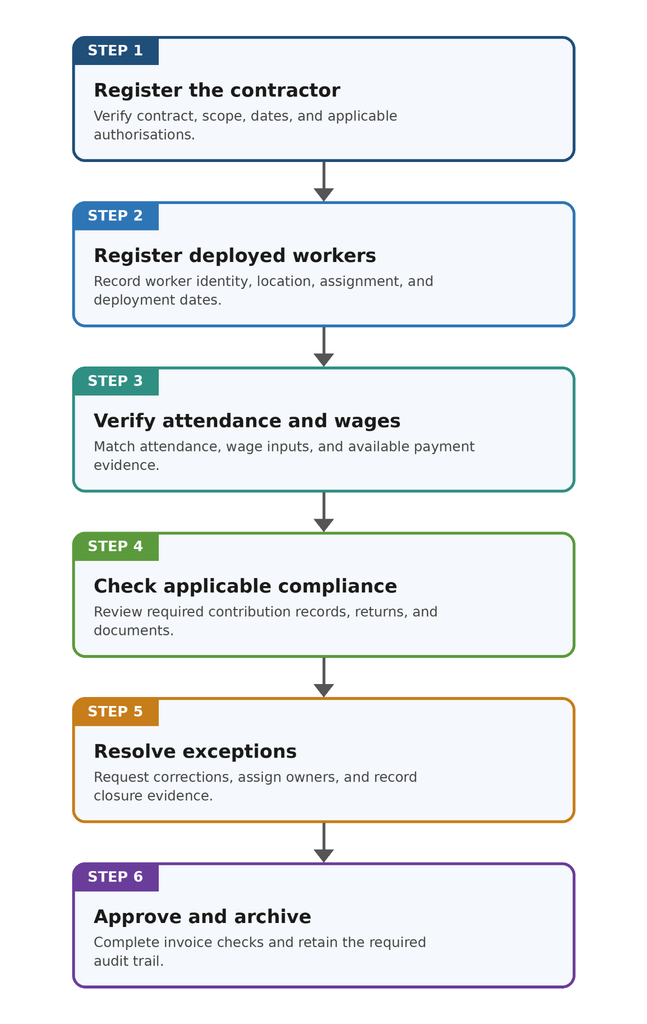
This process gives HR operations, finance, procurement, and compliance teams a shared workflow for identifying missing documents before they affect payments or audits.
What Recordkeeping Mistakes Should HR Operations Avoid?
Even organizations with established HR processes can face problems when contractor and direct employee records are incomplete, inconsistent, or maintained in disconnected systems. The most effective way to reduce these risks is to define clear record ownership, validation rules, and periodic review procedures.
1. Using the same employment classification for everyone
A contractor’s worker should not automatically be entered into the HRMS as a direct employee merely because they need an employee ID for attendance or building access.
What to do instead: Use a distinct worker category and link the worker to the relevant contractor and deployment record. Keep operational access separate from employment classification.
2. Processing contractor invoices like employee payroll
Direct employee payroll and contractor billing follow different processes. Employee salary is calculated using the applicable employment terms, whereas contractor invoices may be based on agreed service rates, verified deployment, deliverables, or other contractual terms.
What to do instead: Establish separate approval workflows while retaining the necessary links between attendance, wage evidence, invoices, and accounting records.
3. Accepting incomplete compliance documents
A contractor invoice or declaration may not, by itself, demonstrate that every applicable worker-level obligation has been fulfilled.
What to do instead: Define the evidence required for each applicable check, assign a reviewer, and maintain a record of discrepancies and corrective actions.
4. Ignoring changes in worker deployment
When a worker changes location or a contractor replaces a worker, old records may remain active while new records are created. This can result in duplicate headcounts, incorrect attendance, or invoices for workers who were not deployed during the billed period.
What to do instead: Track effective dates for onboarding, transfer, replacement, and exit. Reconcile worker lists with site-level attendance each month.
5. Storing sensitive documents without access controls
Identity documents, bank details, salary records, tax information, and employment documents should not be accessible to every user who can view workforce data.
What to do instead: Apply role-based access, maintain access logs, establish document-retention rules, and use secure storage and sharing practices.
6. Keeping multiple conflicting spreadsheets
Different versions of contractor lists, payroll files, and attendance reports make it difficult to establish which information is correct.
What to do instead: Establish an authoritative record for each data category. Use unique IDs, controlled updates, and documented approval processes.
7. Failing to monitor record quality
An organization may have thousands of stored documents but still lack reliable compliance visibility if the records are outdated or cannot be matched to workers.
What to do instead: Monitor completeness, duplicate records, missing documents, unresolved exceptions, and average correction time.
How can HR measure improvement?
Use the following illustrative dashboard to monitor recordkeeping performance. The targets are suggested internal goals, not statutory standards or industry averages.
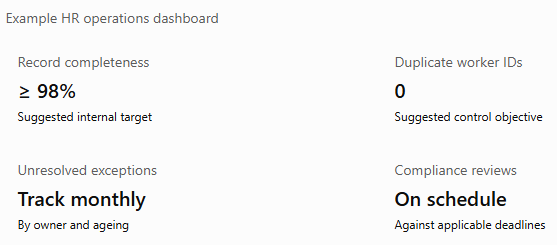
Review these metrics by location, contractor, business unit, and worker category. That helps HR identify whether a problem is isolated to one contractor or reflects a wider process issue.
How Can HRMS Software Help Manage Contractor and Direct Employee Records Separately?
Managing contractor and direct employee records through disconnected spreadsheets, email attachments, and manual registers can become increasingly difficult as a business expands. An HRMS can provide a more structured way to organize workforce information, automate routine checks, and produce consolidated reports.
However, an HRMS should support the organization’s legal and operational processes, not replace the need to determine which laws and obligations apply.
1. Maintain separate worker categories
An HRMS should allow organizations to distinguish direct employees from contractor workers and associate each record with the relevant employment relationship, contractor, location, and status.
This helps HR generate accurate workforce reports without treating every individual as a direct employee.
2. Centralise documents and expiry tracking
A central document repository can help HR track appointment letters, contractor agreements, relevant licences, worker deployment records, and other required documents.
Automated reminders can flag contracts approaching expiry or documents awaiting renewal. Access controls help ensure that only authorized users can view or update sensitive information.
3. Improve payroll and attendance accuracy
Integration between attendance systems and payroll workflows can reduce manual data entry and improve reconciliation.
For direct employees, approved attendance and leave can feed the relevant payroll calculations. For contract workers, verified deployment and attendance can support wage checks and invoice validation where appropriate.
The system should preserve the distinction between salary processing and contractor billing.
4. Monitor statutory compliance
An HRMS or integrated compliance platform can help track applicable contribution evidence, filing status, missing documents, and overdue actions. The usefulness of these features depends on the product’s actual functionality and the quality of the underlying data.
HR teams should verify compliance evidence rather than treating an automated status indicator as conclusive proof that every legal obligation has been met.
5. Use analytics for better decisions
HR dashboards can help answer practical questions such as:
- How many direct employees and contract workers are deployed at each site?
- Which contractors have missing or expired documents?
- How many payroll or attendance exceptions remain unresolved?
- What is the monthly workforce cost by department, location, and worker category?
- Which contractors have recurring documentation or reconciliation issues?
- How long does it take to close a compliance exception?
Example: Manual records versus structured HRMS workflows
| Activity | Manual approach | Structured HRMS approach |
| Worker classification | Repeated manual checks | Category-based records and validation |
| Document tracking | Spreadsheet reminders | Expiry alerts, where supported |
| Attendance reconciliation | Separate file comparisons | Integrated records and exception reports, where supported |
| Contractor invoice verification | Manual matching of documents | Linked deployment, attendance, and approval workflows, where supported |
| Compliance monitoring | Email follow-ups | Central status tracking and assigned actions |
| Reporting | Manual consolidation | Filterable workforce dashboards and reports |
These benefits depend on system configuration, data quality, and integrations. Not every HRMS offers contractor management, compliance monitoring, or contractor invoice workflows as standard features.
Conclusion
Keeping contractor and direct employee records separate helps HR teams maintain accurate payroll, simplify compliance, and reduce recordkeeping errors. With clear processes and suitable HRMS software, businesses can improve workforce visibility, strengthen audit readiness, and manage employee documentation more efficiently while supporting smooth HR operations.
Still managing employee and contractor records manually?
Let Savvy HRMS help you simplify HR tasks and keep workforce data organized.
Explore Savvy HRMS today and make everyday HR management a little easier!
Frequently Asked Questions (FAQs):
1. What is the difference between contractor and direct employee records?
Direct employee records contain employment details, salary, attendance, leave, and benefits. Contractor records cover contractor agreements, worker deployment, wage details, and applicable compliance documents.
2. Why should HR keep contractor and direct employee records separate?
Separate records help HR avoid payroll errors, maintain accurate workforce data, track compliance requirements, and simplify audits.
3. Who is responsible for maintaining contractor records?
Both the contractor and principal employer may have recordkeeping responsibilities. Their specific duties depend on applicable labour laws, contractual terms, and the nature of the engagement.
4. How should HR manage payroll records for contract workers?
HR should verify deployment, attendance, applicable wage calculations, payment evidence, and relevant statutory contributions before approving contractor invoices or related payments.
5. Can HRMS software help manage contractor and direct employee records separately?
Yes. An HRMS can help organize worker records, track documents, manage attendance, monitor compliance tasks, and generate workforce reports, depending on the software’s available features.