

What Is OKR? A Beginner’s Guide for HR Teams Using HR Software


-
AuthorRuchika Rajput
-
 Last Updated
July 04, 2026
Last Updated
July 04, 2026
-
 Reading Time
11 Mins
Reading Time
11 Mins
Organizations looking for lasting performance benefits and growth must use goal setting. Teams that do not have a system for setting or managing their goals lack direction (which means that they may not be able to figure out where to spend the majority of their efforts), as well as being able to identify the most important things that each member of their team should be working on.
In order to align their goals with those of their organization, it is important for HR teams to create a framework whereby each employee’s goals are tied to the organization’s business priorities. Unfortunately, managing goals using a paper-based or different system for tracking progress on employee performance is challenging, creating a lack of accountability and producing outcomes that are often unimportant.
HR teams that use OKRs as a framework for setting and tracking employee goals and performance can connect OKRs as a goal framework, performance management systems, attendance and leave management systems, and payroll systems through HR technology platforms. This allows HR to create a smooth, integrated system for managing goals that are consistent across all aspects of the employee’s work life.
What Is OKR?
The meaning of OKR (Objectives & Key Results) is the setting of a company’s direction through the establishment of metrics or standards for measuring success to identify whether the goals were reached.
OKR provides an organization with the capability to focus on important areas, build a strong sense of accountability across all levels of an organization, being able to align performance management systems with OKRs, using modern HRMS and HR Software tools, thereby simplifying the way an Organization tracks progress on its goals and objectives.
Why Do OKRs Matter for Every Organization?
OKRs provide the way that an organization presents direction, clarity, and measurable focus. They are particularly beneficial to an organization growing rapidly with remote or hybrid teams, in that they will connect the individual contributions of every employee to the overall objectives of the organization.
1. Goal Alignment
The OKR system connects the goals of employees and their contributions to the overall business goals. This helps everyone in the organization stay focused and aligned on the same objectives.
2. Focus and Prioritization
OKRs create the necessary focus for employees, so they will spend their time on the highest priority tasks instead of being distracted by low-priority and low-impact tasks.
3. Performance Measurability
The OKR Key Results set forth specific, quantifiable metrics that objectively measure employee performance.
4. Team Transparency
OKRs provide visibility to each team’s objectives, so all departments have greater visibility into how the other departments work towards their goals.
5. Employee Engagement
Employees who can see how their work affects the overall success of the organization will have higher levels of motivation.
6. Learning Improvement
Regularly scheduled OKR reviews will encourage ongoing feedback, learning, and continual improvement of employee performance.
7. HR Software Usage
OKRs can be easily tracked, analyzed, and reported when they are included in the HR software or HRMS that the organization uses.
How Does OKR Work in Any Organization?
OKRs work as a structured and continuous cycle rather than a one-time activity. HR teams use HR software to manage this cycle efficiently.
1. Defining Company-Wide Goals
The executive management will develop clear, measurable, company-wide goals based on the top-priority goals for the organization. There will be an effort to ensure that all teams understand the organization’s direction and focus on specifically defined areas of focus and projected results.
2. Creating Department-Level OKRs
Company-wide goals are broken down into departmental functional objectives (OKRs) for Departments to determine how they can best contribute to achieving the company’s overall objectives, while ensuring alignment with the overall goals of the organization.
3. Establishing Individual-Related OKRs
Each Employee will have their own individual OKRs aligned with department-level and company-wide goals, clearly defining the employee’s area of responsibility, expectations, and how to measure their success.
4. Incorporating OKRs with HR Systems
The HR Management System (HRMS) will include OKRs with Attendance Tracking Software and Performance Management (PM) modules within the HRMS. This integration allows for centralization of OKR tracking, automated tracking of the OKRs, and better visibility for the HR team.
5. Continuous Tracking of Progress
There will be regular monitoring of progress (weekly, bi-Weekly or monthly), using HRMS Dashboards. This allows employees and managers to track progress, identify gaps, adjust priorities as necessary, and ensure they stay on track.
6. Ongoing Check-In Meetings and Reviews
Managers will continuously check in with their staff to review progress, provide ongoing feedback, and support staff through challenges created by the development of OKRs. These meetings and reviews will provide opportunities for all employees to continuously develop their performance and remain accountable to their OKRs.
7. Assessing OKR Results
At the end of each cycle, OKRs will be evaluated by Managers to measure individual accomplishments, to identify gaps, and to assess how the OKR impacted overall performance.
8. Revising and Learning
Lessons learned through the evaluation of OKR results can be used by organizations to create more effective OKRs for the next cycle and improve the quality of goals.
What Are the Best Practices for Setting OKRs?
Setting effective OKRs needs clarity, discipline, and consistency. HR teams must guide managers and employees on best practices while using HR software for structure.
Below are the best practices for setting OKRs:
1. Objectives Must be Straight Forward and Simple
Mutually agreeable objectives will enhance the odds of maximizing employee productivity while holding them accountable for ultimately achieving the specific goals.
2. OKRs Should Have A Maximum Limit of 5 Per Cycle
Implementing a maximum of 3-5 OKRs for each cycle prevents excessive OKR overload, allowing individuals to concentrate on a defined high-priority goal.
3. Key Results Must Be Quantifiable
To effectively measure whether or not your objective has been met, it is imperative that all key results are quantifiable, timed, and delineated as to when they will need to be measured.
4. Alignment Across All Levels Is Critical
All levels of an organization must have similar OKRs to ensure coordination and collaboration among individuals, departments, and divisions.
5. Use Shorter OKRs Cycles
Using shorter cycles for your OKRs (historically quarterly) enables quicker processing time for updates and corrections to OKRs due to changes in business priorities.
6. Tracking Your OKRs Using HRIS Software
Tracking your OKRs with the help of HRIS will provide transparency into the process as well as real-time updates and seamless collaboration between HR personnel and OKR managers for future evaluations of OKR performance.
How to Write an OKR?
Writing OKRs becomes easier when HR teams follow a structured approach supported by HR software.
Step 1: Identify the Goal
An objective should be simple and specific to help identify the outcome, how to achieve it, and the overall direction of the objective. This is how an organization can see what it means to achieve a successful outcome.
Objectives should motivate a team to focus its attention on the most meaningful outcome, clarify how to focus on accomplishing the outcome, and have a clear direction toward an overall goal.
Step 2: Align with Strategy
When aligning objectives with the strategy, departments and company leadership align objectives with the organization’s strategy, so there are no wasted resources or conflicting objectives in the organization.
When objectives are aligned vertically through the organization and horizontally between departments, employees understand how the objective is relevant to them, which keeps them motivated to complete the objective.
Step 3: Define Key Results
Key results are the process for measuring success for achieving an objective; therefore, key results create a basis for measuring success and defining when a goal will be reached.
Fewer than five key results for each objective create a more focused approach and allow teams to track success more consistently across multiple cycles.
Step 4: Make Results Measurable
Key results have quantifiable numerical, percentage-based, and milestone-based measures of success. By establishing measurable key results, one can eliminate darkness about a key result to make performance discussions objective and data-driven for all participants.
Having established metrics allows HR teams to not only track their HR performance through dashboard functionality in their HR software but also quickly identify gaps needing corrective measures at all times.
Step 5: Assign Ownership
To enhance ownership, a clear assignment of responsibility must occur to provide confidence and ownership for individuals or teams driving results consistently throughout the entire cycle.
Having established ownership will improve the HR team’s follow-up, encourage proactive problem-solving, and reduce any confusion during performance reviews.
Step 6: Track within the HR Software System
Using HRMS for tracking OKR provides real-time visibility of HRMS, structured updates to the HRMS, and centralized storage of HRMS records for HR teams across cycles.
HRMS software dashboard tools enable regular check-ins on OKR, support analysis on progress, and provide timely intervention on OKR, thus maintaining OKR to be consistent with business success throughout.
What Type of OKRs Do Companies Use?
Organizations use various types of OKRs based on their structure and goals.
1. OKRs of the company
The company’s objectives and key results (OKRs) are important in creating a framework for the overall direction, priorities, and measures of success for the organisation, and they help ensure that leadership and functional organisations are aligned to long-term business objectives.
2. Department
Departmental OKRs are the OKRs that translate the company’s objectives into functional OKRs to define how the HR, sales, finance, and operations teams will work towards the success of the organisation.
3. Individual
Individual OKRs focus on employee-level goal setting to create clear accountability, measurable performance expectations, and visibility into how an employee’s goals align with their team’s objectives.
4. Committed OKRs
Committed OKRs are important goals for teams that are expected to achieve the full potential of committed OKRs during a defined cycle, resulting in a measurable impact on key business accomplishments.
5. Aspirational OKRs
Aspirational OKRs are designed to challenge teams to be innovative, to take risks and experiment with new things, while creating aspirations for future growth, even if they are not fully achieved.
OKR Examples for better understanding
Example 1: HR Team OKR
Objective: Improve employee engagement across the organization
Key Results:
- Increase engagement survey score from 70% to 85%.
- Reduce employee attrition by 15%.
- Implement monthly feedback using HR software.
Example 2: Payroll and Compliance OKR
Objective: Improve payroll accuracy and compliance
Key Results:
- Achieve 100% on-time payroll processing.
- Reduce payroll errors by 90% using payroll software.
- Automate attendance and leave tracking through HRMS.
What Are the Benefits of OKRs?
OKRs offer multiple benefits when implemented correctly using HR software.
1. Clear, Linked Goals
Employees, Teams, Leaders, are all of us working toward the same objectives. As a result, not being on the same page has caused many of the problems organizations have today. In addition to this, organizations can work together as a merged team in achieving their objectives.
2. Performance Management Strategy
As we know, OKRs create a framework for how we manage our continued ability to perform. Using the continuous performance management method and providing ongoing feedback to employees with measurable results has eliminated the annual performance appraisal model.
3. Decision Making
As leadership teams have access to real-time information regarding OKR metrics, they can make informed decisions more quickly than ever before and identify and address issues earlier. Decision-making will be based on metrics rather than just data; course corrections can also be achieved more quickly.
4. Accountability
With the clarity of OKRs and responsibilities for achieving shareable and measurable outcomes, employees are called upon to provide accountability for their own accomplishments, keep track of progress, and continue meeting the organization’s objectives.
5. Transparency
Human Resource Management System dashboards provide a view of OKR priorities, and the use of the OKR dashboard allows for increased visibility, trust, and agreement across various levels in management.
6. Scalability
OKRs can scale up with your organization when there are changes in priorities or growth in the organization, thus adapting to new conditions or implementing new strategies.
7. Integration with Human Resources Tools
OKRs are easily integrated with attendance, leave, and payroll systems as well as HR systems, offering a fully integrated performance management solution.
Conclusion
OKRs not only help to set goals; they establish a culture that promotes concentration, unity, and quantifiable output. Through using OKRs, HR departments can create alignment between their personnel programmes and business results while providing transparency and accountability.
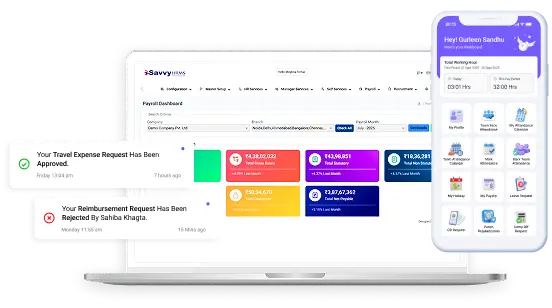
With the beginning of advanced human resources management (HRMS) systems such as Savvy HRMS, the implementation of OKRs can be simplified and expanded. These systems enable HR professionals to track OKRs and manage payroll, track attendance, and manage employees’ leaves of absence in one location. Using advanced HR technology in conjunction with OKR methodology enables companies to create high-performance, results-oriented work environments.