

Best HR Software for the Healthcare Industry (2026 Edition)


-
AuthorRuchika Rajput
-
 Last Updated
December 30, 2025
Last Updated
December 30, 2025
-
 Reading Time
12 Mins
Reading Time
12 Mins
The healthcare industry runs 24/7. From doctors and nurses working in different shifts to administrative staff managing compliance, payroll, and patient support, people management in healthcare is difficult.
Are traditional HR methods enough to handle this level of employee intensity? Or is it the right time to switch to smarter digital solutions?
With growing regulatory requirements, staff shortages, and increasing patient expectations, the healthcare industry can no longer afford manual HR processes. This is where HR software for the healthcare industry plays an important role, simplifying attendance, payroll, compliance, and performance management systems in one merged system.
But with so much software available, how do you choose the best HR software for the healthcare industry? Which solution supports shift-based attendance, statutory compliance, and employee scalability while remaining easy to use? This blog answers all these questions and more.
In this complete guide, we explore what HR software means for healthcare, review the top HR software for the healthcare industry, highlight key features, selection factors, implementation strategies, and conclude with why Savvy HRMS stands out as a preferred choice.
What Is HR Software for the Healthcare Industry?
HR software for the healthcare industry is a specialized digital solution designed to manage complex employee operations in hospitals, clinics, diagnostic centers, and medical institutions. It helps automate essential HR tasks such as employee records, shift-based attendance management systems, leave tracking, payroll software, and compliance management.
Unlike other general HR software, healthcare-focused HR systems address unique challenges such as 24/7 staffing, night shifts, stand-by doctors, contractual employees, credential tracking, and strict labor laws. By integrating payroll software, leave management systems, and performance management systems, HR teams can reduce errors, save time, and improve overall employee efficiency.
Best HR Software for the Healthcare Industry
1. Savvy HRMS
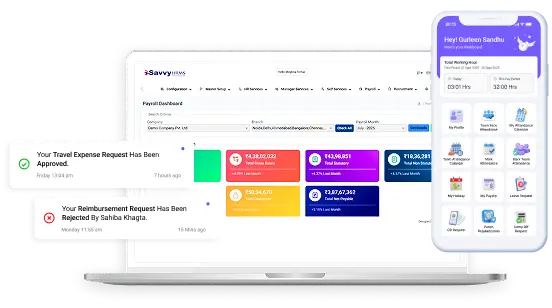
Savvy HRMS is a complete and scalable HR software designed to meet the demanding employee needs of the healthcare industry. It smoothly integrates attendance, payroll, compliance, and performance management, making it perfect for hospitals, clinics, and healthcare chains.
Why Choose Savvy HRMS?
- Shift-Based Attendance Management System: Supports rotating shifts, night duties, and biometric integrations.
- Automated Payroll Software: Ensures correct salary processing with statutory compliance.
- Advanced Leave Management System: Handles planned, unplanned, emergency, and compensatory leaves.
- Compliance & Statutory Readiness: Built-in compliance with PF, ESI, PT, and labor laws.
- Performance Management System: Track KPIs, appraisals, and continuous staff performance.
- Employee Self-Service (ESS) Portal: Reduces HR workload with self-service access for staff.
- Scalable for Growing Healthcare Units: Perfect for single clinics to multi-location hospitals.
- User-Friendly Interface: Minimal training required for HR teams and employees.
- Customizable Workflows: Tailored modules for healthcare-specific HR needs.
Price: Starting from ₹50 – ₹80 per employee per month (this is the approximate pricing and can be customizable according to the needs of the healthcare industry)
Best For: Hospitals, clinics, diagnostic centers, and healthcare companies of all sizes
2. Keka HR
Keka HR is a modern HR software offering payroll, attendance management, and performance tools with a clean and intuitive interface suitable for healthcare companies.
Why Choose Keka HR?
- Smart Attendance Tracking: Supports biometric and geo-based attendance.
- Payroll Automation: Precise and compliant payroll software.
- Leave Management System: Configurable leave requests and approvals.
- Performance Management Tools: Goal setting and appraisals.
- Employee Self-Service: Improves HR efficiency.
- Easy Integrations: Connects with third-party systems.
Price: Starting from ₹60 per employee per month
Best For: Perfect for Mid-sized hospitals and healthcare startups.
3. Pocket HRMS
Pocket HRMS is a cloud-based HR software offering strong automation, payroll compliance, and mobile accessibility for healthcare industries.
Why Choose Pocket HRMS?
- Cloud-Based HR Software: It can be accessed from anywhere.
- Payroll & Compliance Management: Provides correct statutory calculations.
- Attendance Management System: Shift and overtime tracking.
- Mobile App Support: Perfect for on-the-go staff.
- HR Analytics & Reports: Data-driven decision-making.
- Secure Employee Database: Centralized records of employee data.
Price: Starting from ₹45 – ₹70 per employee per month
Best For: Small Clinics and small-to-mid healthcare companies.
4. uKnowva HRMS
uKnowva HRMS combines HR automation with collaboration tools, making it perfect for healthcare teams requiring communication and engagement.
Why Choose uKnowva HRMS?
- Centralized HR Operations: All HR processes in one platform.
- Attendance & Leave Management: Custom shift handling.
- Payroll Software Integration: Correct salary processing.
- Employee Engagement Tools: Internal communication features.
- Performance Tracking: Goal-based evaluations.
- Custom Workflows: Adaptable to healthcare needs.
Price: Starting from ₹40 – ₹60 per employee per month
Best For: Small hospitals and medical institutions
5. Darwinbox
Darwinbox is an enterprise-grade HR software designed for large healthcare organizations with complex employee needs.
Why Choose Darwinbox?
- End-to-End HR Lifecycle Management: From hiring to retirement.
- Advanced Attendance Management System: Multi-location support.
- Payroll & Compliance Automation: Enterprise-level accuracy.
- Performance Management System: Continuous feedback and analytics.
- AI-Powered Insights: Predictive HR analytics.
- Scalable Architecture: Handles large employee databases.
Price: Custom pricing (For any number of employees)
Best For: Large hospitals and healthcare chains
6. Kredily
Kredily offers free HR software with important HR and payroll features, making it attractive for small healthcare setups.
Why Choose Kredily?
- Free HR Software: No-cost basic plan.
- Payroll Software Support: Automated salary calculations.
- Attendance & Leave Tracking: Simple and efficient attendance tracking.
- Employee Self-Service: Basic ESS portal.
- Compliance Management: Supports statutory requirements.
- Easy Setup: Quick onboarding.
Price: Free (includes some features) and paid add-ons available
Best For: Small clinics and startups
7. PeopleStrong
PeopleStrong is a strong HR platform offering advanced HR, payroll, and employee analytics for the healthcare industry.
Why Choose PeopleStrong?
- Complete HR Software Suite: Covers all HR needs.
- Payroll & Compliance Excellence: Trusted statutory management.
- Attendance Management System: Supports complex shifts.
- Performance Management System: Continuous evaluation models.
- HR Analytics & Reporting: Actionable insights.
- Scalable & Secure: Enterprise-ready solution.
Price: Custom pricing
Best For: Large healthcare industries and hospital networks
Key Features of HR Software in the Healthcare Industry
1. Attendance Management System
A smart attendance setup helps clinics handle rotating schedules, late-night work, extra hours, or fingerprint logins without mistakes. With live updates on who’s working, it cuts down paperwork slips while making team scheduling smoother from unit to unit.
2. Leave Management System
A smart way to handle time off lets hospital HR keep track of scheduled breaks, sudden absences, or legal leave needs without any issues. Because coverage stays stable, patients still get reliable care; meanwhile, employees see clear updates and quicker responses to their requests.
3. Payroll Software with Compliance
Payroll software handles paychecks automatically, including extra hours worked, while sorting out mandatory cutbacks like pension funds or health insurance, along with tax rules. This system removes mistakes when paying staff, guarantees staff get paid on time, yet sticks to medical employment laws without any issue.
4. Performance Management System
A performance setup keeps an eye on staff output, patient care stats, or office targets, along with review timelines. It backs ongoing check-ins, shared objectives, or learning growth, helping clinics improve team effectiveness and ownership.
5. Employee Self-Service Portal
An employee can use a self-service page to check time records, vacation left, pay info, or update their own data without help. That means less pressure on HR teams, clearer processes, and gives those teams more room to work on big-picture staffing goals.
6. Compliance & Audit Readiness
HR software keeps things on track by storing correct staff details, official paperwork, and rule updates. So hospitals can follow job rules better, have lower chances of trouble, and get ready if someone checks their files.
7. Centralized Employee Database
A single platform keeps staff details safe, like licenses, files, and job records. Because everything’s in one place, finding info is fast. Errors drop when updates happen once. Clearer insights help managers make smarter choices at clinics and hospitals.
8. Analytics & Reporting
Smart number-crunching tools show real patterns in who shows up, how much staff pay adds up, who leaves, and the team’s results. Reports built on facts guide hospital managers when choosing shifts, adjusting teams, or simplifying daily work.
Key Factors to Consider While Choosing HR Software for the Healthcare Industry
1. Shift & Workforce Complexity
Healthcare Industries run nonstop, so handling work hours gets tricky. Instead, HR software needs to manage changing schedules, evening jobs, extra time, or standby employees, keeping treatment going without gaps while using teams wisely.
A strong check-in setup makes it easier to see who’s working when, right away, in every team. Because of this, shifts line up better, people skip work less often, while busy times or sudden needs still get covered properly.
2. Compliance Requirements
Healthcare HR teams need to follow various government and work rules. So, HR software should handle provident fund, insurance schemes, job taxes, pay standards, and shift time policies, which helps to avoid fines or legal trouble.
Auto handling rules keep paperwork correct and ready for checks. Less hands-on work happens because of this, clearer info flows out, letting clinics match new job laws faster now.
3. Scalability
When clinics grow, their HR software needs to keep up smoothly. Adding fresh teams, branches, or staff? The platform’s got to adjust fast, no lag, no headaches. It just works.
Scalable HR software handles more tasks over time, like bigger payroll loads, monitoring work hours, or managing employee records. Healthcare groups can expand smoothly since they won’t need constant system switches.
4. Ease of Use
Teams in HR or clinics barely have time to learn new software, so simplicity matters. An intuitive layout helps people get going fast while keeping everyday tasks hassle-free, no tech headaches involved.
Simple dashboards and tools let staff handle check-ins, time off, or pay info on their own. That improves how employees feel about the job, while cutting down busywork for HR teams.
5. Integration Capabilities
HR software must work well with fingerprint scanners, business management platforms, or medical service apps. When connections run without problems, it stops repeated entries while keeping time tracking and pay updates correct on the spot.
Good connections between tools keep info moving smoothly from one system to another. Because of that, daily tasks run quicker, reports turn out more dependable, also teams can work within a single digital setup.
6. Data Security
The healthcare industries deal with private employees’ details needing constant protection. Instead of broad permissions, systems should have job-specific logins, confusing info, and store it on locked-down online servers to block leaks.
Good safeguards keep info safe while meeting rules, which helps staff feel confident. Locked-down HR software guards private details, pay records, or legal stuff against hackers or unwanted entry.
7. Vendor Support & Training
Good help from your provider matters when setting up HR software. Hospitals or clinics must get quick answers while installing, adjusting, or using the system every day, so things keep running smoothly.
Complete training, along with follow-up help, makes switching easier for every team. A quick-support provider fixes problems fast while keeping the HR system useful over time.
8. Cost-Effectiveness
Cheap HR software gives great benefits while keeping key functions complete. Hospitals should check costs alongside practicality, growth room, or rules to help they save cash later on.
Cheap surprises fade when prices stay clear through growth or updates. A fairly priced HR tool brings smoother workflow, less hands-on grind, so your cash comes back smarter.
Implementation Strategies for HR Software in the Healthcare Industry
1. Needs Assessment
This stage is followed by a structured review of key HR areas, including:
- Analyze current HR challenges such as shift scheduling, attendance tracking, and payroll errors.
- Identify compliance gaps related to labor laws, statutory deductions, and audits.
- Evaluate employee size, shift complexity, and multi-location requirements.
- Document existing manual or legacy HR processes.
- Define clear implementation goals and success metrics.
- Prioritize features important for healthcare operations.
2. Contributor Involvement
This step focuses on collaborative planning and is followed by the involvement of key contributors across the organization:
- Involve HR teams to define functional and operational requirements.
- Engage hospital administrators for compliance and policy alignment.
- Include department heads to understand staffing and shift needs.
- Consult IT teams for integration and data security planning.
- Communicate implementation goals across all levels.
- Assign internal project owners for accountability.
3. Data Relocation Planning
This phase is followed by the secure and correct relocation of critical healthcare employee data:
- Audit existing employee records for accuracy and completeness.
- Clean outdated or duplicate employee data.
- Standardize data formats for smooth relocation.
- Relocate attendance, leave, payroll, and compliance records securely.
- Validate relocated data to prevent payroll disturbances.
- Maintain backup copies before final relocation.
4. Phased Implementation
To ensure smooth adoption and operational stability, HR software should be implemented in clearly defined stages, such as:
- Start with core modules such as attendance and payroll software.
- Implement leave management and compliance modules next.
- Roll out the performance management system in later phases.
- Test each module before moving to the next phase.
- Reduce operational disturbances through slow adoption.
- Collect feedback at each implementation stage.
5. Employee Training
Successful HR software adoption depends heavily on effective training and continuous user enablement, which includes:
- Conduct role-based training for HR teams and administrators.
- Provide simple user guides and video tutorials for staff.
- Train employees on self-service features like attendance and leaves.
- Organize refresher sessions post go-live.
- Address user queries and concerns promptly.
- Promote adoption through continuous support.
6. System Testing
To avoid operational issues after go-live, the HR software must undergo complete testing, such as:
- Test the attendance management system for shift accuracy.
- Confirm payroll calculations and statutory deductions.
- Verify leave balances and approval workflows.
- Conduct user acceptance testing with real scenarios.
- Identify and fix system errors before full rollout.
- Ensure integration accuracy with biometric and ERP systems.
7. Continuous Improvement
Long-term success depends on continuous monitoring and improvement of the HR system, which includes:
- Monitor system usage and adoption rates regularly.
- Analyze HR reports to identify process gaps.
- Refine workflows based on healthcare staffing needs.
- Update compliance settings as regulations change.
- Implement user feedback for ongoing improvement.
- Leverage provider support for system improvements.
Conclusion
Managing healthcare staff is not just about payroll; it’s about ensuring continuity of care, compliance, and employee efficiency. Choosing the right HR software can significantly reduce administrative burden while improving employee satisfaction.
Among the top HR software for the healthcare industry, Savvy HRMS stands out with its healthcare-ready features, strong attendance management system, correct payroll software, and flexible performance management system. Its scalability and user-friendly design make it suitable for both small clinics and large hospitals. Are you ready to simplify your healthcare HR operations? Looking for the best HR software for the healthcare industry that grows with your organization?
Book a free demo of Savvy HRMS today and experience smarter, faster, and more compliant HR management tailored for healthcare.