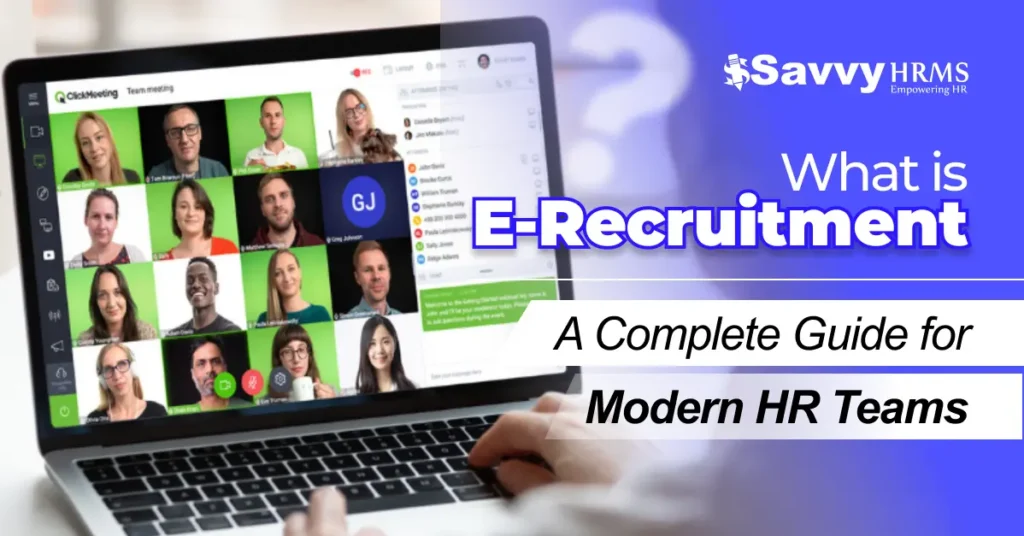
Job recruitment has long passed the stage of placing advertisements in newspapers and managing walk-in interviews. In today’s fast-paced digital environment, e-recruitment is set to transform the way organizations recruit, evaluate, and select candidates.
Through this blog, you will get to know what e-recruitment is all about, how it operates, its advantages, the tools used, the challenges, and the future trends that are influencing the current state of HR departments around the world.
As an HR manager, recruitment manager, or business executive, it is important to hold the concept of e-recruitment because it improves faster recruitment, decreases recruitment costs, and improves the candidate experience and employer brand.
What is E-Recruitment?
E-recruitment, also known as digital recruitment or online recruitment, is defined as the process of using digital platforms, internet-based applications, and recruitment management software to attract, filter, assess, and hire talent easily.
E-recruitment includes job portals, corporate career websites, social media recruitment, applicant tracking systems, AI-powered screening software, and online interviews. E-recruitment helps to automate recruitment activities, make informed decisions with the help of data analytics, and allows companies to manage the recruitment process strategically.
What are the Key Components of E-Recruitment?
Recent e-recruitment requires the integration of various online tools. The following are the various components of modern e-recruitment:
1. Online Job Portals
Companies use online job platforms to advertise job vacancies to a large pool of candidates. Online job platforms help to filter, search, and manage applicants easily.
2. Company Career Page
A career page of a company improves its employer branding and gives candidates information about the company’s work environment, employee benefits, and opportunities for advancement.
3. Applicant Tracking System (ATS)
The ATS is an important component of recruitment management software. It collects resumes, filters job applications based on keywords, monitors candidate progress, and stores recruitment data in a single database.
4. Social Media Recruitment
Social media platforms such as LinkedIn, Facebook, and Twitter enable recruiters to connect with talented candidates, build employer branding, and advertise job vacancies effectively.
5. AI & Automation Tools
Artificial intelligence tools assist in resume screening, chatbot communication, predictive hiring, and eliminating unconscious bias in the recruitment process.
6. Virtual Assessments & Interviews
Online video interviews and online skill tests simplify the recruitment process, especially for remote and global teams.
How does E-Recruitment actually work?
Step 1: Job Requisition and Approval
The hiring manager creates a digital job requisition using recruitment management software, which highlights the job requirements, budget, and approvals before the job is posted online.
Step 2: Job Posting on Digital Platforms
The HR department posts the job opening on e-recruitment platforms, such as company websites, job sites, and social media sites, to reach a larger audience of active and passive candidates.
Step 3: Online Application Collection
Applicants submit their applications online using integrated software, where resumes, cover letters, and supporting documents are automatically stored in the applicant tracking system database.
Step 4: Automated Resume Screening
The applicant tracking system scans resumes based on predetermined keywords, skills, and qualifications, shortlisting suitable candidates while rejecting applications that do not meet the criteria.
Step 5: Online Assessments and Shortlisting
Shortlisted candidates are asked to undertake online assessments, skill tests, or AI-driven evaluations, which assist recruiters in easily evaluating candidates’ skills and efficiently reducing the final shortlist.
Step 6: Virtual Interviews and Evaluation
Recruiters use video interviews arranged through e-recruitment software, which helps in structured evaluations, team feedback from hiring managers, and quicker decision-making in geographically distributed teams.
Step 7: Digital Offer and Onboarding
Shortlisted candidates are sent digital offer letters through recruitment management software, followed by digital documentation, background verification, and structured onboarding procedures to facilitate a smooth employee hiring process.
This simplified process reduces manual errors and accelerates time-to-hire.
What are the Benefits of E-Recruitment for Modern HR Teams?
1. Faster Recruitment Process
E recruitment enables the automation of screening resumes, scheduling interviews, and communicating with candidates, thus removing delays linked with paperwork and administrative tasks.
Recruitment management software enables the automation of each recruitment process, makes organizations to hire faster and beat the competition to secure the best candidates.
2. Cost-Effective Recruitment
E-recruitment eliminates costs associated with print media advertising, paperwork, and third-party recruitment platforms, making recruitment more cost-effective and efficient for organizations.
Recruitment management software enables organizations to track cost-per-hire and plan their finances better by reducing duplication of work and improving resource allocation.
3. Broader Talent Pool
Online job portals and platforms allow organizations to reach candidates from different cities, states, and countries without geographical locations.
E recruitment encourages diversity by expanding talent pools and providing equal opportunities to candidates from various backgrounds.
4. Enhanced Candidate Experience
Automated emails, status updates, and application platforms make the hiring process smooth and transparent for candidates.
E recruitment enables effective communication, eliminating errors and building trust, thus improving the organization’s reputation with job seekers and future candidates.
5. Data-Driven Decision Making
The use of advanced insights in recruitment management software offers accessible data on recruitment records, candidate sources, and recruitment metrics.
With the right data from e-recruitment software, HR professionals can refine their strategies, enhance the quality of hire, and make informed workforce decisions.
6. Enhanced Employer Branding
Having a strong online presence through career sites and social networks helps the organization appear modern, innovative, and candidate-centric.
E recruitment strengthens employer branding by highlighting company culture, employee testimonials, and opportunities for growth, thus attracting top talent that fits the organization’s values.
What is the role of recruitment management software?
Recruitment management software is at the platform that simplifies the entire e-recruitment process by automating job advertising, resume screening, interview scheduling, and communication with candidates in one digital platform.
It helps HR professionals handle large volumes of applications effectively, enhance collaboration with hiring managers, keep the workflow organized, and leverage data analytics for faster and more informed hiring decisions.
Major Functions of Recruitment Management Software
1. Centralized Application Management
Manages candidate resumes, profiles, and communication records in a centralised database for easy tracking and management.
2. Automated Resume Screening
Screens resumes based on pre-defined keywords and AI algorithms to quickly identify perfectly talented candidates for shortlisting.
3. Interview Management and Coordination
Automates interview requests, calendar management, reminders, and feedback collection to simplify collaboration between recruiters and hiring managers.
4. Analytics and Reporting
Offers real-time analytics and reporting on recruitment metrics like time-to-hire, cost-per-hire, source effectiveness, and recruiter performance.
5. Improved Candidate Communication
Automates email communications, status updates, and notifications to ensure transparency and improve candidate experience at all stages of recruitment.
6. Compliance and Data Security
Guarantees secure storage of candidate data and facilitates data protection compliance and recruitment policy adherence.
7. Integration with HR Systems
Integrates with HRMS, payroll software, onboarding, and performance management software for efficient employee life cycle management post-recruitment.
How Does E-Recruitment Support Diversity, Equity, and Inclusion (DEI)?
E-recruitment increases the reach of opportunities by overcoming geographical locations, thus allowing organizations to reach a large pool of candidates from various backgrounds, cultures, and communities through online recruitment platforms and inclusive recruitment advertising strategies.
Organizations can overcome unconscious bias in hiring by using recruitment management software, assessments, and data-driven recruitment strategies.
E recruitment strengthens DEI initiatives in the following ways:
- Increases the reach of opportunities beyond the local and conventional network.
- Allows blind resume screening to overcome unconscious bias.
- Uses standardized approach for candidate comparison.
- Monitors diversity recruitment metrics through analytics tools.
- Promotes inclusive employer branding on online platforms.
- Allows remote recruitment, making it accessible to underrepresented groups.
What Are the Future Trends in E-Recruitment?
The future of e-recruitment is closely aligned with digital transformation and employee evolution.
1. AI-Driven Predictive Hiring
AI-driven predictive hiring is based on machine learning algorithms that analyse candidate information, historical hiring data, and performance data to predict future success, thereby ensuring a significantly improved quality of hire and reducing recruitment risks.
2. Chatbots for Real-Time Candidate Engagement
Chatbots in digital recruitment enable instant responses to candidate issues, conduct interviews, send job information, and ensure constant candidate engagement, thereby ensuring an improved candidate experience and minimising recruiter effort effectively.
3. Mobile-First Recruitment Processes
Mobile-first recruitment involves optimising job application, testing, and communication processes on smartphones, enabling candidates to apply for jobs at any time, thereby ensuring a significantly improved application rate and accessibility for various parts of the workforce.
4. Skill-Based Hiring Over Degree-Based Hiring
Skill-based hiring involves assessing actual skills, certifications, and abilities rather than academic qualifications, thereby enabling organizations to identify qualified candidates and ensure merit-based and inclusive recruitment practices.
5. Advanced Analytics and Workforce Planning
Advanced analytics in recruitment management software enable organizations to gain insights into hiring trends, talent gaps, and employee requirements, thereby ensuring strategic workforce planning and long-term organizational development and productivity.
As remote and hybrid work models expand, e-recruitment will continue to enable global hiring strategies and virtual onboarding experiences.
Conclusion
E-recruitment enables today’s HR professionals to recruit smarter, faster, and more strategically with the help of technology, AI, and recruitment management software. E recruitment improves efficiency, candidate experience, and data-driven decision-making.
To remain competitive, companies must go for best-in-class HR technology solutions such as Savvy HRMS, improve their e-recruitment process, monitor key recruitment metrics, and continually boost digital recruitment processes.