
Salary negotiation is no longer a guessing game; it has become a data-driven conversation for modern organizations.
The businesses have gone through significant changes in recent times. One of the key areas in this new workplace is the concept of pay transparency. The days when job seekers went into salary negotiations without enough information and employers were secretive about the compensation packages they offered are behind us. The new workplace has brought significant changes to the way salary negotiations take place.
Today, job seekers expect clarity, fairness, and transparency in the compensation packages they receive. They go into salary negotiations provided with sufficient information. Therefore, salary negotiation has concluded to be just about opinion; it has become about alignment.
This new trend in salary negotiation has both positive and negative implications for HR teams and organizations. The benefits of the new trend in salary negotiation include the fact that it helps in creating trust and strengthening employer branding.
The modern Salary Negotiation Framework 2026
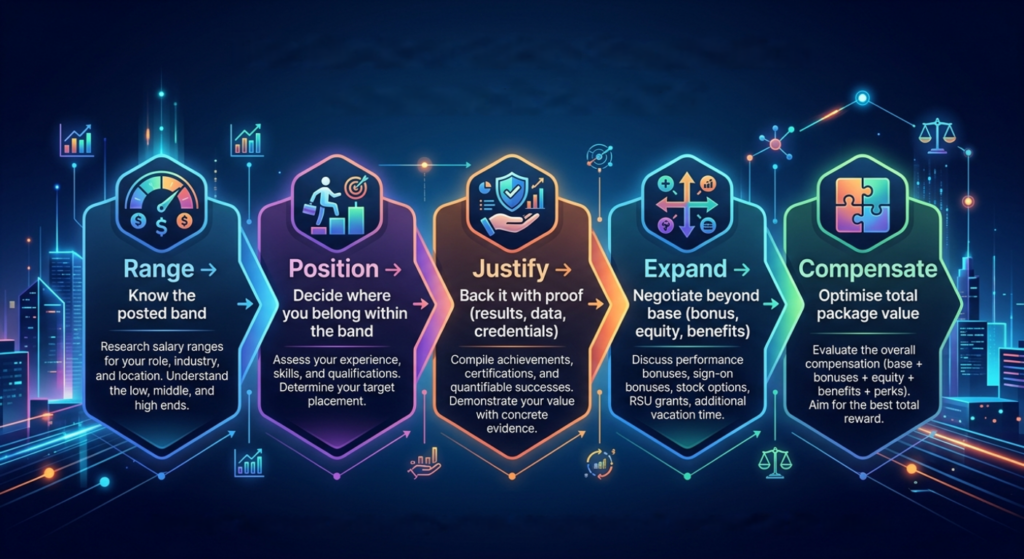
Step 1: Range → Know the Posted Band
Determine the complete salary band for this position using the data from the market, geographical locations, and the size of the organization to determine an objective and actual minimum.
Step 2: Position → Decide Where You Belong Within the Band
Evaluating your experience and special talents in light of the job description to pinpoint your exact position in the salary band.
Step 3: Justify → Back It with Proof (Results, Data, Credentials)
Collect your evidence by collecting your past achievements and quantifying your success to prove your actual and projected self-worth in the market.
Step 4: Expand → Negotiate Beyond Base (Bonus, Equity, Benefits)
If the basic salary is not possible, then move on to the next options, such as performance bonuses, equity and RSUs, sign-on bonuses, and valuable non-monetary benefits such as PTO.
Step 5: Compensate → Optimise Total Package Value
Instead of focusing on the individual components of the compensation package, calculate the total benefits of the complete compensation package.
How Have Pay Transparency Laws Changed Salary Negotiation?
The implementation of pay transparency laws has significantly changed the dynamics of the compensation process. Instead of making assumptions and decisions based on the candidate’s or employee’s past salaries, both the employer and the employee now engage in a more transparent and structured process.
This has eliminated the uncertain area in the process and has made the situation more accountable. Employers must now account for every compensation decision, and the employee has to engage in a more structured negotiation process based on skills and value addition.
For Employers, It Means:
- Salary bands are established for every position and every level.
- The necessity to address pay equity within the organization.
- A stronger dependence on tools for calculating salaries.
- Transparent communication in the hiring and appraisal process.
- Greater accountability in compensation decisions.
- Enhanced employer branding and reputation.
- The inclusion of payroll and compensation modules in HR software.
For Employees, the Change Brings:
- Greater understanding of salary bands before application.
- More confidence in the negotiation process.
- Less reliance on guesswork and negotiation tricks.
- The ability to compare offers easily.
- A stronger focus on skills and value addition.
- Equal opportunities without bias.
- More leverage based on market forces
What Are 5 New Salary Negotiation Strategies for Transparent Pay Ranges?
1. Leverage Data to Build Your Case
Data will be your strongest partner in a transparent pay system. Instead of depending on assumptions to negotiate your salary, leverage industry standards, job-specific salary information, and internal pay bands. This will enable you to build a strong case.
For HR professionals, the adoption of analytics technology in HRMS software will enable correct salary calculation, thus simplify smooth negotiation processes.
2. Negotiate on Value, Not Just Money
The dynamics of a salary negotiation process have undergone various shifts. Salary negotiation is no longer about demanding more money; it’s about proving your worth.
Employers will be more willing to offer higher salaries when the candidate clearly displays the value addition to the business.
3. Consider the Total Compensation Package
Transparent salary bands might not reveal the complete picture. Other factors such as bonuses, incentives, ESOPs, flexible work arrangements, and wellness benefits also contribute to the total compensation package.
Job seekers will have to consider the total compensation package, while HR professionals will have to effectively communicate the same using structured compensation management tools.
4. Be Prepared to Justify Your Expectations
With salary ranges now openly discussed, it is no longer sufficient to simply ask for the higher end of the range. One has to be able to justify it based on experience, expertise, and performance.
On the other hand, organizations need to implement structured appraisal and performance tracking systems to be able to justify compensation internally and externally.
5. Stay Flexible and Open to Discussion
Transparency does not mean there is no longer any room for negotiation. It refines it.
Employers can utilize various HR software tools to create scenarios for compensation to ensure it is at an attractive rate, yet within internal equity.
What Are the Common Salary Negotiation Mistakes in the Transparency Era?
| Mistake | Description | Solution |
| Ignoring Salary Data | Candidates fail to research salary benchmarks despite transparency | Use reliable salary data and HR analytics tools to prepare before discussions |
| Asking Without Justification | Requesting higher pay without explaining the value | Support your expectations with achievements, skills, and measurable impact |
| Overlooking Total Compensation | Focusing only on base salary | Evaluate bonuses, benefits, and long-term incentives as part of the package |
| Not Understanding Pay Bands | Misinterpreting salary ranges shared by employers | Ask for clarity on how ranges are structured and what determines placement |
| Being Too Aggressive | Taking a rigid or challenging approach | Maintain a collaborative and professional tone during negotiation |
| Accepting Too Quickly | Not negotiating despite having room within the range | Take time to evaluate and negotiate based on your value |
| Lack of Internal Alignment (Employers) | Offering inconsistent salaries for similar roles | Use HRMS tools to ensure internal pay equity and standardization |
| Poor Communication | Lack of transparency from employers during discussions | Clearly communicate compensation structures and growth opportunities |
| Ignoring Performance Metrics | Not linking salary to performance outcomes | Implement performance management systems for fair evaluations |
| Failing to Document Decisions | Not maintaining records of compensation decisions | Use centralized HR software to track and manage compensation data |
Conclusion
Pay transparency has changed the very nature of salary negotiations. It is now a much more structured, fair, and data-driven process. Both employers and employees have to get used to this new pattern, where clarity, consistency, and value-based discussions become the new method.
For employers, adopting modern HR solutions like Savvy HRMS can help simplify their compensation-related activities. From payroll to performance management, Savvy HRMS can help organizations become compliant and ensure internal equity.
As the nature of the workplace is bound to change further, embracing transparency is not an option but a necessity. Organizations that successfully equip the potential of HR solutions will not only be able to attract the best talent but also ensure employee satisfaction.
Are you ready to simplify salary management and get ahead in the era of transparency?
Look no further. Transform your HR functions with ease — all in one platform.
Book a Demo Today