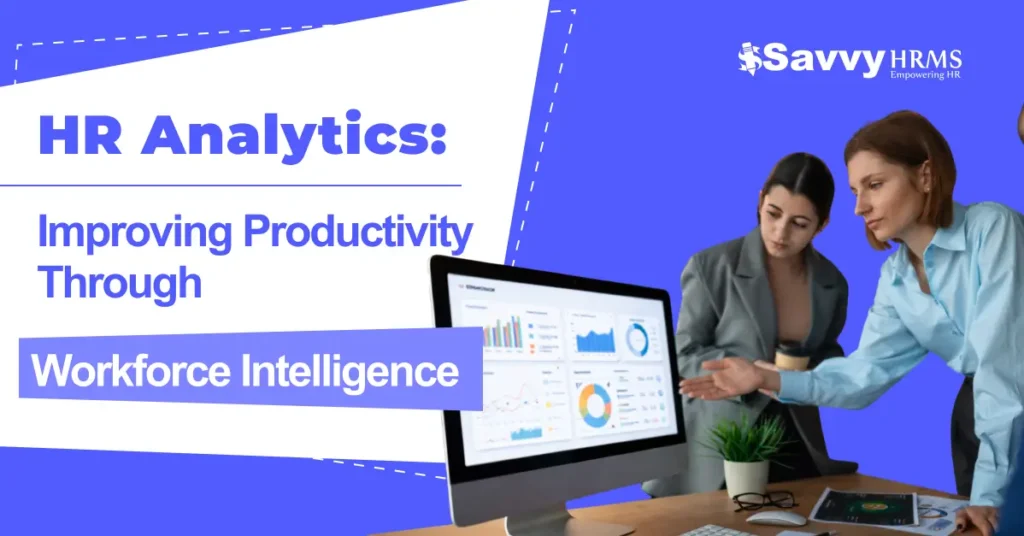
An evolving and developing workplace environment requires HR leaders to depend only on intelligence. Organizations require data-based insights to manage people effectively and sustain productivity. HR analytics has become a true capability for HR leaders to enable their strategic impact.
As organizations continue to become more complex, the use of employee data and analytics to provide insight into how employees behave, perform, and develop over time helps identify operational gaps and trends and make more informed decisions about the employee lifecycle.
As HR teams leverage employee data to develop business intelligence, it allows them to move beyond an administrative role and positively influence business outcomes. With HR analytics, HR teams can convert raw employee data and insights into a more meaningful direction that can affect productivity, ensure employee engagement, and drive the organization’s success.
What Is HR Analytics?
“HR analytics” is a term used for workforce analytics, which consists of the activities associated with collecting information about employees and examining it for various HR decisions to improve overall business performance.
HR analytics uses various types of data from different HR software products (like attendance management, performance management, leave management, and recruitment systems).
HR analytics allows HR professionals to identify emerging trends, forecast potential future outcomes, and create the best possible workforce strategy using historical HR information. It connects the world of HR operations and Business Intelligence.
Why HR Data Analytics Matters More Than Ever?
As an organization navigates a rapidly changing work environment due, in part, to digital transformation and the rise of remote work, HR analytics gives HR leaders clarity around employee expectations and how they can effectively address various workforce challenges as well as help them identify ways, through their use of technology, to drive higher levels of productivity.
At present, there are a number of important reasons for organizations to use HR analytics. These include:
1. Decision-Making Based On Data
HR Analytics enables organizations to support their employees’ decisions on data rather than assumptions. This results in accurate decisions that improve an organization’s ability to manage its performance, thereby enhancing overall organizational effectiveness.
2. Enhancing Employee Productivity
By analyzing data relating to employee workload patterns, attendance management, and employee performance metrics, HR departments are able to determine productivity restrictions and modify how employees are utilized to maximize productivity.
3. Increased Employee Retention
Through HR analytics, human resources professionals are able to proactively determine attrition risks and take appropriate actions to reduce the chance of losing valued employees.
4. Optimizing Workforce Planning
Using HR analytics, an organization can effectively match the right people to the right jobs in the future by utilizing a predictive workforce intelligence approach.
5. Better Management of Employee Performance
HR analytics links the performance of individual employees to the goals of the organization, allowing HR managers to provide targeted feedback and development opportunities to employees.
6. Enhanced Employee Experience
Utilizing HR analytics enables HR professionals to better personalize the employee journey, improving employee engagement, satisfaction, and retention.
7. Compliance and Mitigation of Risk
Accurate employee data allows organizations to comply with laws regarding mental health and disability discrimination. It also ensures compliance with organizational policies and state and federal regulations regarding the management of employee attendance and leave.
Types of HR Analytics
Types of HR Analytics provide various forms of workforce data analysis to show past trends, identify root causes, predict future outcomes, and support with strategic recommendations for organizations to be more effective in their decision-making process.
The various Types of HR Analytics are as follows:
1. Descriptive Analytics
Descriptive HR Analytics looks at what has occurred in the past through descriptive data analysis of an organisation’s employee base. It uses information such as turnover rates, attendance trends, and employee performance metrics, among others, to provide a picture of the trends within the employee workforce.
2. Diagnostic Analytics
Through Diagnostic HR Analytics, organisations can find out what is causing a variety of behaviours related to their employee workforce, including absenteeism, low productivity, or higher-than-normal employee attrition rates. Diagnostic analytics allows HR professionals to investigate these problems at their source and then take action to resolve them.
3. Predictive Analytics
Predictive HR Analytics is used to identify the likely future behaviours of employees within an organisation based on the historical and current data available. Predictive HR Analytics will allow an HR professional to anticipate those behaviours related to employee turnover, performance risk, or needing additional employees for an organisation.
4. Prescriptive Analytics
Prescriptive HR Analytics provide HR professionals with the right recommendations for how to use the information obtained through predictive HR analytics. Prescriptive HR analytics recommends the best way to increase employee performance and productivity, and ultimately help employers manage their employee workforce efficiently.
How to Implement HR Analytics in Your Organization?
Step 1. Define HR Goals Clearly
Begin by identifying HR objectives as well as company objectives, such as increasing retention, improving employee performance, or utilizing analytics to increase attendance or manage workforce through complete analysis of workforce data.
Step 2. Collect HR Data Correctly
Accurately collect human resources data from HRIS and other software systems that capture all functions of HR, including recruitment, employee performance, employee leave, payroll, and attendance management. This will enable the most dependable analytics results.
Step 3. Integrate Human Resource Technology
Use integrated HR tech platforms to centralize HR Data, remove data errors, and make it easily accessible for HR analytics reporting and dashboard.
Step 4. Build an Analytical Capability
Train HR staff on how to analyze and understand the patterns in HR analytics reporting, as well as how to convert these insights into strategic employee management decisions.
Step 5. Identify the Right Metrics
Use specific KPIs in order to identify relevant metrics that support your organization’s objectives, such as Absenteeism, Engagement, Productivity, and Retention, through Analytics.
Step 6. Continually Act on the Insights Provided
HR Analytics will only have an impact if you act on the Insights Collectively. Routinely Review and Refine HR Strategies Based on Analytics Findings.
Role of HR Analytics in Shaping the Future of Employees
A future-ready workforce is one that is prepared to meet the needs of employees and the business. HR analytics helps to identify the current state of the workforce and align the future of the workforce with business objectives through the use of data-driven analytics for workforce intelligence.
The following are five ways HR analytics will help shape the future of employees:
1. Personalized Career Development
HR analytics enables an organization’s ability to identify the skills needed and identify the trends in employee performance. Because of this, HR analytics allows for the development of customized learning and employee development programs.
2. Fair and Transparent Performance Management
Performance Management using data reduces biases in employee evaluations; therefore, HR analytics will help promote fair and objective evaluations at all levels of the organization across teams.
3. Improved Work-Life Balance
Utilizing data regarding attendance management and leave management, organizations can create flexible working environments with policies that support the individual needs of employees.
4. Proactive Employee Engagement
HR analytics identifies signs of disengagement within employees and allows for timely intervention that will boost the confidence and productivity of employees before it becomes a larger problem.
5. Informed Leadership Decisions
HR analytics enables managers to utilize workforce intelligence to make data-informed decisions that support employee development and job satisfaction.
6. Diverse and Equitable Workforce Planning
It also supports the efforts of diversity, equity, and inclusion initiatives by tracking employee representation, progression, and fairness across the organization in real-time.
How HR Analytics Software Transforms Your Workplace with Actionable Insights?
1. Centralized Workforce Data
HR Analytics Software transfers employee data from various sources into a centralized system for accurate and consistent reporting about your employees.
2. Real-Time Workforce Insight
Real-Time dashboards provide on-demand reporting about the workforce and allow for timely and informed decisions regarding performance and employee engagement.
3. Performance Management Enabled by Analytics
Using Analytics to drive performance management will allow for increased, consistent feedback, goal tracking, performance enhancement, and measurable insight into employee performance.
4. Predictive Intelligence for Workforce Planning
Using advanced HR Analytics Software, HR professionals can anticipate turnover, skill shortages, and workforce planning requirements through statistical modeling and predictive analytics.
5. Increased Efficiency through Automation of Reporting
Automating Reporting will decrease the time required for manual labor and help HR professionals concentrate on strategic initiatives
6. Improved Compliance Tracking through HR Software
HR Software enables organizations to track attendance, leave management, and policy compliance accurately, and to minimize legal and compliance risk.
7. Alignment of HR Analytics Insights with Strategy
Practical insights from HR Analytics allow HR professionals to align their people strategies with the overall business growth and objectives.
Challenges in HR Analytics and How to Overcome Them
Challenge 1: Poor Quality Data
HR data that is incomplete or incorrect makes it difficult to leverage HR Analytics effectively and will produce unreliable insights about the workforce.
Solution: Establish standard data entry procedures and use a fully integrated human resource management solution (HRMS) to maintain consistency with the carrier app for performance management, attendance management, and leave management.
Challenge 2: Data collected Between Systems
If you don’t have access to all HR systems, you may not be able to conduct a complete analysis of your workforce. This decreases the potential value of using HR Analytics.
Solution: Use integrated HR Analytics Platforms that pull data from all your HCM systems into one location so you have a complete picture.
Challenge 3: No Analytical Skill Set
HR may not know how to work with data or be able to translate data into useful business action.
Solution: Provide access to training resources on HR Analytics, and consider purchasing advanced visual display tools to provide an easier means of using data.
Challenge 4: Resistance to Using HR Analytics Data
Most managers depend on gut feelings to judge HR data instead of depending on data-driven insights for HR analytics.
Solution: A successful way to help staff overcome resistance to a data-driven culture is to showcase the impact of HR analytics on the organization’s profitability through improvements in productivity and performance measured by management.
Challenge 5: Data Privacy and Security Issues Related to Employee Data
Handling employee-sensitive data creates risks of compliance and confidentiality.
Solution: Use a secure HR system and have appropriate access controls, use encryption to protect all employee information, and ensure that you comply with data protection regulations.
Challenge 6: Identifying the Key Metrics that Matter
Measuring too many metrics weakens focus and decreases the value of HR data analytics.
Solution: By focusing on a smaller number of KPIs aligned with the company’s goals and objectives, such as improving employee productivity, engagement, and retention, the company will get maximum benefit from its HR data-analysis efforts.
Conclusion
The function of HR Analytics has transformed from being a support function to strategically being an influence on productivity & workforce intelligence. With the proper use of Data, HR will allow the ability for an organization to gain data-based decision-making skills with the data they provide to the employers & employees.
HR Analytics will provide the employer with data from performance management systems, attendance management systems & sick leave systems to develop procedures & programs through the employer’s ERP systems. HR Analytics will allow HR professionals the ability to predict issues & develop controls to reduce any risk associated with those challenges. Any company that is interested in realizing the potential of HR Analytics must use the correct technology business partner. With Savvy HRMS, companies will be able to convert their workforce data into a strategic decision-making tool that will increase production & create a future-ready organizational environment utilizing innovative HR analytics.