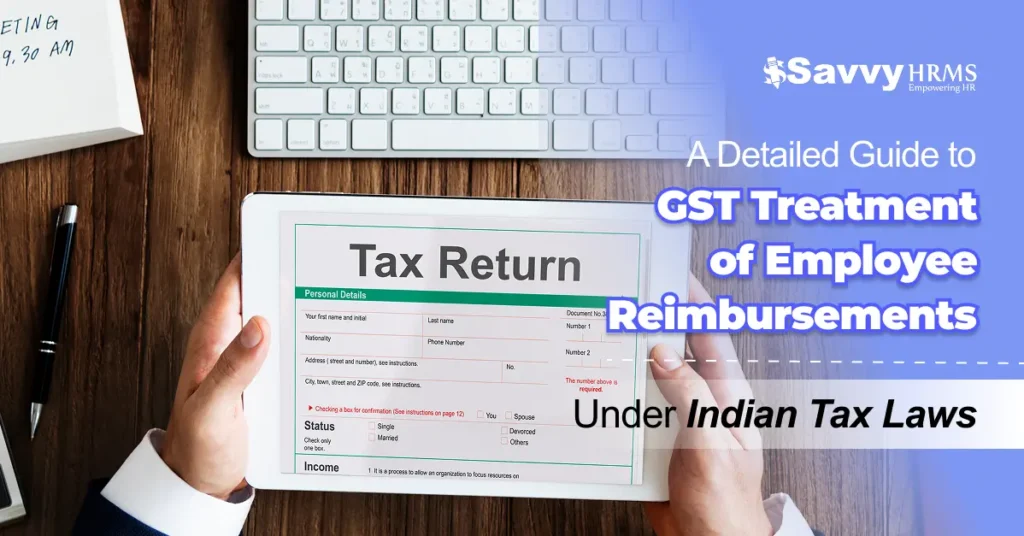
As businesses regularly practice employee reimbursement of costs incurred by employees when acting on behalf of the business, the GST treatment of employee reimbursements under the Central Goods and Services Tax Act of India has complicated the implementation of GST on these expenses, and therefore makes it important for employers to appropriately ensure compliance.
A common misconception about employee reimbursements is that they are outside the scope of GST. However, the determination of taxability of the expenditure is subject to a number of factors, including but not limited to the nature of the expenses incurred, how the expense was documented, the contractual terms of the reimbursement, and the application of the “pure agent” concept to the reimbursement. Understanding these factors creates an essential foundation for HR and finance teams to ensure proper compliance and to avoid exposure to penalties and compliance risk.
What is Employee Reimbursement?
Employee reimbursement is how an employer reimburses an employee for business-related expenses incurred while the employee performs their duties at work. Business-related expenses may include travel, lodging, food while traveling, entertainment of clients, mobile phone bills, training costs, and fuel costs. The basic principle is that the employee pays the money on behalf of the company and later requests reimbursement of the amount paid.
Unlike an employee’s wages and allowances, employee reimbursement is not a form of payment for work performed; rather, it is a reimbursement of costs incurred in the course of the employee’s legal work duties. However, whether a reimbursement is considered taxable or not for GST purposes depends on the way the reimbursement is set up and documented in the company’s reimbursement policy.
What Are the Key Factors Determining GST Applicability on Employee Reimbursements?
1. Expense Type
GST applicability is dependent on which types of expenses will be subject to input tax credits, so there are two categories of business expenses: those that allow you to claim an input tax credit against your purchase, and those that do not. The first category is referred to as ‘input tax’, and the second category is referred to as ‘blocked input tax’.
2. Business Use vs. Private Use
An expense that has been incurred only for business purposes is considered to have input tax credit eligibility under GST. Expenses incurred for both business and personal purposes will generally only restrict or exclude input tax credit claims.
3. Valid Tax Invoice
To successfully claim input tax credits for employee reimbursements, you must have a proper invoice that complies with the GST invoicing requirements, which must contain accurate details of the applicable GST and Tax, the GSTIN of the supplier, and the name of your company.
4. Invoices are Issued in the Name of the Employer
There is a significant advantage in being able to claim input tax credits for amounts claimed by the employee when the invoice is issued in the employer’s name rather than in the employee’s name.
5. Pure Agent Requirements
If the employer’s reimbursement arrangement is for pure agent service under the Central Goods and Services Tax Act, 2017, they may be excluded from the taxable value of the transaction.
6. Blocked Input Tax Provisions
As outlined in section 17(5), no input tax credits will be available on certain expenses, such as food, club membership fees, and some types of travel benefits, regardless of whether they were reimbursed in relation to a business transaction.
7. Correct GST Reporting
Accurate accounting and timely filing of your GST returns, along with a reconciliation of your GSTR-2B, are important to preventing the risk of credit reversals, penalties, or an audit compliance!
What Are the Common Scenarios and Their GST Treatment in Employee Reimbursements?
1. Travel and Hotel Accommodation
Scenario: There may be various instances where employees travel on employer business and spend money on airfare, train tickets, hotel fees, etc. When they return, they submit invoices to the employer in order to get reimbursed for costs.
GST Treatment: When an employee uses an airline or hotel for travel purposes, the amounts paid for GST are typically recoverable to the employer as an input tax credit (ITC) if all eligibility requirements and the blocked credit rules are met. The reimbursement of the travel expense is not considered to be a separate supply that is subject to GST tax.
2. Food & Beverage
Scenario: Because employees often eat meals or take clients for lunch or refreshments during business work or travel, there are many opportunities for reimbursement.
GST Treatment: Many food and beverage costs will be subject to a blocked credit under Section 17(5) of the Act, with limited exceptions such as the above one. Once you get the approval, you can start claiming on GST; however, the reimbursement does not automatically entitle you to a GST credit.
3. Telecommunication Expenses
Scenario: When an employee uses their telecommunications services (mobile and internet) partially or entirely for business purposes and requests reimbursement, two key factors will determine whether they can recover the costs of service.
GST Treatment: If the telecommunication services are invoiced to the employer, the employer can claim the ITC. If the employee was invoiced for the telecommunication services, the employer may only be able to claim an ITC depending on the employee’s use of the telecommunication services.
4. Cost of Fuel
Scenario: An employee travels for business using an automobile and submits receipts for the use of fuel (gasoline or diesel) in relation to that travel.
GST Treatment: Since gasoline and diesel are excluded from the GST system, an organization cannot claim an input tax credit on these purchases, regardless of whether or not the employee is reimbursed for the purchase of said fuel.
What Are the Compliance Risks and Audit Challenges in Employee Reimbursements?
Improper classification of employee reimbursement can lead to:
1. Incorrect Input Tax Credit Claims
Claiming input tax credits on ineligible or blocked expenses can result in reversals and interest liabilities, penalties, and increased inspection upon a GST audit.
2. Inadequate Documentation
Failure to maintain records, lack of an invoice or a complete invoice with GST, and missing bills may create challenges in receiving input tax credits and remaining compliant during assessments.
3. GSTR-2B Reconciliation Mismatches
Differences between invoices from vendors and the GSTR-2B report might result in the disallowance of input tax credits, which could necessitate further explanation during a GST audit.
4. Misclassification of Allowances
Misclassification of payments to employees as a fixed allowance (rather than a reimbursement) could lead to heightened inspection, reclassification, and possible tax penalties during departmental reviews.
5. Incorrect Pure Agent Application
Failure to meet the necessary criteria to qualify as a pure agent may result in payments being included in taxable value assessments for the business taxpayer.
6. Weak Internal Controls
Depending upon manual processes and a lack of system controls create a much higher degree of exposure to errors, compliance gaps, and the potential for auditing.
7. Financial and Reputational Risks
Failure to remain compliant will result in significant penalties, interest costs, and interruptions to business operations, and could lead to reputational risks with the authorities.
What are the Best Practices for Managing GST on Employee Reimbursements?
1. Set Clear Guidelines on Reimbursement Policies
- Clearly outline what can be claimed and what cannot.
- Outline documentation and invoices required.
- List how GST will be claimed.
- List who can approve the claims, when, and how.
2. Collect Appropriate GST Compliant Invoices
- All invoices should include the supplier’s GSTIN.
- Check that tax amounts are accurate (CGST, SGST, IGST, etc.).
- Check that the corporate name on the invoice is correct.
- Double-check the invoice date and number.
3. Confirm Expenses Related to Your Business
- Verify that any expense claims are for business use.
- Managerial approval is needed before payment.
- Do not submit claims that are for personal and mixed-use items.
- Make sure proof of travel and meeting is attached.
4. Stay abreast of Blocked Credit Provisions
- Be aware of the restrictions found in Section 17(5) when completing your return.
- Do not file ITC for food and beverage purchases.
- Do not file any expenses for club memberships.
- Check for restrictions on the use of cars for business purposes.
5. Regularly Reconcile Your GSTR-2B
- Make sure all invoices match what is reported in your GSTR-2B.
- Identify missing and mismatched invoices.
- Follow up with vendors who do not follow compliance.
- Keep a record of the reconciliation process for audit purposes.
6. Use Integrated Payroll Software
- Use a payroll system to automate the process of processing expense claims.
- View and track GST by component.
- Use electronic records for tracking purposes.
- Create reports that are GST-compliant quickly and easily.
What is the Role of HR and Finance Teams in Employee Reimbursement?
1. Policy Creation and Governance
HR creates a structured reimbursement policy, while finance ensures GST compliance by determining which expenses are eligible, how to approve them, which documents are necessary to support them, and the controls necessary to manage them.
2. Expense Approval and Review
HR will confirm whether the policy has been adhered to before the finance team will review invoices, both including any components that require tax payments, as well as confirming that the respective expense is business-related. Only then can the employee’s expense be reimbursed.
3. Compliance with GST and Management of ITCS
Finance monitors input tax credit (ITC) eligibility by periodically reviewing blocked credits, reconciling GSTR-2B with actual invoices, and ensuring proper GST reporting.
4. Integration of Payroll and Systems
HR works with finance to ensure that any reimbursement from this programme is accurately captured in payroll systems for proper accounting, tax treatment, and reporting, in addition to the reimbursement being compliant with the respective policy.
5. Audit Preparedness and Risk Management
Each team utilises the records generated as a result of their respective roles, and establishes relevant documentation and strong internal controls to prepare audit-ready records in order to reduce potential non-compliance or assessment of penalties.
Conclusion
The development of an efficient employee reimbursement system produces a compliant, accurate, and efficient process for managing transaction records subject to GST regulations. By putting established procedures in place, maintaining good records, integrating payroll systems, and using automated spending management systems, organizations can enhance their ability to meet audit requirements and further reduce risk in the reconciliation process.
A complete human resource management system like Savvy HRMS provides an integrated reimbursement system to enhance workforce management, ensure compliance with GST requirements, and simplify the reimbursement process.