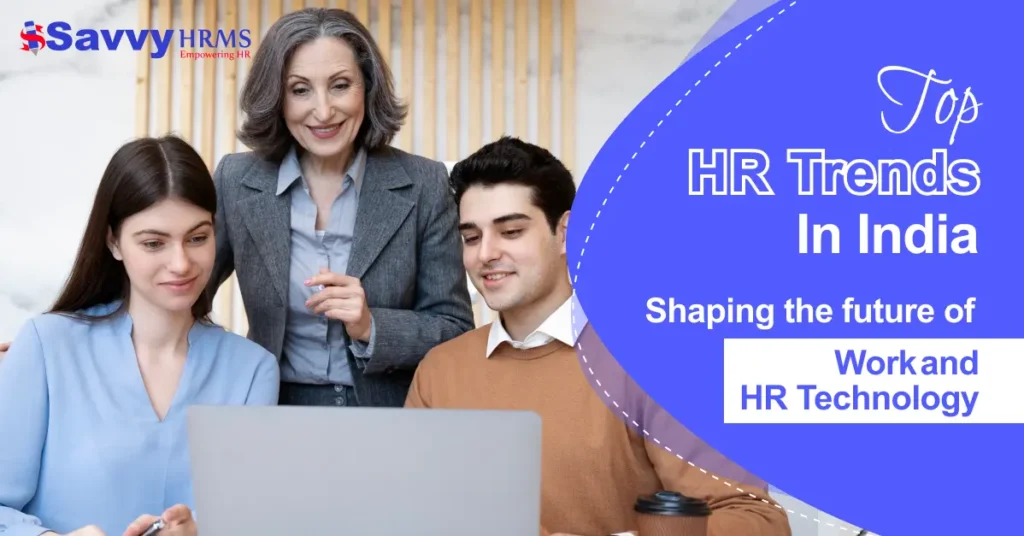
The workplace in India is changing more quickly than ever. To meet the new demands created by digital transformation, increased employee expectations, and hybrid work environments, HR will no longer just be seen as an administrative function of support; HR will become a strategic enabler of the business.
By 2026, HR teams in India will need to operate at the intersection of the following four primary factors: technology adoption, compliance, employee experience, and productivity. Companies that do not respond to emerging HR trends will see decreased rates of talent retention, decreased engagement with employees, and reduced operational efficiency.
This blog post will discuss the following topics: the top HR trends in India in 2026, how HR’s role is changing, and how technology and modern HR software will continue to impact the future of work.
What Are HR Trends?
HR trends describe the ways new technology, practice and strategy influence how organisations will manage their people, work environment and all related activities. HR trends are reflective of the changing behaviours of employees, as well as organisational needs and employee expectations in the workplace.
India has seen many HR trends developed through the increasing use of digitalisation, through the implementation of restructuring in labour laws, the rise of remote working and the increasing demand for flexible and employee-friendly workplace solutions through HRMS platforms.
What Is the Evolving Role of HR in Workplace Transformation?
The functions of the Human Resource Department have expanded from the narrow focus of being the hiring and payroll processors to those found within the area of change leadership, culture development and providing organisational strategy as a partner in transformation.
HR has to align strategic business goals with the workforce strategy by providing a positive employee experience while ensuring that the business is compliant and will provide the business with the ability to use technology in order to improve the way that HR operates and make strategic business decisions.
5 Areas where HR are driving workplace transformation:
1. Strategic Workforce Planning
HR forecasts the skills that will be required in the future and aligns the talent strategy with the long-term goals of the business for sustainable growth and workforce readiness.
2. Technology-Driven Operations
HR uses HR Software and HRMS tools to automate attendance, payroll, and leave management, reducing the amount of manual work and errors that are commonly associated with the above.
3. Employee Experience
HR is focused on the areas of engagement, well-being, and personalisation throughout the Employee Lifecycle in order to improve retention and productivity.
4. Culture and Values
HR builds inclusive and performance-driven cultures that align with the organisational values.
5. Compliance and Risk Management
HR provides assurance that all aspects of Indian Labour Laws, Payroll Regulations and Statutory requirements are being adhered to using compliant payroll software.
6. Using Data to Inform HR Decisions
HR uses data provided by attendance management tools and HRMS systems to help identify trend activity, forecast future employee turnover, and determine what HR policies may need to be updated.
7. Change Management and Transformation Leadership
HR leads the digital transformation of HR functions, implements new key human capital policies and restructures organizations by offering communication and training initiatives to support the processes.
Top HR Trends in 2026: What Leaders Must Prepare For?
As businesses adapt to changing employees, HR leaders must prepare for trends that redefine how work is structured, managed, and measured.
In 2026, successful HR strategies will focus on agility, automation, employee well-being, and smarter use of HR technology.
1. Technology with AI Suite for Employees
The addition of tech with artificial intelligence (AI) to an employee management system allows for more accurate recruitment methods.
In addition to improving efficiencies by automating day-to-day tasks and creating customized experiences for the individual, these new tools will allow HR departments to support speed.
2. Hybrid and Flexible Work Environments
In the modern workplace, the “hybrid” work arrangement has now become the norm. As a result, HR and attendance management software will have to accommodate flexible work timelines and track work performance even if employees are not physically at the office.
3. Skills Are the Future of Workforce Management
Businesses are transitioning to a skills-based model of workforce management, and HR will be required to record skill sets, learning paths, and job movement (internal) through the use of Human Resource Management Systems (HRMS).
4. Mental Health Will Be a Core Metric of HR
Due to the increasing number of employees reporting mental health issues such as burnout, depression, or anxiety, as well as other forms of mental or emotional fatigue, HR departments are now focusing on integrating mental health initiatives into policies and utilizing HR database software for measuring engagement and absenteeism patterns.
5. Advanced Payroll Automation & Compliance
As India continues to experience changes in its regulations and increased diversity among employees, its payroll processing has also become increasingly complex.
Modern software allows employers to automatically calculate payroll, provide timely filing of all statutory requirements per the applicable laws, and maintain comprehensive digital records of all payroll-related data with the least amount of human interaction.
6. Personalized Employee Experiences
Employees are beginning to demand similar shopping experiences from their employer. Human resources management systems now offer employees solutions that offer self-service techniques and a wide variety of choices for leave policies and payroll transparency to help improve employee satisfaction and create positive experiences while at work.
7. HR Analytics & Predictive Insights
More HR decisions are being made based on the data available than ever before. HR professionals can use analytics from employee time and attendance systems, leave management software, and other systems to help predict employee turnover, optimize workforce planning and measure the ROI of HR.
8. Increased Emphasis on Employer Branding
HR is a key player in creating the overall reputation of an employer. The use of improved technology in the onboarding and employee-tools areas, and the ability of HR to develop proactive and engaging HR processes, help to improve an environment of trust and create an appealing workplace for top candidates.
How Are HR Strategies Building the Future of Work?
Forward-looking HR strategies are shaping workplaces that are flexible, inclusive, and technology-enabled.
These strategies help organizations remain competitive while meeting employee expectations in a rapidly changing environment. Below are some HR strategies for building the future at work:
1. Digital First HR Operations
Digital First HR enables the replacement of manual spreadsheet-based record keeping with integrated Human Resource Management Systems (HRMS) and other Human Resource (HR) technology that provides a greater ability to manage employee records and information, as well as to provide greater accuracy of data, and provides real-time visibility of its employees’ payroll, attendance and leave management systems.
2. Continuous Learning and Upskilling
Modern HR strategies are geared towards the continuous learning capacity of employees through learning agility and the capacity for organisations to grow and change in response to business and industry change. HR’s use of digital learning platforms integrated with HR technology supports Learning and Development(L&D).
3. Employee-Centric Policy Creation
HR develops policy that is designed to be flexible, inclusive and responsive to the needs of employees and the modern workforce. Leave management systems support the ability for employees to create their own personalised leave policy.
4. Automation of routine HR activities
Utilisation of payroll and attendance management systems allows for automation of repetitive tasks that reduce HR’s manual workloads, automate report creation, increase efficiency, reduce error rates and free HR staff time to focus on workforce strategy and planning.
5. Compliance and Governance are Top Priority
HRMS enable organisations to remain compliant with regulatory requirements and updates, and accurately process employee payroll in accordance with Indian Labour Laws and Governance requirements.
6. Building Resilient and Agile Workforces
HR also enables organisations to create resilient and agile workforces through flexible job roles, using data to assist with employee planning and supporting organisational success and long-term growth, resilience and adaptability.
Is Employee Experience the Real Driver of HR Transformation?
The foundations of the modern HR transformation lie within Employee Experience. Organizations now understand that productivity, retention, and overall business success depend upon the feelings employees have while at work.
HR Technology is essential to the experience of the employee. It simplifies HR processes and increases transparency between the employer and employee to empower employees with self-service capabilities to access important information.
Why Employee Experience is Important to HR Transformation?
Today’s employees are looking for a smooth experience when engaging with their human resources management system (HRMS) and HR software. Here are the key benefits of providing a positive employee experience in HR:
- HR Payroll Software that Provides Transparency.
- Leave Management Software that Provides Flexibility.
- Attendance Management Software that Supports Flexibility.
- A Personal Approach to HR Communication.
Conclusion
In 2026, there has been a major change in India’s HR to a technology-driven and employee-centred data-based HR function. The HR function no longer manages persons; HR now helps organisations shape how to create future-proofed workplaces.
As the Talent Market continues to change owing to evolution and modernisation, organisations that invest in accounting or payroll and attendance software applications, along with employee experience platforms,s will have a considerable, competitive advantage.
To respond effectively to these HR trends, organisations require an HRMS solution that is reliable and scalable to help enhance & simplify how employees and managers manage their resources, payroll & attendance, employee management, and ‘Employer’ compliance and ultimately allow the HR manager to focus on building a workforce ready for the Future!