Picture this: It’s Monday morning. An employee logs in, and before they have finished their first cup of coffee, their AI-powered dashboard has already identified pending approvals, summarized last week’s attendance records, and suggested a check-in with a team member who’s been showing signs of disconnection.
This isn’t a scene from a sci-fi film. This is the modern workplace, and it’s happening right now in organizations that have adapted intelligent HR technology.
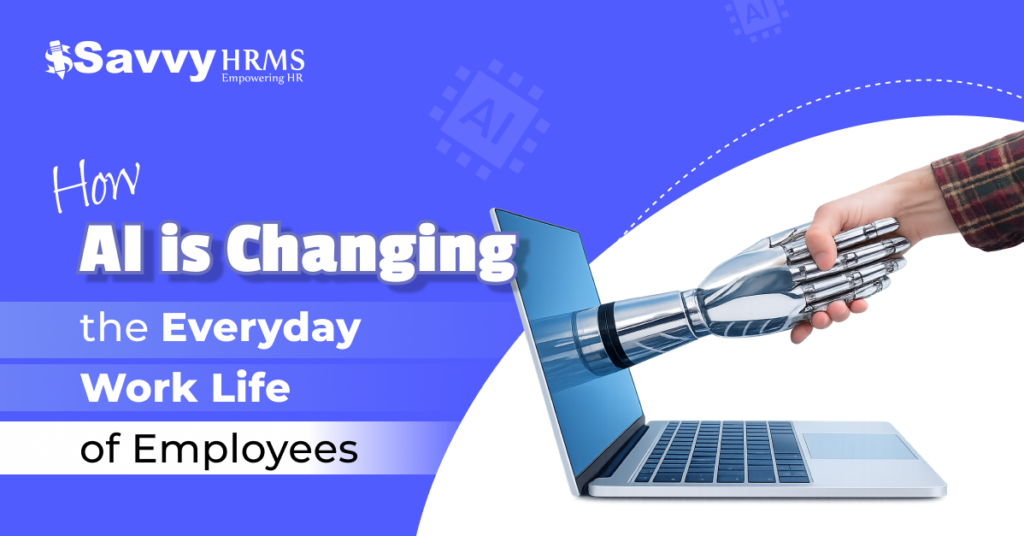
AI is no longer a concept reserved for tech companies. Today, AI in the workplace is interlinked into the daily work life of employees across various sectors, from automating repetitive tasks to shaping how managers lead, how employees grow, and how HR teams make decisions. The transformation is extreme, and it’s only picking up speed.
Let’s take a closer look at how AI is reshaping the everyday employee experience.
From Paperwork to Smart Workflows: The Death of Manual HR Tasks
Ask any HR professional what eats up most of their time, and you will hear the same and familiar list. These tasks are important, but they are also repetitive, time-consuming, and prone to human error. AI changes all of that. Here’s how:
1. Automated Attendance & Leave Management
Employees no longer need to pin HR for leave approvals or attendance issues. AI-powered attendance management auto-tracks clock-ins, addresses issues, and processes leave requests in real time, no back-and-forth emails, no delays.
2. Error-Free Payroll Processing
Manual payroll is one of the biggest sources of HR errors and compliance risk. With AI-driven payroll automation, salary calculations, deductions, tax compliance, and payslip generation happen smoothly, on time, every time.
3. Paperless Onboarding Documentation
Those days are gone in which HR spends a lot of time hiring new candidates. AI automates document collection, e-signatures, background verification issues, and compliance checklists, giving new employees a smooth, professional start from day one.
4. Smart Compliance & Policy Tracking
Labor laws change. Policies develop. AI continuously monitors compliance requirements and point gaps before they become costly violations, keeping HR teams one step ahead without manual paperwork.
5. Timesheet Validation & Shift Scheduling
AI removes the manual effort of reviewing timesheets row by row. It confirms entries against shift schedules, flags issues, and even suggests improved shift plans based on workforce availability and workload patterns.
6. Automated Alerts & Approval Workflows
From expense reimbursements to promotion approvals, AI-powered workflows route requests to the right person automatically, with reminders, build-up rules, and audit trails built in. Nothing falls through the cracks.
Why Are Employees Expecting More from Self-Service HR Tools Than Ever Before?
The answer is simple: AI has raised the bar. Employees today don’t want to wait for HR to answer a basic question. They want instant access to their payslips, leave balances, reimbursement status, and their documents on their phone, at any time. And with AI making that possible, anything less feels outdated.
Here’s how AI-powered Employee Self-Service is transforming the everyday employee experience:
1. 24/7 AI Chatbots & Virtual HR Assistants
No more waiting until Monday morning to get a simple HR question answered. AI-powered chatbots integrated within Savvy HRMS handle employee queries around the clock, whether it’s “How many casual leaves do I have left?” or “What’s my provident fund contribution this month?” Instant answers, zero HR effort.
2. On-Demand Access to Personal HR Data
Payslips, tax documents, attendance records, and offer letters, employees can access everything they need from a mobile-friendly self-service portal, anytime and from anywhere. No more raising tickets or waiting in queues just to download a salary slip.
3. Hassle-Free Leave & Attendance Management
Employees can apply for leave, check approval status, regulate attendance, and view their holiday calendar, all without stepping into the HR cabin. AI auto-routes requests to the right manager and sends real-time notifications at every step.
4. Instant Expense & Reimbursement Tracking
Submitting travel claims or expense reimbursements used to mean emails, receipts, and follow-ups. With AI-driven reimbursement workflows, employees submit claims through the portal, track approval stages in real time, and get notified the moment funds are processed.
5. Self-Managed Profile & Document Updates
Change of address? New bank account? Updated emergency contact? Employees can update their own records directly through the self-service module, and AI addresses any issues and routing changes for HR verification automatically. Clean data, less admin.
6. Personalized Dashboards & Smart Notifications
Every employee sees a dashboard adapted to their role, location, and work schedule. AI surfaces what matters most, pending tasks, upcoming appraisals, training deadlines, or policy acknowledgments, so nothing important gets missed or delayed.
7. Real-Time Visibility Into Pay, Benefits & Entitlements
Employees no longer need to wonder about their CTC breakup, bonus eligibility, or remaining benefits. AI-powered ESS portals give complete, real-time visibility into compensation structures, benefits enrollment, and advantages, building transparency and trust between employees and the organization.
Is Your Annual Performance Review Actually Helping Your Employees Grow?
If you are being honest, probably not.
The traditional annual performance review is one of the most outdated methods in corporate life. Managers move quickly to recall 12 months of work in a single sitting. Employees support feedback that feels more like a judgment than a conversation. And by the time it’s done, both sides walk away feeling like the whole exercise could have been handled better.
The truth is, it could be. And AI is proving it every single day.
1. Goodbye Annual Reviews, Hello Continuous Feedback.
AI makes it possible to move from a once-a-year checkbox exercise to a culture of real-time, ongoing performance conversations. With an automated performance management system in place, feedback doesn’t wait for December. It happens in the moment, when it’s applicable, actionable, and actually useful.
Managers get automated encouragement to check in with their teams regularly. Employees receive timely feedback tied to real work, not indefinite memories from months ago.
2. Goal Tracking That Actually Stays on Track
How often do goals get set in January and forgotten by March? With AI-powered OKR and goal management, both employees and managers have full visibility into progress at all times.
A perfect software tracks goal completion in real time, sends alerts when records are approaching, and points when a target is at risk, early enough to adjust correctly, not after it’s too late.
3. Data-Driven Ratings That Remove Bias
One of the biggest issues with traditional performance reviews is subjectivity. Who you like, who you remember, and who speaks the loudest, these factors influence ratings more than they should.
AI changes this by building performance scores based on actual data, attendance patterns, goal completion rates, project contributions, colleagues’ feedback, and more. The result is a fairer, more transparent appraisal process that employees can trust.
4. 360-Degree Feedback Made Simple
Great performance management isn’t just top-down. It involves input from colleagues, direct reports, and cross-functional collaborators. But collecting and identifying all of that manually is like a nightmare.
360-degree performance review automates the entire 360-degree feedback process, sending surveys, collecting responses, and presenting analytics in a clean, easy-to-read format. Managers get a complete picture. Employees get well-rounded, meaningful feedback.
5. Personalized Development Plans, Not Generic Ones
Once AI identifies where an employee is influencing and where they need support, it doesn’t just stop at the discovery. It recommends a personalized development plan, specific courses, extended assignments, mentorship opportunities, and skill-building activities adapted to that individual.
No more generic “attend a leadership workshop” suggestions that apply to everyone and help no one.
6. Early Warning System for Flight Risks
Here’s something no annual review can do: predict who is about to quit.
AI can. By identifying patterns in performance dips, disengagement signals, absenteeism trends, and feedback scores, HR Software surfaces early warning signs that an employee may be disengaging, giving HR and managers the chance to step in, have a real conversation, and turn things around before a resignation letter lands on their desk.
7. Recognition That Doesn’t Wait for Appraisal Season
Employees don’t want to wait a whole year to be told they did a great job. AI helps managers spot high performers in real time and gives rise to timely identification, whether that’s a shoutout, a spot bonus, or a fast-track promotion conversation.
Because when people feel seen and valued in the moment, they stay motivated, not just during appraisal season, but all year long.
What Does Personalized Learning Actually Look Like for Your Employees?
Think about the last time your organization gave training sessions to employees. Chances are, the same content went to everyone, the new joiner and the ten-year old employee, the sales executive and the finance analyst. Everyone sat through the same modules, completed the same assessments, and moved on. Some found it useful. Most didn’t.
That’s not learning. That’s a checkbox.
AI-powered Learning & Development turns this completely. Instead of pushing generic training to everyone, it pulls the right learning to the right person, at exactly the right time in their career journey.
1. Learning That Knows You
AI engines look at each employee as an individual, their role, their performance data, their career goals, their skill gaps, and even how they’ve engaged with past training. From all of this, it builds a personalized learning path that actually makes sense for that employee.
Think of it for professional growth. The more the system learns about you, the smarter its recommendations get.
- Right course, right time, right person, no more one-size-fits-all training.
- Learning recommendations update generally as roles and goals develop.
- Employees spend less time on irrelevant content and more time on what actually moves the needle.
2. Closing Skill Gaps Before They Become Business Problems
Here’s where AI really earns its place. When a software identifies a pattern, say, a team continuously missing project deadlines or a department showing lower customer satisfaction scores, it doesn’t just report the problem. It connects the dots.
It identifies the underlying skill gaps and automatically points out relevant training for the employee who needs it most. Learning becomes proactive, not reactive. Problems get addressed before they escalate into something bigger.
3. A Clear Path Forward, For Every Employee
One of the biggest reasons employees leave is feeling stuck. They can’t see where they are headed, and no one looks to be helping them figure it out.
AI changes that narrative entirely. By mapping an employee’s current skills against the requirements of their next role, it helps both employees and managers have meaningful career progression conversations, backed by data, not guesswork.
Employees know exactly what they need to learn to get to the next level. Managers know how to support them. And the organization retains talent that might otherwise walk out the door simply because no one showed them a path forward.
4. Learning in the Flow of Work
The best learning doesn’t happen in a classroom or a mandatory webinar. It happens in the middle of real work, a quick video before a tough client call, a micro-course while waiting for a meeting to start, a skill refresher before taking on a new project.
A perfect Software delivers bite-sized, mobile-friendly learning content that fits into an employee’s actual workday, not something they have to cut out separate time for. Because when learning is easy to access and immediately relevant, people actually do it.
The result? Employees who feel genuinely invested in. Teams that are sharper, more capable, and more confident. An organization that grows its talent from within rather than constantly hiring to fill gaps.
How Does AI Make Recruitment and Onboarding Faster and Smarter?
1. AI-Powered Resume Screening
AI scans thousands of resumes instantly, ranks candidates by role fit, and removes bias, delivering only the most qualified profiles to your hiring team.
2. Smarter Interview Scheduling
AI automates interview coordination between candidates and panels, sends notifications, handles rescheduling, and eliminates here-and-there emails, making the hiring process faster and stress-free.
3. Automated Offer & Documentation Workflow
From offer letter generation to document collection and e-signatures, every step is handled automatically, ensuring new candidates complete formalities quickly without unnecessary delays or confusion.
4. Personalized Onboarding Journey
AI adapts the onboarding experience based on role, department, and location, giving every new employee a structured, welcoming start that feels personal rather than generic and confusing.
5. Real-Time Onboarding Progress Tracking
HR teams get full visibility into each new hire’s onboarding status, pending tasks, completed modules, and upcoming milestones, ensuring no step is missed and no employee feels lost.
Why Does Employee Wellbeing Need More Than a Manager’s Observation?
Burnout doesn’t announce itself. Disengagement doesn’t send a calendar invite. By the time a manager notices something is wrong, the employee has already been struggling silently for weeks, sometimes even months.
So, how many employees in your organization are struggling right now without anyone knowing? AI spots the patterns humans miss, attendance shifts, productivity drops, engagement drops, and surfaces them before they become an issue.
Here’s how AI actively protects employee well-being every single day:
- AI continuously monitors attendance, productivity, and engagement patterns to detect early signs of burnout or disengagement.
- Short, quick pulse surveys replace lengthy annual ones, capturing honest employee points of view in real time.
- Wellbeing alerts are automatically sent to HR when an employee’s behavior signals they may need support.
- AI identifies which teams or departments are under the most pressure, helping leaders redistribute workload before burnout sets in.
- Managers receive timely urges to check in with specific employees, making care feel personal, not procedural.
- Every wellbeing insight is backed by data, helping HR make fair, informed, and compassionate decisions across the workforce.
Conclusion: The Future of Work Is Already Here
AI is not on the view for the workplace; it has already arrived. Organizations that embrace intelligent HRMS platforms are seeing measurable improvements in productivity, engagement, retention, and HR efficiency. Those who resist are falling behind.
For employees, the AI-powered workplace isn’t something to fear. It’s an opportunity to work smarter, grow faster, and be part of an organization that uses technology not to replace people, but to put people first.
Savvy HRMS is built for exactly this future, with AI-powered modules across recruitment, onboarding, attendance, payroll, performance management, learning & development, and workforce analytics. All in one platform. All working together.
Because when your HRMS gets smarter, your entire workforce gets better.
Ready to experience the future of HR? Explore how Savvy HRMS can transform your employee experience.