


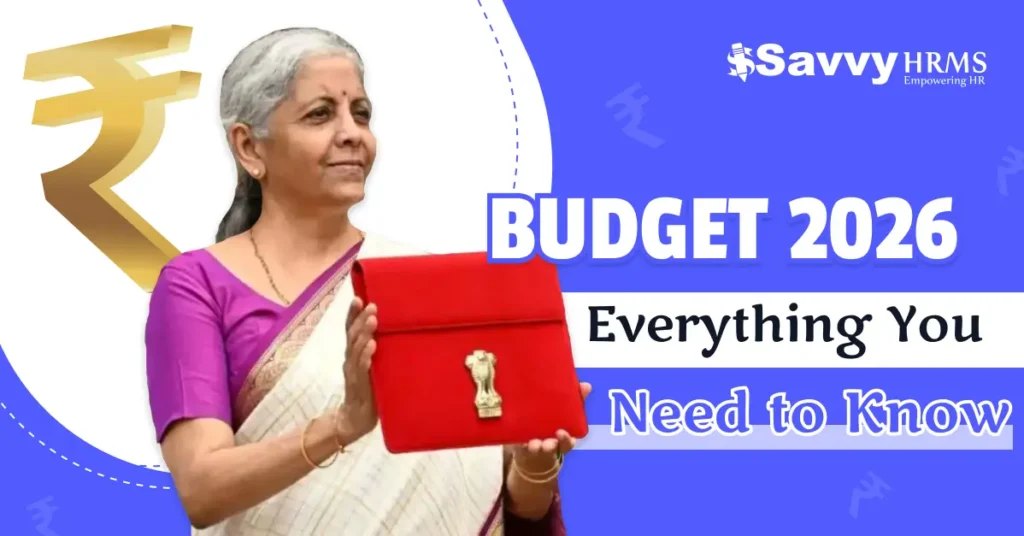

The Union Budget of India has a yearly impact on India’s economic growth, government sectors, taxation policy, and industrial focus; therefore, Budget 2026 is no exception.
However, it differs in that it places an increased importance on long-term economic growth, infrastructure development, the strengthening of the manufacturing industry, and reforms to the financial market. Presented by Finance Minister Nirmala Sitharaman on February 1, 2026, a historic Sunday presentation, this budget serves as a bridge to the New Income Tax Act, 2025.
Budget 2026 will affect nearly every sector of the economy through its effect on taxes, stock market regulations, and development funding for infrastructure, technology, agriculture, and industries. This blog post provides detailed descriptions of all of the major announcements, sector-wide changes, and their implications in an easily understood format.
Overview of Union Budget 2026
In 2026-27, the Union Budget presents the Government’s financial plan for one year. The Budget outlines how the government will earn revenue and how it will spend that revenue, and the policies that will be put in place to improve economic growth while ensuring revenue responsibility.
The total expenditure is estimated at ₹53.5 lakh crore, with a record capital expenditure outlay of ₹12.2 lakh crore (an 11% increase from the previous year). The government remains committed to fiscal discipline, targeting a fiscal deficit of 4.3% of GDP for FY27.
The Three “Kartavyas” (Priorities) of Budget 2026:
- Accelerating Growth: Sustaining economic momentum through massive capital investment and digital infrastructure.
- Fulfilling Aspirations: Enhancing the “Orange Economy” (creative industries) and “Yuva Shakti” through skills and jobs.
- Resource Access for All: Ensuring that every family and region, from the “Rare Earth Corridors” of the south to the industrial hubs of the north, has equal opportunity.
Healthcare Revolution: Medicines and Rare Diseases
One of the most human-centric aspects of Budget 2026 is the massive relief provided to patients battling life-threatening illnesses. The government has prioritized affordability by slashing import barriers.
1. The 17 Cancer Drugs Exemption
Finance Minister Nirmala Sitharaman announced a 100% exemption from Basic Customs Duty (BCD) for 17 important cancer drugs. Previously, these medicines attracted duties ranging from 5% to 11%. This move is expected to reduce the retail price (MRP) of these life-saving therapies by significant margins.
2. Relief for Rare Diseases
The budget expanded the list of Rare Diseases eligible for tax-free personal imports. 7 new diseases (including Primary Hyperoxaluria and Cystinosis) were added to the exemption list. This allows families to import specialised drugs and Food for Special Medical Purposes (FSMP) without paying any customs duty, providing relief from costs that often exceed ₹1 lakh per month.
The “Sin Tax” Overhaul: Tobacco and GST
Budget 2026 introduces a tougher tax rule for “sin goods” to replace the outgoing GST Compensation Cess framework. This marks the most significant overhaul of tobacco taxation since 2017.
1. The New 40% GST Slab
Effective February 1, 2026, most tobacco products, including cigarettes, pan masala, and gutkha, now attract a merged 40% GST rate. Previously, these were taxed at 28% plus a varying compensation cess.
- Biris: Recognizing the impact on rural livelihoods, the GST rate on Biris was reduced from 28% to 18%.
- MRP-Based Valuation: To control tax avoidance, GST will now be calculated based on the Retail Sale Price (RSP) printed on the package, rather than the transaction value between wholesalers.
2. Additional Excise Duties on Cigarettes
A new length-based Central Excise Duty has been introduced on cigarettes (per 1,000 sticks):
- Non-Filter (<65mm): ₹2,050
- Filter (70-75mm): ₹5,400
- Premium and Non-standard: ₹8,500.
Furthermore, a new Health and National Security Cess has been charged on Pan Masala based on manufacturing capacity, requiring factories to install 24-hour CCTV monitoring to prevent illegal production.
What are the changes in Income Tax and Personal Finance?
Taxation is a key focus for every Budget, and the tax changes proposed in Budget 2026 are aimed at making compliance simpler and improving the overall experience of taxpayers with the system.
1. The New Income Tax Act, 2025
The much-anticipated New Income Tax Act replaces the 65-year-old 1961 code. The focus is on a “trust-based” system with minimal exemptions and lower rates.
Key Personal Finance Highlights:
- Zero Tax Limit: Individuals with an income up to ₹12 lakh pay zero tax under the New Rule(after rebates).
- Standard Deduction: Increased to ₹75,000 for salaried employees.
- Revised Returns: You can now file a revised return until March 31 of the assessment year. A late fee of ₹1,000 (for income up to ₹5 lakh) or ₹5,000 (for income above ₹5 lakh) applies after December 31.
- TCS on Foreign Travel: To enhance domestic tourism, the TCS on overseas tour packages has been slashed to 2%.
2. Rationalization of TDS and Compliance
The key measures being implemented for TDS rationalization and improved compliance are as follows:
- Fewer Filings: The number of mandatory TDS returns has been reduced to ease the burden on small businesses.
- Transparency: Form 26AS is being redesigned to provide a real-time view of tax credits, reducing mismatches and disputes.
What are the Key Changes in the Stock Market and Investments?
Budget 2026 aims to control speculative “excess” in the markets while rewarding long-term capital formation.
1. Securities Transaction Tax (STT)
The cost of trading in derivatives has increased significantly:
- Equity Futures: STT raised from 0.02% to 0.05%.
- Equity Options: STT on the premium raised from 0.1% to 0.15%.
- Buybacks: Share buybacks are now taxed in the hands of the company as Capital Gains (at 22% for corporates), ending the practice of using buybacks as a tax-free way to return cash to promoters.
2. Market Sentiment Impact
The immediate reaction of the market following the budget was a period of short-term changes. Higher transaction costs for day traders may lead to a temporary dip in volumes, but the government believes this will lead to a healthier, less speculative market environment.
How Does Budget 2026 Strengthen Infrastructure and Capital Expenditure?
The government has announced a significant increase in capital expenditure, focusing on transforming India’s logistics landscape.
Record Capital Expenditure (₹12.2 Lakh Crore)
- Roadways & Highways: An allocation of ₹3.09 lakh crore for MoRTH to accelerate the Bharatmala projects.
- Railways & Freight: A record outlay of ₹2.93 lakh crore. This includes the operationalisation of the Dankuni-Surat East-West Freight Corridor and the rapid rollout of Kavach (anti-collision technology) across 40,000 km.
- High-Speed Rail: The announcement of 7 new high-speed corridors connecting major hubs like Mumbai-Pune, Delhi-Varanasi, and Hyderabad-Bengaluru.
- Waterways: 20 new national waterways will be functionalised over the next 5 years to reduce logistics costs by 30%.
Manufacturing and Industry: The Global Hub Vision
Budget 2026 strongly supports domestic manufacturing and self-dependence through strategic “frontier” sectors.
1. Electronics and Semiconductor Manufacturing
Allocation for the India Semiconductor Mission (ISM) 2.0 has been increased to ₹40,000 crore. This funding will support the design of indigenous “full-stack” Indian IPs and the establishment of high-tech tool rooms.
2. Biopharma and Healthcare Manufacturing
The launch of the Biopharma SHAKTI scheme (Strategy for Healthcare Advancement through Knowledge, Technology, and Innovation) comes with an outlay of ₹10,000 crore. It aims to:
- Establish 3 new NIPERs (National Institutes of Pharmaceutical Education and Research).
- Create a network of 1,000+ accredited clinical trial sites to make India a global hub for drug testing.
What are the Impacts on the Services Sector?
1. IT and Digital Services
To position India as a “Data Capital,” the budget offers a tax holiday until 2047 for foreign companies setting up global data centres in India. Additionally, a Safe Harbour margin of 15.5% has been introduced for ITeS exporters to reduce transfer pricing disputes.
2. Tourism and Hospitality
The budget focuses on “Cultural & Heritage Tourism Circuits.” By developing infrastructure around 50 identified destinations and providing skill development for 1.5 lakh hospitality staff, the government expects the tourism sector to contribute 10% to India’s GDP by 2030.
Supporting Agriculture and the Rural Economy
Budget 2026 introduces several initiatives to improve the income of India’s 120 million farming households.
- High-Value Crops: A dedicated fund to promote the export of fruits, vegetables, and medicinal plants.
- Kisan Credit Cards: Simplified loan processes with the integration of the Digital Public Infrastructure (DPI) for agriculture.
- Rural Infrastructure: The Mahatma Gandhi Gram Swaraj initiative was launched to modernise traditional collections like Khadi and handlooms, providing them with global market linkages.
How does this budget reforms Banking and Financial Sector?
A complete review of the banking sector has been proposed to boost transparency and accountability.
- Viksit Bharat Banking Committee: A new high-level committee will align credit flow with the needs of the MSME and manufacturing sectors.
- Foreign Investment: The individual investment limit for non-residents (PROI) in listed Indian companies has been doubled from 5% to 10%.
What Budget 2026 Means for Investors?
The Budget 2026 presents both opportunities and difficulties to investors. The application of higher STT on derivatives may raise costs for traders; however, key sectors have long-term prospects.
Key sectors such as infrastructure, manufacturing, and technology will likely benefit from future government spending. On the whole, the Budget encourages long-term investing through regulations designed to promote sustainable growth.
Final Thoughts
The goal of the 2026 Budget is to create a framework for establishing long-term economic development by emphasising manufacturing, infrastructure improvements, technology advancement, and financial stability.
Although there will be some temporary modifications in the marketplace, the overarching goal of the Budget provides a competitive advantage, creates jobs, and provides long-term economic resiliency. Businesses can adopt Savvy HRMS software to effectively manage their payroll processes under the New Income Tax Act 2025, monitor employee performance, and develop talent strategies to exploit the growth opportunities generated by this historic budget.
Official Government Resources
For official information, visit these authoritative sources:
- Ministry of Finance: https://www.pib.gov.in/PressReleasePage.aspx?PRID=2221458®=3&lang=2
- India Budget: https://www.indiabudget.gov.in