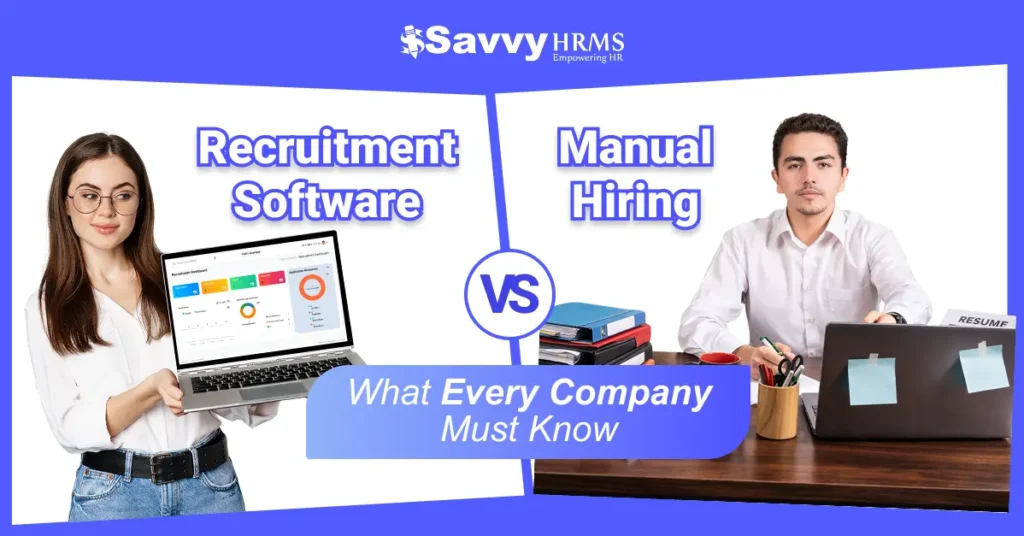
It’s essential to see that finding the best fit for your organization has always been a huge challenge and responsibility, and it’s only getting harder due to supplier development and the increased competition for top-quality candidates. As a result, companies must rethink their processes for attracting, evaluating, and hiring candidates. This is where the discussion of recruitment software vs manual hiring is really important.
Hiring was previously done manually, by using spreadsheets, emails, job postings, etc., and the constant following up they’re required to do. In the case where there are only a few people on the team, this works, but hiring will soon become inefficient, slow, and error-prone as the number of candidates increases. With modern-day hiring, organizations expect quicker turnaround times for hiring, better candidate experiences, and decisions to be made based on data.
Recruitment software is designed to solve those problems and provide your business with the ability to automate your job function and build your hiring process in a structured and scalable manner. So, does that mean that manual hiring is no longer a viable option? Alternatively, does it still have a role to play? Let’s take a deeper look at the two methods of hiring so you can determine the right approach for your organization.
What Is Recruitment Software and Manual Hiring?
What is Recruitment Software?
Recruitment Software is a digital tool that allows companies to automate and create a more efficient hiring process from application through interview and selection, and next to onboarding. It helps human resource teams efficiently manage the recruitment process using technology and provides a centralised candidate database for storing all candidate assets.
Key features of Recruitment Software are:
- Automated job posting on multiple platforms
- Resume parsing and applicant tracking
- Interview scheduling and communication
- Recruitment analytics and reports
- Integrations with other HR tools, such as attendance management software, leave management software, and payroll software.
What Is Manual Hiring?
Manual hiring is the traditional recruiting method in which HR teams manage the process without the help of invested recruitment technology. Most tasks are done using email, spreadsheets, phone calls, and individual job boards.
Some characteristics of manual hiring are:
- Posting jobs one at a time on job boards
- Screening resumes manually
- Tracking candidates using Excel spreadsheets
- Scheduling interviews via phone and email
- Limited reporting & visibility to hiring metrics
Difference Between Recruitment Software and Manual Hiring
| Aspect | Recruitment Software | Manual Hiring |
| Resume Screening | Automated shortlisting using filters and keywords | Manual resume review, time-intensive |
| Candidate Tracking | Centralized system with real-time status updates | Tracking via spreadsheets and emails |
| Hiring Speed | Faster time-to-hire through automation | Slower due to multiple manual steps |
| Data Accuracy | High accuracy with system-driven records | Prone to human errors and duplication |
| Scalability | Easily handles growing hiring volumes | Hard to manage at scale |
| Cost Efficiency | Cost-effective in the long run | Hidden and recurring costs |
| Reporting & Analytics | Real-time hiring insights and metrics | Limited or no reporting |
| Candidate Experience | Structured, timely, and professional | Inconsistent communication |
| Collaboration | Easy coordination among HR and managers | Depends on manual follow-ups |
| HR Integration | Integrates with payroll, leave, and attendance software | Works in isolation |
Key Differences Explained
1. Automation vs. Manual Effort
Automation simplifies recruitment tasks, such as resume screening, interview scheduling, and follow-up, while manual recruitment depends on human labor for most of these tasks. As a result, manual recruitment places a higher workload on recruiters and often results in longer timeframes to complete individual hiring tasks.
2. Centralized Data vs. Scattered Data
With recruitment software, all candidate information is located in one central location. In contrast, manual recruitment typically has candidate data that is scattered across emails, spreadsheets, and job boards.
3. Improved Accuracy and Compliance
Automation-based solutions remove or significantly reduce the likelihood of making errors and allow easy access to the documentation required to remain compliant. Instead, manual solutions have a higher likelihood of creating errors in data, duplicates, and compliance gaps.
4. Speed of Hire
Automation solutions will accelerate the speed of hire when used effectively, while manual methods may slow down hire when the volume of candidates increases.
5. Reporting and Decision-Making
Recruitment software provides hiring metrics such as cost-per-hire and performance effectiveness of each sourcing option. Unfortunately, manual processes generally do not provide structured reports, which complicates the ability to make data-driven decisions.
6. Candidate Experience
Candidates benefit from the use of automated communication and the provision of timely updates. On the other hand, candidates who are part of a manual process often experience delays and less-than-optimal communication.
Which Is More Cost-Effective: Recruitment Software or Manual Hiring?
Manual hiring may seem cheaper initially, as there are no upfront fees; however, research and HR benchmarks show that manual hiring can actually lead to 30–50% higher recruitment costs due to its time-consuming nature, delayed hiring times, and a higher likelihood of making poor hiring decisions.
Recruitment software requires an initial investment; however, it can reduce the overall cost of hiring by 25–40% in the long run. By automating tasks, shortening time-to-fill, and improving accuracy when paired with attendance management, leave management, and payroll software, organizations benefit from a much more cost-effective and scalable HR ecosystem.
| Cost Factor | Recruitment Software | Manual Hiring |
| Initial Cost | 5–10% of annual HR budget (subscription-based) | 0–2% upfront, but misleading |
| HR Time Cost | Reduced by 40–60% through automation | Increased by 50–70% due to manual effort |
| Hiring Errors | 20–30% fewer bad hires | 25–40% higher risk of mis-hires |
| Vacancy Costs | Vacancy duration reduced by 30–45% | Vacancies extend by 20–35% |
| Scalability Costs | Cost increase limited to 10–15% as hiring grows | Costs rise sharply by 40–60% |
| Administrative Costs | Reduced by 35–50% | Higher due to repetitive tasks |
| Overall ROI | Positive ROI of 120–200% over time | ROI declines by 30–50% |
How Does Each Approach Impact Hiring Speed and Time Efficiency?
Recruitment Software
The use of recruiting software helps speed up the hiring process through the automation of repetitive, time-consuming tasks such as screening resumes, scheduling interviews, and communicating with candidates. As a result, instead of sorting through hundreds of applications manually, HR teams can quickly identify suitable candidates based on pre-defined filters. This increases efficiency by reducing delay, decreasing the hiring cycle, and enabling companies to acquire top talent before they are acquired by competitors.
The key benefits of recruiting software on the speed and effectiveness of hiring include:
- Automated resume screening and shortlisting
- Decreased average time to hire by 30 to 50%
- Increased speed of scheduling interviews
- Significantly reduced HR administrative workload
- Improved speed of candidate communication and follow-up
Manual Hiring
Manually recruiting people can slow down a company’s hiring process because each aspect of the hiring process requires human input. HR staff have to individually review resumes, set up interviews via telephone or email, and keep track of candidates manually. So, as the number of applicants increases, it becomes increasingly difficult to hire new employees in a timely manner, resulting in the following situations:
- Time-consuming manual resume screening
- Lengthy recruiting processes caused by multiple manual steps
- Increased need for HR to be available throughout the process
- Late communication with candidates
- Greater chance of losing top talent to employers who hire faster.
Which Approach Scales With Your Company’s Growth?
As a business scales, they’re going to need to hire fast, a lot, and with growing complexities. Recruitment software is designed to allow companies to scale easily, to allow companies to easily manage multiple job openings, an enormous number of applicants, and multiple recruiters without creating much operating difficulty and overhead. Automated workflows allow for consistent hiring processes, no matter how high your hiring activity is.
For smaller teams, manual hiring may work fine, but as the company grows, managing this process gets harder. The more applicants you have, means that you have many more resumes, emails, follow-ups, and spreadsheets you have to manage, which makes things confusing for HR teams. This leads to loss of time, resulting in mistakes and missing an opportunity to fill an open position.
For developing companies, recruitment software allows your company to grow in a sustainable manner and improves the manner in which you recruit. It integrates with other HR tools, thus allowing the HR department to continue being strategic and focus on the things that matter instead of the administration of hiring new staff.
How Can You Make the Right Choice for Your Growing Company?
1. Evaluate Your Current Level of Hiring
Determine the frequency of your hiring and your annual volume of filled positions. Large-volume or frequent hiring requires system automation in order to sustain the appropriate level of operational strain and speed.
2. Determine Your Recruitment Pain Points
Identify specific issues currently found in your hiring process. Examples include long hiring times, candidates dropping off halfway through the hiring process, or being confused by administrative responsibilities. Making a list of these issues will help determine if the issues are due to the inability to grow because of manual hiring processes.
3. Outline Your Growth Plans
Identify your plans for business growth and ensure your recruiting strategy matches your company’s goals. If you have a plan to grow your company quickly, you will need a scalable recruiting solution to meet the demands of your increasing workforce.
4. Compare Cost and Long-Term Value
When comparing recruiting software to your manual hiring process, look at what you spend today and what you would save in efficiencies, reduced errors, or increased productivity, and how these savings will provide long-term value to you.
5. Consider How Quickly You Need Roles Filled
Analyze the time frame in which you need to fill roles. You must fill roles quickly in a competitive marketplace; if you do not respond quickly enough to candidates, you may lose out on talent that could have filled those positions.
6. Verify Integration Options
Choose a recruiting solution that integrates with your attendance management software, leave management software, and payroll software to ensure you have a smooth end-to-end HR operation.
7. Positive Candidate Experience
Implementing an industry-standard hiring process will increase your employer brand and the satisfaction of your candidates, which will help you attract and retain top talent over the long term.
Conclusion
The debate of recruitment software vs. manual hiring eventually comes down to efficiency, scalability, and long-term value. Manual hiring may look simple, but it often results in inefficiencies, higher hidden costs, and limited growth potential.
Recruitment software allows organizations to hire smarter, faster, and more strategically. With an all-in-one solution like Savvy HRMS, organizations can simplify recruitment while managing attendance, leave, payroll, and other HR functions from one platform. For growing companies, the right recruitment technology isn’t just an option; it’s a necessity.