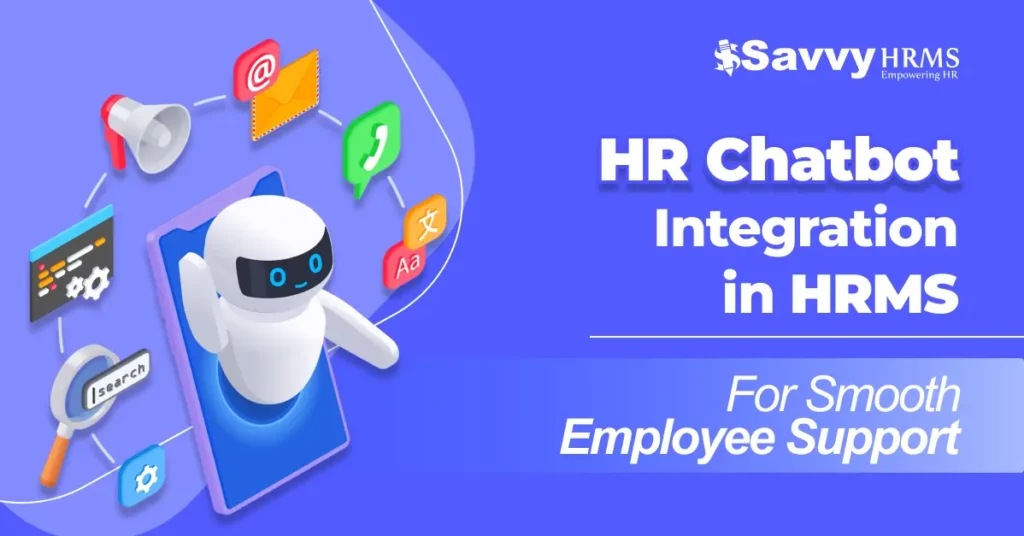
All modern organizations need assistance that is customized to fit their specific needs. Developing an HR chatbot that integrates into your current HRMS makes it easy to assist your employees in every step within their employee lifecycle by providing instant and smooth support while also improving the overall efficiency of the HR function.
Companies are increasingly using digital tools such as HR software, payroll software, attendance management software, and leave management software. The need for simple communication tools and enhanced employee experiences through smart automation is becoming increasingly apparent.
What are HR Chatbots?
An HR chatbot is an AI-based virtual assistant embedded into HRMS or HR software that enables automated employee interaction, response to queries, and supports other HR functions so as to be performed more easily.
It is like a virtual HR representative, delivering instant answers to payroll software, leave management software, attendance management software, policies, and guidance throughout the employee lifecycle.
HR Chatbots enhance employee satisfaction throughout all organizations while also reducing workloads through automation and improving the timeliness and accuracy of dealing with HR queries by implementing AI and natural language processing technologies.
What Are the Types of HR Chatbots?
1. Rule-Based HR Chatbots
HR chatbots that are rule-based work off of set scripts and decision trees and will respond appropriately to specific keywords or structured questions within an hrms system.
2. AI-Powered HR Chatbots
AI-powered HR chatbots utilize machine learning and natural language processing technologies, allowing them to understand context, learn from previous conversations with users, and provide intelligent and relevant responses to user queries across multiple HR functions.
3. Hybrid HR Chatbots
HR chatbots that are hybrid combine rule-based and artificial intelligence technologies, allowing them to provide structured responses while still adjusting to complex employee issues within an hr software environment.
4. Voice-Enabled HR Chatbots
Voice-enabled HR chatbots utilize voice recognition technology and, therefore, enable an employee to speak with an HR chatbot when asking questions regarding payroll, attendance management software, or to inquire about leave in order to have a more convenient interaction with the HR chatbot.
How Do HR Chatbots Work?
1. Query Recognition
Through either text or voice, employees submit their questions through the HR chatbot, which then analyzes the keywords found in these questions with the help of natural language processing (NLP) in a fully integrated HRMS platform.
2. Intent Identification
The use of advanced AI technology is able to identify the intent of the user and determine whether the situation is dealing with the payroll software, leave management software, attendance tracking software, or policy documentation.
3. Data Retrieval
The HR chatbot securely connects with the data source within the HR software database to retrieve accurate employee-related information, thereby ensuring both real-time data and personalized data are responded to in an efficient manner.
4. Automated Response Generation
The use of collected data and intent analysis allows the HR chatbot to generate automated, contextually relevant responses to support employees with their needs.
5. Workflow Triggering
When a task is complex and requires an HR team member, such as approving a leave request or processing payroll information, the HR chatbot will automatically trigger the workflow process from an automated platform in the HRMS system, thus eliminating the need for manual HR leaders.
6. Continuous Learning
AI-based chatbots will learn from their interactions; therefore, as they continue to receive new data, their accuracy in understanding how employees’ behaviours change will improve over time and enhance the overall quality of service provided.
7. Escalation to HR Teams
Should an employee inquiry necessitate human intervention, the HR chatbot will intuitively escalate issues to the appropriate HR representative, allowing for complete employee support.
What Are the Key Elements of HR Chatbots?
1. Natural Language Processing
The HR chatbot uses natural language processing so that it can interpret employee questions in a conversational manner throughout the various HRMS platforms with accurate and speedy contextual understanding of the question being answered.
Natural language Processing enables the HR Chatbot to understand the intent behind an employee’s question, their tone, and key phrases within the context of the inquiry, resulting in accurate responses regarding payroll software, attendance management software, and HR policies.
2. AI and Machine Learning
By utilizing AI and machine learning, the HR Chatbot’s intelligence increases as it continually learns from an employee’s interactions with the HR software systems utilized by the company.
As a result, over time, the HR Chatbot’s accuracy of response substantially improves, is able to predict the most commonly asked questions, and personalizes the employee’s support experience throughout the HRMS platforms in the most efficient manner possible.
3. HRMS Integration
Integration of the various HRMS modules provides the HR Chatbot with the ability to connect smoothly with payroll software, leave management software, and attendance management software.
This connectivity provides real-time retrieval of data, accurate updates, and smooth execution of HR processes without requiring any manual intervention.
4. Data Security Management
Data security management is the protection of employee payroll data and personally identifiable information stored in HR integrated HRMS and HR Software.
Advanced encryption processes combined with compliance measures will help ensure confidentiality by protecting this sensitive HR information from being accessed or breached by people who should not have been able to do so.
5. Intuitive User Interface
An intuitive user interface enables employees to easily utilize the HR Chatbot across desktop and mobile HRMS platforms.
Simple navigation, combined with an intuitive graphic design, will promote HR usage without technical issues or confusion.
6. Workflow Automation Engine
The Workflow automation engine will allow the HR Chatbot to effectively initiate approval, updates, and notifications within the HRMS.
It will also help decrease manual task activities by automating repetitive HR activities through the use of Payroll and HRMS software and Leave Management software modules.
What Are the Main Functions of HR Chatbots?
1. Employee Query Resolution
An HR chatbot can answer several typical questions that might appear from employees to HR relating to payroll software, attendance management software, policies and procedures, and leave management software through the hrms.
2. Leave and Attendance Management
Employees who would like to apply for leave, check their leave balances, track their attendance, and receive a notification if they have any updates, may do so via HR integrated systems.
3. Payroll Assistance
By using the hrms, employees may have access to their payslips, find out their pay breakdown, understand tax deductions, receive payroll software updates in a timely manner, respecting their pay cycle.
4. Onboarding Support
New hires will receive ‘automated’ support for all documentation required by HRMS, related company policies, training schedule, and employee benefit information through automated HRMS workflows
5. Policy and Document Access
The HR chatbot will provide companies’ employees with instant access to company policies, employee handbooks, compliance documentation, etc., stored in their HR systems.
What Are the Advantages of HR Chatbots?
1. 24/7 Employee Support
Offered continuous support for payroll, attendance management, and leave management inquiries, and assists with them through an HRMS platform integration whenever they are required.
2. Reduced HR Workloads
Automates repetitive employee inquiries and routine tasks, helping to free up HR professionals to concentrate on strategic initiatives and workforce development.
3. Faster Response Time
Provides immediate and accurate answers to employee issues, resulting in a drastic reduction in the dependence on email, phone calls, and other methods of communicating with HR.
4. Better Employee Experience
Improves employee satisfaction through personalized interactions, smooth navigation, and quick and easy access to HR software services and information.
5. Cost Efficiency
Lowers administrative costs by reducing the number of times that manual processes, paperwork, and resources are used, resulting in an overall increase in efficiency across payroll and HR operations.
6. Accurate Data
Ensures that payroll calculations and attendance are accurately tracked using an HRMS system by minimizing the amount of manual errors that occur in the HRMS system as well as related software systems.
7. Scalable
Will be adapted to meet expanding workforce needs, so that you can effectively grow your organisation without increasing HR staff resources proportionally.
Conclusion
Adding an HR chatbot to your HRMS can help automate repetitive tasks, be more responsive to employees, and improve the efficiency of your HR software system.
The Savvy HRMS platform provides a combination of sophisticated payroll software, attendance software, and leave management software with its intelligent HR chatbot capabilities to enable modern businesses to achieve continuous, scalable HR transformation.