A project manager once had to build a full team in 72 hours, not because talent was rare, but because there was no system in place to do the particular task fast. That single moment cost the business both time and money.
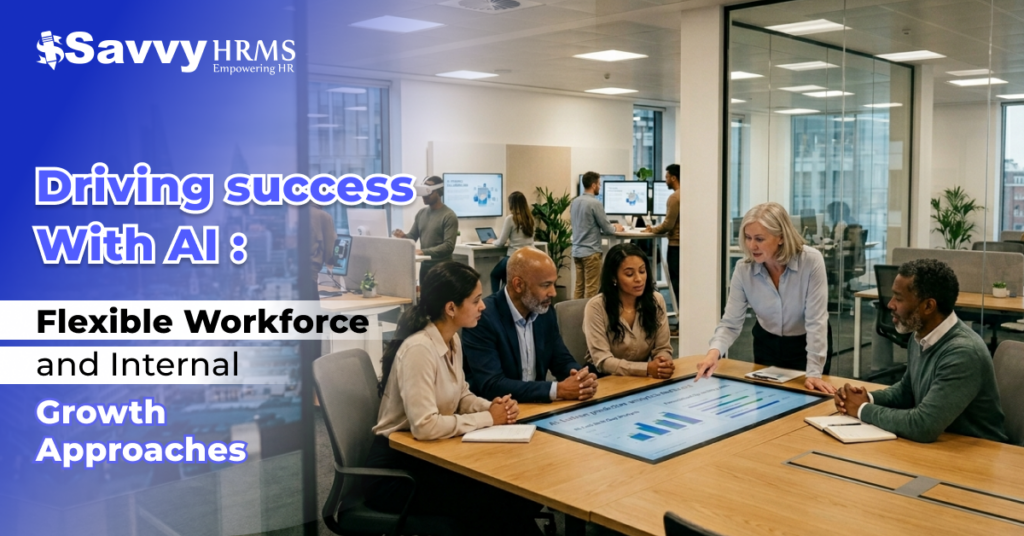
Today, organisations that depend on outdated workforce models are quietly falling behind. AI-powered HR software is changing how businesses plan, build, and manage their teams, making speed and precision available to every HR professional, not just the largest organizations.
The real competitive edge now belongs to companies that combine flexible workforce strategies with a genuine commitment to internal growth. This blog breaks down how to do exactly that, practically, clearly, and in a way your whole team can act on.
What Are the Practical Ways Flexible Workforces Stay Ahead Without Losing Their Human Touch?
A retail chain once automated its whole shift-scheduling process and actually saw employee satisfaction go up, because employees finally got shifts that matched their availability. Technology, when used well, makes work feel more human, not less.
Here are the practical approaches that keep flexible workforces ahead without losing that human connection:
1. Lead with data but decide with empathy
HR software gives managers real-time visibility into workloads, attendance patterns, and performance trends. But the best managers use that data as a starting point for honest conversations, not as a replacement for them.
2. Invest in transparent communication tools
Employees in flexible setups, remote, hybrid, part-time, or contract, stay engaged when they can access their schedules, raise concerns, and track their own progress through a single HRMS platform. Clarity builds trust, and trust drives performance.
3. Tackle workforce blind spots before they become problems
Issues like time theft, scheduling conflicts, and burnout often go unnoticed in flexible teams until it is too late. Modern HR software addresses these patterns early, giving managers the chance to act before small issues become expensive ones.
How Is AI Transforming Flexible Workforce Strategies?
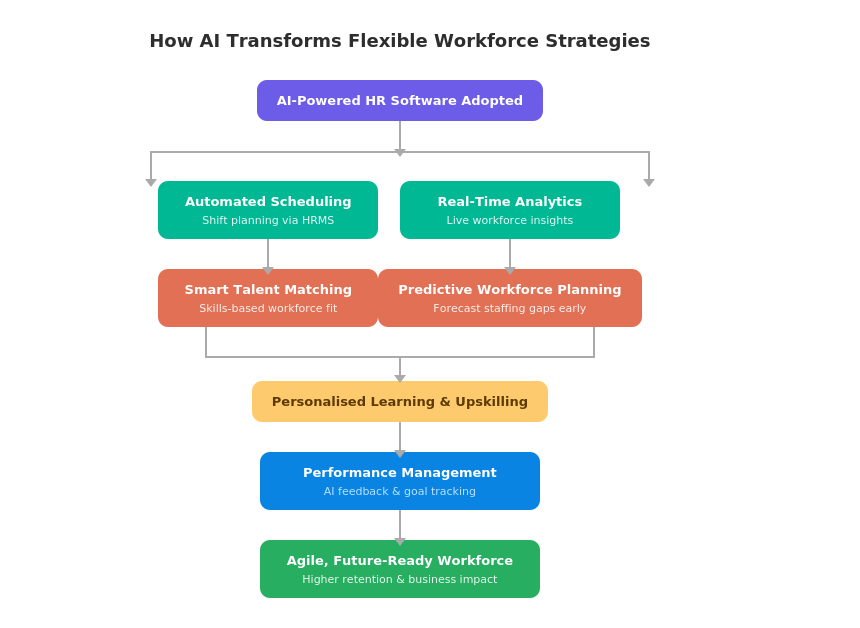
Here is what each step in that transformation actually means on the ground:
1. AI-powered HR software adopted
Everything starts here. When organisations move from manual processes to an intelligent HRMS, they gain the foundation needed to make smarter, faster workforce decisions.
2. Automated scheduling
AI handles shift planning, availability matching, and workload distribution. Managers reclaim hours previously lost to spreadsheets and back-and-forth messaging.
3. Real-time analytics
Rather than waiting for closing reports, HR leaders can see what is happening across their workforce today and adjust plans accordingly before situations grow.
4. Smart talent matching
AI maps existing employee skills against open roles and project needs, reducing the need to hire externally when the right person may already be on the team.
5. Predictive workforce planning
By identifying historical patterns and current business demand, HR software can forecast staffing gaps months before they appear, turning reactive hiring into strategic planning.
6. Personalised learning and upskilling
AI identifies individual skill gaps and recommends learning routes tailored to each employee’s role and career goals, making development feel relevant rather than generic.
7. Performance management
Continuous, AI-assisted feedback replaces annual reviews with ongoing conversations, helping employees improve in real time rather than waiting for a year to hear how they are doing.
8. Agile, future-ready workforce
The result of all of the above: A workforce that adapts quickly, retains top talent, and consistently delivers on business goals.
Why Are Flexible Workforces Important for Business Success Today?
1. They Allow Businesses to Scale Without the Usual Delays
Traditional hiring takes weeks. A well-managed flexible workforce, supported by HR software, means organizations can respond to emergencies in demand within days, not months.
2. They Open the Door to a Much Wider Talent Pool
When location is no longer a restriction, organisations can recruit based on capability rather than location. Flexible models attract talent that simply would not consider a rigid 9-to-5 setup.
3. They Help Control Workforce Costs More Precisely
A mix of permanent, part-time, and contract roles, managed through a reliable HRMS, allows organizations to align their employee costs with actual business activity, avoiding expensive over-hiring during slower periods.
4. They Significantly Improve Retention
Employees who have flexibility and growth opportunities are far less likely to leave. Smart HR software helps managers spot early warning signs of disengagement and act before a resignation lands on their desk.
5. They Create a Skills-First Culture
Moving away from rigid job titles toward capability-based teams promotes employees to develop broader skill sets. Organisations with skills-first cultures are consistently better at responding to change and driving innovation.
6. They Fuel Cross-Team Innovation
When employees move across departments, work on different projects, and collaborate with different teams, ideas travel further. Flexible workforce structures break down the structure that kills creativity in traditional setups.
7. They Prepare the Business for Long-Term Disruption
Industries are changing faster than ever. A flexible workforce managed through a modern HRMS is not just a short-term staffing solution; it is a long-term resilience strategy that keeps businesses competitive regardless of what the market throws at them.
What Role Does Internal Growth Play in a Future-Ready Workforce?
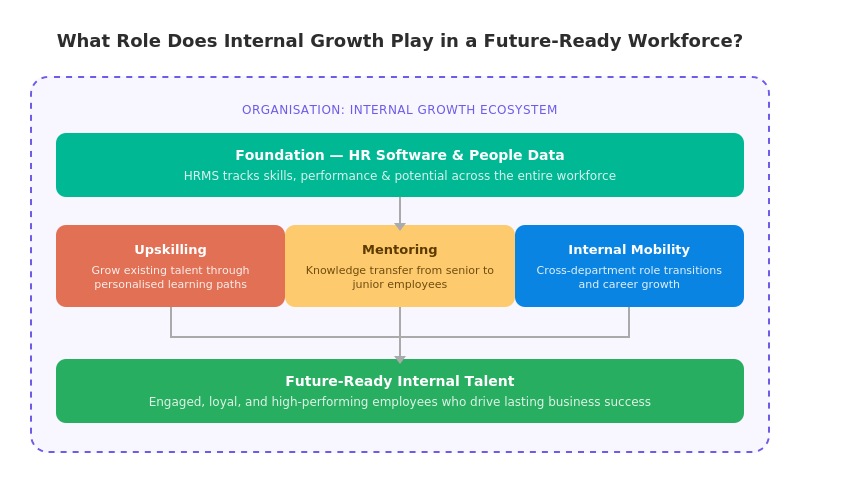
A senior developer at a mid-sized tech company once turned down three external job offers in one year, not because the money was not enough, but because their company kept giving them new challenges to grow into. Internal growth is one of the most powerful retention tools a business has, and most organizations are rarely scratching the surface.
Reflection question: When did you last sit down with each team member and map out where they want to be in two years, and how your organization can help them get there?
The foundation of internal growth is visibility. When a strong HRMS tracks skills, performance history, learning progress, and career goals in one place, HR leaders can identify their next managers, specialists, and team leads from within, rather than spending time and money searching externally. Employees who feel seen and invested in are the ones who show up fully and stay long-term.
Internal growth also creates a rebuilding effect within the organizations. When one employee is developed and promoted, they become a mentor to the next person coming up. This cycle of knowledge transfer builds institutional judgement that no external hire can copy on day one.
Worth asking: Is your current HR system helping you identify tomorrow’s leaders from today’s workforce, or are great people slipping through the cracks?
The organizations leading in workforce development right now are the ones that treat internal growth not as an HR initiative but as a core business strategy. They use workforce analytics to forecast where talent will be needed, identify which employees have the same skills ready to develop, and build structured pathways that turn potential into performance, all supported by a reliable, integrated HRMS.
How Can Upskilling and Reskilling Drive Internal Talent Development?
Upskilling: Helping Employees Go Deeper in What They Do
1. Start with a clear skills gap evaluation
Use your HRMS to address current capabilities against future business needs. This gives HR and managers a shared picture of where investment is needed most, and prevents guesswork.
2. Build personalised learning journeys, not one-size-fits-all programmes
Employees engage more with development when it connects directly to their own role and career path. HR software that links learning modules to individual growth plans makes this practical at scale.
3. Bring learning into the flow of daily work
Short, focused learning moments embedded in the working day are more effective than occasional training sessions. Mobile-accessible HRMS platforms make this easy to deliver without disturbing productivity.
4. Recognise and reward learning milestones visibly
When managers celebrate upskilling progress, not just output, it sends a clear signal that growth is valued. HR software can automate recognition activities, keeping momentum alive.
Reskilling: Preparing People for What Comes Next
1. Use workforce data to spot role disruption early
When HR analytics point out that certain roles may change significantly due to automation or restructuring, reskilling programmes can begin proactively, turning a potential excess situation into a growth story.
2. Build clear, structured transition pathways between roles
Reskilling feels far less discouraging when employees can see a mapped route from where they are now to where they are headed. A good HRMS visualises these pathways, making internal transitions feel like promotions rather than experiments.
3. Measure what is working and adjust quickly
Track completion rates, performance improvements, and internal mobility results through your HR software. The data tells you which programmes are driving real results and which ones need rethinking, so you never invest in the wrong approach for long.
Conclusion
The organizations building lasting success right now are not simply adopting new technology; they are using it to unlock the full potential of the people already in their teams. Flexible workforce strategies and internal growth are not separate processes; together, they form a complete approach to building a business that is both agile and strong in equal measure.
This is exactly the kind of transformation that Savvy HRMS is designed to support. From automated scheduling and real-time attendance tracking to personalized learning, performance management, and workforce analytics, Savvy HRMS brings every part of your employee strategy into one intelligent platform, so HR teams can stop firefighting and start building for the future.
Your next great hire might already be on your team. And your strongest workforce might be one smart platform away. Start your journey with Savvy HRMS today.