


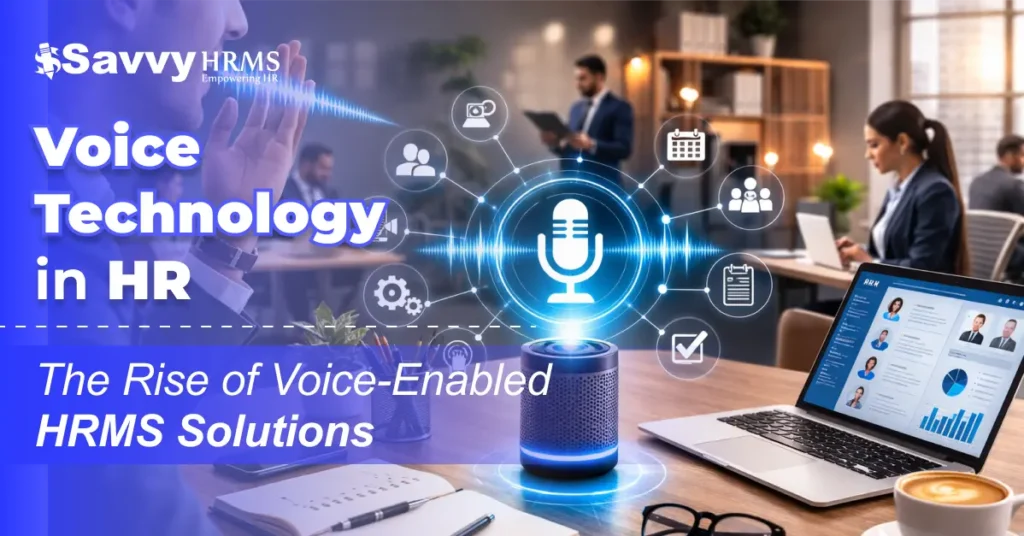

The workplace is undergoing a rapid transformation, and so is HR technology. Organizations are shifting from conventional dashboards to smarter, faster, and more user-friendly systems driven by voice technology in HR.
As HR departments handle payroll software, attendance management, leave management, and employee engagement, the need for efficiency has become the only option. Voice-driven HRMS solutions are on the verge of becoming the answer to this need.
With instant policy searches to modern payroll updates, voice commands are making complicated HR processes easier. The growing need for voice-driven HR software marks the beginning of a new era of hands-free and intelligent employee management.
What Is Voice Technology in HR?
Voice technology in HR is the combination of voice recognition and AI assistants with HRMS and HR software solutions. It enables employees to communicate with the HR system using natural language instructions rather than manual entry.
Using voice-enabled HRMS solutions, employees can access attendance management records, apply for leave management, view payroll information, or access company policies. For HR leaders, it saves time, increases response time, and improves productivity.
How Voice AI Is Transforming Employee Engagement and Workplace Satisfaction?
Voice AI increases employee engagement through instant support, reduces administrative issues, personalization, and employee empowerment through accessible HRMS systems.
1. Instant HR Support
Voice-enabled HR Software answers queries related to policies, payroll software, attendance management, and leave management instantly without any delay or human disturbances.
2. Personalized Employee Interactions
Voice AI in HR systems enables personalized responses to employees based on their information, preferences, roles, and past interactions stored in integrated HR software systems.
3. Reduced Administrative Frustration
Employees do not have to fill out long forms or navigate complicated portals by using voice commands for attendance management, leave management, and payroll software queries.
4. 24/7 Accessibility
Voice-enabled HR software systems enable employees to access HRMS services 24/7, thereby increasing satisfaction among remote, hybrid, and global employees.
5. Faster Issue Resolution
Voice assistants automatically develop issues in HRMS systems, thereby reducing overall times and increasing employee engagement levels.
6. Inclusive Workplace Experience
Voice AI in HR systems benefits differently-abled employees by making the workplace experience more comprehensive and accessible for them through attendance management and payroll software systems.
How Voice AI Is Reshaping Workplace Communication and Feedback?
1. Real-Time Feedback Gathering
Voice-enabled HRMS systems collect real-time feedback from employees, allowing companies to track sentiment and improve workplace culture.
2. Smooth Manager-Employee Communication
Voice technology in the HR department helps to fill communication gaps by allowing employees to make automated updates, confirm tasks, and track workflow in HR software platforms.
3. Anonymous Voice Surveys
Employees are promoted to give their honest feedback through secure voice-enabled HRMS survey systems, which boosts transparency and actionable insights for leadership teams.
4. Quick Internal Notifications
HR leaders use voice AI technology integrated with HR software to make announcements about policy changes, payroll software reminders, and attendance management changes.
5. Conversational Performance Reviews
Voice-based feedback systems make performance reviews easier by allowing feedback to be stored directly in HRMS records for tracking of well-structured evaluation and development.
6. Enhanced Listening Culture
Voice technology in HR helps to create a listening culture by analyzing tone, sentiment, and engagement records in employee communication channels.
7. Continuous Pulse Monitoring
Voice AI technology integrated with HRMS systems helps to conduct continuous pulse surveys, which allow HR software to identify engagement issues before productivity drops.
What are the Key Benefits of Voice-Enabled HRMS Solutions?
1. Boost in Operational Efficiency
The use of voice technology in HR departments removes manual data entry in HRMS, payroll software, attendance management systems, and leave management systems.
2. Better Employee Experience
The interactive voice interface improves the usability of HR software, leading to increased adoption and satisfaction among employees.
3. Faster Decision-Making
The use of voice AI insights with HRMS offers immediate analytics into the workforce, enabling data-driven decisions in payroll software and talent management.
4. Decrease in HR Departmental Workload
Repeated queries are automated with voice-enabled HR software, allowing HR teams to concentrate on strategic planning and employee development.
5. Improved Data Accuracy
Voice technology in HR departments reduces the risks of errors in attendance management, payroll software, and leave management systems.
6. Mobile and Remote Accessibility
Employees can use HRMS services on smartphones with voice commands, also improving engagement in mobile and hybrid work environments.
What Are the Key Voice AI Use Cases Across HR Functions?
1. Recruitment and Onboarding
Voice-enabled HRMS helps top talents with application status, interview schedules, and onboarding documents through voice interactions with HR software.
2. Attendance Management
Employees can access attendance management records, mark their attendance, or look for corrections instantly using voice technology in HR software.
3. Leave Management
Voice assistance makes leave management requests, approvals, and explanations easier in integrated HRMS software.
4. Payroll Software Assistance
Employees can view salary statements, tax deductions, and payroll software information securely using voice-enabled HR software tools.
5. Learning and Development
Voice AI suggests training modules in HRMS software, aligning employee development with organizational competency requirements.
6. Employee Self-Service
Voice-enabled HRMS improves employee self-service with instant access to HR software resources without manual disturbances.
What are the Challenges in Implementing Voice Technology in HR?
1. Data Privacy Issues
Organizations need to ensure the use of secure encryption in HRMS systems while implementing voice technology in HR-related processes.
2. Integration Issues
The integration of voice-enabled functionalities with the current payroll management, attendance management, and leave management systems in an organization requires proper planning.
3. Resistance to Adoption
Employees may withstand the use of voice-enabled HR software, and training and communication programs need to be implemented.
4. Accuracy Issues
Inaccuracies in voice recognition technology may affect the accuracy of HRMS data, particularly in a multilingual or noisy environment.
5. Infrastructure Needs
The implementation of voice technology in HR needs a stable network, a modern architecture for HR software, and an AI-powered backend infrastructure.
What is The Future of Voice Technology in HR?
The future of voice technology in the HR department will see it move from a simple command-based system to a predictive and proactive HRMS assistant. The system will be able to analyze attendance management data, payroll software, and engagement data to provide intelligent suggestions.
With the automation of AI capabilities, voice-enabled HR software will be able to integrate more with analytics dashboards, performance management software, and employee planning tools. The integration of informal interfaces and data intelligence will change the way companies manage their teams.
The future HRMS environment will be voice-first, mobile-friendly, and highly personalized. Companies that go for voice technology in the HR department early will have a competitive edge in employee engagement and efficiency.
Conclusion
Voice technology in HR is changing the way HRMS, payroll software, attendance software, and leave software work by making them smarter and conversational. Growing companies using Savvy HRMS can enhance engagement, efficiency, and employee satisfaction with voice technology in HR software.
Book a personalized demo with Savvy HRMS today and experience how voice-enabled HR software can convert your HRMS functions easily.