


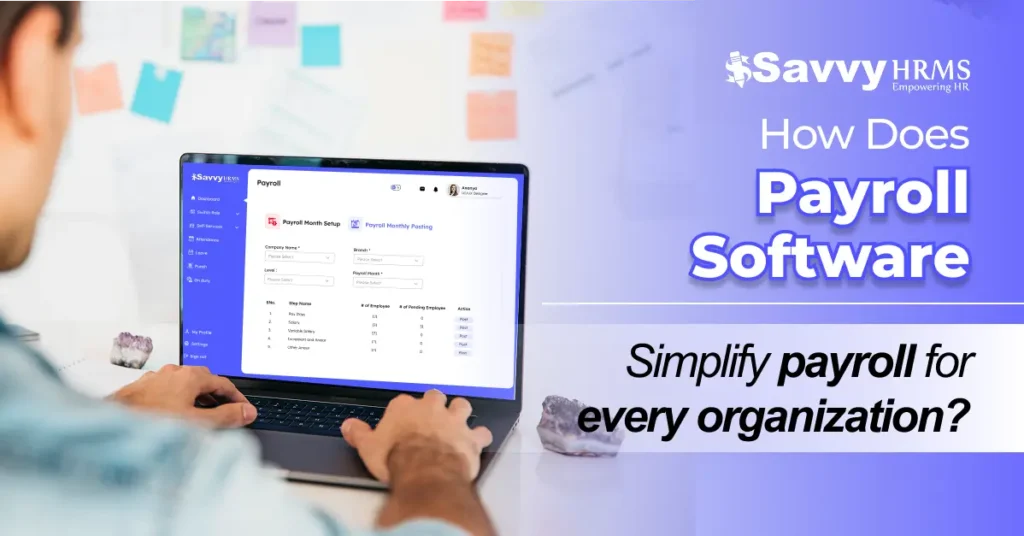

One of an organization’s most important, yet complicated, business functions is payroll. Payroll consists of many functions, including salary calculation and compliance with labor laws. Therefore, even minor mistakes can result in dissatisfaction among employees and legal complications for the employer.
As businesses grow and develop, it becomes increasingly difficult and time-consuming for the employer to use manual payroll methods. Companies are now utilizing advanced payroll software to simplify payroll functions and improve efficiency.
Today, payroll has developed beyond simply paying employees’ salaries; payroll software now works with other applications such as leave management, attendance management, and overall human resource management systems (HRMS). Therefore, payroll can now be managed more easily, accurately, and efficiently than ever.
What Is Payroll Software?
Payroll Software is a solution that helps companies calculate employees’ salaries, deductions, bonuses, taxes, and net pay accurately and on time, which also eliminates the need to depend on spreadsheets by automating routine tasks.
Payroll software generally resides within HR software or HRMS and collects attendance, leave, and compliance information from multiple systems to ensure accurate calculations are made for all payroll periods.
What Are the Challenges with Manual Payroll Processing?
Manual payroll processing depends heavily on spreadsheets, paperwork, and human calculations. While it may work for very small teams, it becomes risky and inefficient as organizations scale.
Here are the common challenges of manual payroll processing:
1. Time-Intensive Processes
The amount of time dedicated by HR teams each month to perform the manual payroll process is important due to repetitive multiple calculations, approvals, correction processes, and dependence on multiple spreadsheets each month.
2. Large Potential for Errors
Being done manually allows the potential for human error, which typically affects payroll-related errors that lead to inaccurate salary payments, incorrect tax classifications, rework, employee dissatisfaction, increased compliance risk, and possibly loss of company credibility.
3. Difficulty With Statutory Compliance
As payroll is managed manually, the burden on businesses becomes much heavier to remain compliant with various statutory regulations, as the updates (PF, ESI, TDS, and labour laws) can occur frequently, and total compliance requires constant tracking manually through a company process.
4. Poor Quality of Data
Due to the repeated manual entry, HR teams will typically not have accurate payroll information, as often attendance, leave, and payroll data will not match; therefore, incorrect salary payment will occur, along with high employee query frequency.
5. Disorganized Records
Due to HR maintaining payroll records using various papers and spreadsheets, the records become difficult to store, retrieve, audit, and secure; therefore, the company remains at an increased risk of data loss due to inadequate processes and procedures to protect the payroll records.
6. Not Scalable
Manual payroll may be limited in its ability to accommodate the growing number of employees across multiple salary structures, multiple locations nationwide, and when delivering increased policy and organizational efficiencies.
7. Lack of Timely Delivery of Payroll Reports
The payroll reporting process through the manual process frequently leads to HR and management not having the ability to provide reporting that contains both accurate and timely information necessary to facilitate quick decision-making.
How Payroll Software Simplifies Payroll Management for Every Organization?
1. Automated Salary Computations
The payroll software automatically calculates salaries, wages, bonuses, and deductions based on predefined structures and attendance records.
This eliminates human errors, saves time, and ensures employees receive correct payments every payroll cycle.
2. Statutory Compliance Management
The software assists organizations in managing statutory requirements such as the Employees’ Provident Fund Organization and the Employees’ State Insurance Corporation.
Automated updates ensure accurate contributions, on-time filings, and minimised chances of penalties or statutory compliance issues.
3. Tax Computation and Filing Assistance
The software automatically computes income tax deductions based on the applicable tax slabs and employee declarations.
It also generates tax reports and forms, making filing easier for both employers and employees.
4. Attendance and Leave Integration
The payroll software smoothly integrates with attendance and leave management software for accurate payroll processing.
This ensures salaries are computed based on actual working days, overtime, and approved leave balances.
5. Secure Data Storage
Sensitive employee information is protected and stored using role-based access controls.
This minimises risks of data breaches, unauthorised access, and payroll-related fraud.
6. Rapid Payroll Processing
Automation greatly accelerates payroll processing compared to manual spreadsheet-based payroll processing.
The HR team can process the monthly payroll in hours instead of days.
7. Detailed Reporting and Analytics
The payroll management system provides detailed reports on salaries, expenses, deductions, and compliance status.
The information enables management to make informed financial and personnel decisions.
8. Enhanced Employee Experience
Employees can view their payslips, tax statements, and salary information through self-service portals.
The feature improves employee satisfaction and reduces queries.
Benefits of Using Payroll Software in Modern Businesses
1. Automated Salary Calculations
With payroll software, salary calculations, deductions, overtime, and bonuses are calculated with improved accuracy and reduced manual effort, time taken to process payrolls and errors in payroll.
2. Statutory Compliance Management
Payroll software enables companies to comply with the requirements of PF, ESI, PT, TDS, and other statutory requirements by automatically performing calculations and by providing timely reminders.
3. Smooth Attendance Integration
By integrating with attendance management software, payroll calculations are based on actual hours worked, eliminating any errors in payroll and enabling accurate payroll calculations.
4. Leave and Payroll Synchronisation
Leave information from a leave management system is processed in real-time by payroll, and all deductions, leave balances, and salary processing are done accurately and consistently every month.
5. Faster Payroll Processing
With the automation of payroll processing, payroll cycles are shorter than before, allowing HR departments to focus on employee engagement, long-term planning, and developing HR strategies.
6. Secure Data Management
Payroll software provides secure storage of employee data with role-based access to protect confidential employee information from unauthorized personnel and the risk of data breaches.
7. Real-Time Data and Reporting
Payroll real-time data, including payroll tax information and payroll expense analysis, enables HR teams to make important decisions with confidence while also ensuring short-term and long-term financial accountability.
8. Improved Employee Satisfaction
Employees who receive their salary promptly and accurately will develop an increased level of trust, high confidence, and increased confidence in the HR department and all organizational processes.
Key Factors to Consider While Choosing a Payroll Software
1. Readiness for Statutory Compliance
Select payroll software that is developed to meet Indian statutory laws and provides continual automatic updates to ensure compliance with PF, ESI, PT, and TDS regulations without the need for ongoing manual monitoring or assurance of ongoing regulatory compliance.
2. Capabilities to Integrate
Payroll software must be able to smoothly integrate with attendance, leave, and other Human Resource modules such as HRIS and Time & Attendance systems to allow for a consistent and timely flow of data into payroll processing, reduce errors throughout the payroll processing cycle, and enhance the administration of payroll processing within each of these integrations.
3. Ease of Use
Payroll software must include user-friendly dashboards that allow an HR organization to quickly manage payroll-related tasks, requiring minimal training, thereby reducing dependance on payroll experts for day-to-day payroll-related activities.
4. Data Security
Payroll software must include strong data encryption, role-based access controls to sensitive employee information, secure storage of all employee data, and comply with all applicable data protection requirements to protect employee privacy.
5. Scalability
Payroll software should be developed as scalable to allow for expansion of the business over time throughout the entire country, to support higher executive headcount, to manage multiple locations, and to change pay structures and other policies as the business grows.
6. Reliable Reporting Functionality
Payroll software should include strong payroll reporting tools that support audits, statutory compliance, cost analysis, and manager-supported workforce planning by providing the necessary accurate and current information in support of business decisions.
Why Businesses Should Invest in Payroll Software?
Payroll software is no longer a luxury; it is a necessity for businesses aiming for efficiency, accuracy, and compliance. Automating payroll reduces operational risks and improves HR productivity.
Here’s why investing in payroll software makes business sense:
1. Reduces Operation Costs
Payroll automation eliminates the efforts needed to prepare a paycheck manually, so there are far fewer administrative hours involved in preparing the payroll, which lowers the overall cost of payroll processing and maximizes overall operational efficiencies for all departments of companies throughout the country.
2. Minimizes Errors in Payroll Calculation
With automated systems, human errors in the payroll calculation process are eliminated completely, salaries can be settled before they are processed, and payroll can be processed accurately every time for employees.
3. Protects the Company from Compliance Issues
Updating compliance should always be automated. Therefore, you have an accurate record of all statutory requirements at a company. This will reduce the company’s risk of a penalty due to a compliance issue and the need for corrections brought by an incorrect compliance update for payroll processing.
4. Provides Additional Focus on Employee Engagement
Payroll software and automation eliminate many repetitive administrative payroll functions. As a result, the HR department has more time to spend on employee engagement, talent development, and strategic initiatives.
5. Grows with Your Business
Payroll software will grow as your workforce grows. You can use payroll software when you have more than one location, a developing pay structure, and changing business needs. Nationwide payroll software will provide you with the best solution.
6. Creates Transparency in Payroll Records
When payroll records are transparent, you and your company are better prepared for audits, and payroll reports can be created more easily. Transparency creates increased visibility for both management and employees and will help build a culture of trust.
7. Enhances the Experience of Employees
An employee who receives their salary accurately and on time will have a greater degree of confidence, satisfaction, and trust in your HR processes and systems, and therefore, the organization will benefit from greater retention and productivity.
Why Savvy HRMS Is the Best Choice?
Savvy HRMS has designed an all-inclusive solution that meets the requirements of Indian-based companies with respect to payroll and HRMS. This will allow you to create your payroll while remaining compliant with statutory requirements.
It brings together payroll, attendance management, and leave management software in one integrated system where data gaps, errors, and manual disturbance are eliminated.
Savvy HRMS’s intuitive user interface, real-time reporting capabilities, and scalable functionality provide organizations with a complete and efficient way of managing payroll while supporting their ongoing business growth.
Conclusion
The transition from manual payroll to a digital payroll solution simplifies the payroll process for businesses. Automated payroll improves accuracy, compliance, and overall employee satisfaction across all organizations.
Businesses that use a reputable HRMS, such as Savvy HRMS, can significantly enhance their payroll process by combining it with their HR Processes and creating the groundwork needed to effectively manage their employees through Workforce Management Solutions.